


Completed


Lesson's Motmot
Momotus lessonii
Silhouette: Andy Wilson · PhyloPic
- KingdomAnimalia (Animals)
- PhylumChordata (Chordates)
- ClassAves (Birds)
- OrderCoraciiformes (Rollers, Kingfishers, and Allies)
- FamilyMomotidae (Motmots)
- GenusMomotus (Blue-crowned and Russet-crowned Motmots)
- SpeciesMomotus lessonii (Lesson's Motmot)
In 3 days ~60% in a week ~90%
879 Verified sightings at Corcovado National Park From 2019 to 2026
22,688 In all 38 parks
February Best month
☀️ Diurnal When it's spotted
About the Lesson's Motmot
Lesson's motmot (Momotus lessonii) or the blue-diademed motmot, is a colorful near-passerine bird found in forests and woodlands of southern Mexico to western Panama. This species and the blue-capped motmot, whooping motmot, Trinidad motmot, Amazonian motmot, and Andean motmot were all considered conspecific.
The central crown is black and surrounded by a blue band. There is a black eyemask. The call is a low owl-like ooo-doot. These birds often sit still, and in their dense forest habitat can be difficult to see, despite their size. They eat small prey such as insects and lizards, and will also regularly take fruit.
Like most of the Coraciiformes, motmots nest in tunnels in banks, laying about three or four white eggs. Wikipedia →
Recent sightings of Lesson's Motmot in Corcovado National Park
LIVEiNaturalistGlobal Distribution
Parks Where Found
Cities Where Found
| # | City | Country | Daily sighting probability |
|---|---|---|---|
| 1 | San José | 🇨🇷 Costa Rica | |
| 2 | San Salvador | 🇸🇻 El Salvador | |
| 3 | Guatemala City | 🇬🇹 Guatemala | |
| 4 | San Pedro Sula | 🇭🇳 Honduras | |
| 5 | Tegucigalpa | 🇭🇳 Honduras | |
| 6 | Managua | 🇳🇮 Nicaragua |
Zoos & Centres Where Found
| # | Zoo / Centre | Country | |
|---|---|---|---|
| 1 | Berlin Zoological Garden | 🇩🇪 Germany | |
| 2 | Parque Zoológico Nacional Simón Bolívar | 🇨🇷 Costa Rica | |
| 3 | Universeum | 🇸🇪 Sweden | |
| 4 | Aquarium Berlin | 🇩🇪 Germany |
Closest Relatives at Corcovado National Park




Before you go
What are the chances of seeing a Lesson's Motmot in Corcovado National Park?
Possible
About 30% of wildlife watchers report a Lesson's Motmot sighting in Corcovado National Park on a given day, based on 879 verified sightings from GBIF citizen-science data from 2019 to 2026. It is the 39th most-seen of the 332 birds we can rate there. Over three days the chance rises to about 60%, and over a week to about 90%, if each day is a fresh chance.
When is the best time to see a Lesson's Motmot in Corcovado National Park?
February
In that month about 40% of wildlife watchers report a Lesson's Motmot in Corcovado National Park on a given day, against about 10% in October and November, the lowest months. That is one of Corcovado National Park's driest months, with about 65 mm of rain against 770 mm in October.
What time of day is best to see a Lesson's Motmot?
Between 9 am and noon
Across all the parks we cover, that three-hour window holds the most Lesson's Motmot sightings with a recorded time, and about 9 in 10 of them come between 6 am and 6 pm: it is a daytime animal.
Is Corcovado National Park the best place to see a Lesson's Motmot?
15th of 38
Of the 38 parks where we can rate Lesson's Motmot sightings, Corcovado National Park ranks 15th at about 30%. The best odds are in Cerro Azul Meámbar National Park (Honduras, about 60%), Monteverde Cloud Forest Reserve (Costa Rica, about 60%) and El Triunfo (Mexico, about 50%). All parks ranked.
Which relatives of the Lesson's Motmot live in Corcovado National Park?
Same order: Coraciiformes
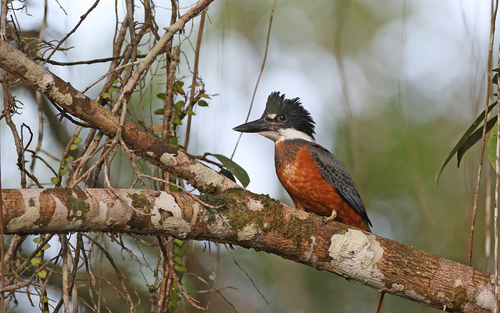
The closest relatives of the Lesson's Motmot that you can see in Corcovado National Park (order Coraciiformes, Rollers, Kingfishers, and Allies) are Green Kingfisher (about 20%) and Ringed Kingfisher (about 10%), with each one's daily chance of a sighting.
Where does the Lesson's Motmot sighting chance come from?
GBIF citizen-science records
It is estimated from how often the Lesson's Motmot is recorded against all the birds logged in Corcovado National Park (879 verified sightings from 2019 to 2026), calibrated against known sighting rates. Figures are rounded to the nearest 10% because citizen-science data supports honest approximations, not decimals, and months with records from fewer than five people show "—". How it works.
