Least Flycatcher

Least Flycatcher

Empidonax minimus

Silhouette: Emily Willoughby · PhyloPic

LCLeast ConcernNTVUENCR
Daily sighting probability ~10% · With luck
at La Tigra National Park

In 3 days ~20% in a week ~30%

18 Verified sightings at La Tigra National Park From 2019 to 2026
11,742 In all 50 parks
August Best month
☀️ Diurnal When it's spotted

About the Least Flycatcher

The least flycatcher (Empidonax minimus) (also called chebec, or chebecker, after the sound it makes) is a small insect-eating bird. It is the smallest Empidonax flycatcher in eastern North America. The closest relative to the least flycatcher was long thought to be the Hammond's flycatcher based on similarities in their songs and appearances. However, mitochondrial DNA analysis has revealed that the least flycatcher diverges significantly from its congeners and does not possess any sister taxa.

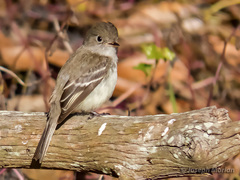
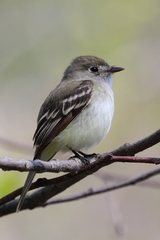
The least flycatcher is hard to distinguish from the other birds of its genus. The bird is one of the smallest of the genus Empidonax, measuring 12 to 14 cm in height with a wingspan of 19 to 22 cm and weighing approximately 10.3 g. Its plumage is dull olive-gray on its back and whitish on its belly, notably brighter than the other Empidonax birds. The least flycatcher's wings are lined with two white bars, and white rings contour its eyes. Its beak is short and the lower mandible is yellowish. The juveniles look similar to the adults except that their wing bars are slightly darker, with tawny/olive hues. Because other flycatchers also have those field marks... Wikipedia →

Sounds

Song0:09

Canada · 2025

© Jan Huus · XC1002527 · CC BY-NC-SA 4.0

Call0:30

Mexico · 2024

© Manuel Grosselet · XC940894 · CC BY-NC-SA 4.0

Alarm call0:33

United States · 2020

© Meena Haribal · XC561399 · CC BY-NC-SA 4.0

Global Distribution

Parks Where Found

# Park Country Daily sighting probability
1 Elk Island National Park 🇨🇦 Canada
~50%
2 Point Pelee National Park 🇨🇦 Canada
~40%
3 Calakmul Biosphere Reserve 🇲🇽 Mexico
~30%
4 Cañón del Sumidero National Park 🇲🇽 Mexico
~30%
5 Riding Mountain National Park 🇨🇦 Canada
~30%
6 Voyageurs National Park 🇺🇸 United States
~20%
7 Biotopo Cerro Cahuí 🇬🇹 Guatemala
~20%
8 El Triunfo 🇲🇽 Mexico
~20%
9 Sian Ka'an Biosphere Reserve 🇲🇽 Mexico
~20%
10 Tikal National Park 🇬🇹 Guatemala
~10%
11 Cockscomb Basin Wildlife Sanctuary 🇧🇿 Belize
~10%
12 Cape Breton Highlands National Park 🇨🇦 Canada
~10%
13 Montes Azules Biosphere Reserve 🇲🇽 Mexico
~10%
14 Banff National Park 🇨🇦 Canada
~10%
15 Celestún Biosphere Reserve 🇲🇽 Mexico
~10%
16 Jasper National Park 🇨🇦 Canada
~10%
17 Glacier National Park 🇺🇸 United States
~10%
18 Arrecifes de Cozumel National Park 🇲🇽 Mexico
~10%
19 Celaque National Park 🇭🇳 Honduras
~10%
20 La Tigra National Park 🇭🇳 Honduras
~10%
21 Lago de Yojoa 🇭🇳 Honduras
~10%
22 Cerro Azul Meámbar National Park 🇭🇳 Honduras
~10%
23 Isle Royale National Park 🇺🇸 United States
~10%
24 Cumbres de Monterrey National Park 🇲🇽 Mexico
~10%
25 Pico Bonito National Park 🇭🇳 Honduras
<5%
26 Shenandoah National Park 🇺🇸 United States
<5%
27 Everglades National Park 🇺🇸 United States
<5%
28 Great Smoky Mountains National Park 🇺🇸 United States
<5%
29 Acadia National Park 🇺🇸 United States
<5%
30 Ría Lagartos Biosphere Reserve 🇲🇽 Mexico
<5%
31 Santa Rosa National Park 🇨🇷 Costa Rica
<5%
32 Kluane National Park 🇨🇦 Canada
<5%
33 Badlands National Park 🇺🇸 United States
<5%
34 Carara National Park 🇨🇷 Costa Rica
<5%
35 Piedras Blancas National Park 🇨🇷 Costa Rica
<5%
36 Gandoca-Manzanillo Wildlife Refuge 🇨🇷 Costa Rica
<5%
37 Arenal Volcano National Park 🇨🇷 Costa Rica
<5%
38 Chirripó National Park 🇨🇷 Costa Rica
<5%
39 Rincón de la Vieja National Park 🇨🇷 Costa Rica
<5%
40 Gros Morne National Park 🇨🇦 Canada
<5%
41 Grand Teton National Park 🇺🇸 United States
<5%
42 Bastimentos Island National Marine Park 🇵🇦 Panama
<5%
43 Tenorio Volcano National Park 🇨🇷 Costa Rica
<5%
44 Palo Verde National Park 🇨🇷 Costa Rica
<5%
45 Yellowstone National Park 🇺🇸 United States
<5%
46 La Amistad International Park (Panama) 🇵🇦 Panama
<5%
47 Monteverde Cloud Forest Reserve 🇨🇷 Costa Rica
<5%
48 Merritt Island National Wildlife Refuge 🇺🇸 United States
<5%
49 Tapantí-Macizo de la Muerte National Park 🇨🇷 Costa Rica
<5%
50 Rocky Mountain National Park 🇺🇸 United States
<5%

Cities Where Found

# City Country Daily sighting probability
1 Calgary 🇨🇦 Canada
~10%
2 Chicago 🇺🇸 United States
~10%
3 Toluca 🇲🇽 México
~10%
4 San Antonio 🇺🇸 United States
~10%
5 Montreal 🇨🇦 Canada
~10%
6 Edmonton 🇨🇦 Canada
~10%
7 Minneapolis [Saint Paul] 🇺🇸 United States
~10%
8 Detroit 🇺🇸 United States
~10%
9 Toronto 🇨🇦 Canada
~10%
10 Austin 🇺🇸 United States
~10%

Before you go

What are the chances of seeing a Least Flycatcher in La Tigra National Park?

With luck

About 10% of wildlife watchers report a Least Flycatcher sighting in La Tigra National Park on a given day, based on 18 verified sightings from GBIF citizen-science data from 2019 to 2026. It is the 99th most-seen of the 176 birds we can rate there. Over three days the chance rises to about 20%, and over a week to about 30%, if each day is a fresh chance.

When is the best time to see a Least Flycatcher in La Tigra National Park?

February and August–November

In those months about 10% of wildlife watchers report a Least Flycatcher in La Tigra National Park on a given day, against under 5% in March–July and December–January, the lowest months.

What time of day is best to see a Least Flycatcher?

Between 8 and 11 am

Across all the parks we cover, that three-hour window holds the most Least Flycatcher sightings with a recorded time, and about 9 in 10 of them come between 6 am and 6 pm: it is a daytime animal.

Where does the Least Flycatcher sighting chance come from?

GBIF citizen-science records

It is estimated from how often the Least Flycatcher is recorded against all the birds logged in La Tigra National Park (18 verified sightings from 2019 to 2026), calibrated against known sighting rates. Figures are rounded to the nearest 10% because citizen-science data supports honest approximations, not decimals, and months with records from fewer than five people show "—". How it works.

← Back to La Tigra National Park