


Completed

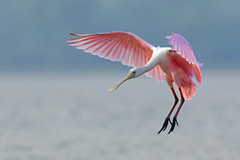


Roseate Spoonbill
Platalea ajaja
Silhouette: Andy Wilson · PhyloPic
- KingdomAnimalia (Animals)
- PhylumChordata (Chordates)
- ClassAves (Birds)
- OrderPelecaniformes (Pelicans, Herons, Ibises, and Allies)
- FamilyThreskiornithidae (Ibises and Spoonbills)
- GenusPlatalea (Spoonbills)
- SpeciesPlatalea ajaja (Roseate Spoonbill)
In 3 days <5%
7 Verified sightings at Marino Ballena National Park From 2019 to 2026
18,453 In all 36 parks
August Best month
☀️ Diurnal When it's spotted
About the Roseate Spoonbill
The roseate spoonbill (Platalea ajaja) is a social wading bird of the ibis and spoonbill family, Threskiornithidae. It is a resident breeder in both South and North America. The roseate spoonbill's pink color is diet-derived, consisting of the carotenoid pigment canthaxanthin, like the American flamingo.
The roseate spoonbill was formally described in 1758 by the Swedish naturalist Carl Linnaeus in the tenth edition of his Systema Naturae under the current binomial name Platalea ajaja. Linnaeus largely based his account on the "Aiaia" that had been described and illustrated over a century earlier by the German naturalist Georg Marcgrave in his book Historia Naturalis Brasiliae. Linnaeus specified the type locality as South America but this is now restricted to Brazil. The genus name Platalea is Latin and means "broad", referring to the distinctive shape of the bill; the specific epithet ajaja is from the name for the species in the Tupi language as reported by Marcgrave. The species is treated as monotypic: no subspecies are recognised.
The roseate spoonbill is sometimes placed in its own genus – Ajaia. A 2010 study of mitochondrial DNA of the spoonbills by Chesser and... Wikipedia →
Recent sightings of Roseate Spoonbill in Marino Ballena National Park
LIVEiNaturalistGlobal Distribution
Parks Where Found
Cities Where Found
| # | City | Country | Daily sighting probability |
|---|---|---|---|
| 1 | Mesa | 🇺🇸 United States | |
| 2 | Guayaquil | 🇪🇨 Ecuador | |
| 3 | Santa Cruz de la Sierra | 🇧🇴 Bolivia | |
| 4 | Miami | 🇺🇸 United States | |
| 5 | Panama City | 🇵🇦 Panama | |
| 6 | Houston | 🇺🇸 United States | |
| 7 | Curitiba | 🇧🇷 Brazil | |
| 8 | Barranquilla | 🇨🇴 Colombia | |
| 9 | Belo Horizonte | 🇧🇷 Brazil | |
| 10 | Havana | 🇨🇺 Cuba |
Zoos & Centres Where Found
| # | Zoo / Centre | Country | |
|---|---|---|---|
| 1 | Disney's Animal Kingdom | 🇺🇸 United States | |
| 2 | SeaWorld Orlando | 🇺🇸 United States | |
| 3 | Busch Gardens Tampa | 🇺🇸 United States | |
| 4 | Pairi Daiza | 🇧🇪 Belgium | |
| 5 | Prague Zoo | 🇨🇿 Czechia | |
| 6 | National Zoological Park | 🇺🇸 United States | |
| 7 | ZooParc de Beauval | 🇫🇷 France | |
| 8 | SeaWorld Abu Dhabi | 🇦🇪 United Arab Emirates | |
| 9 | Dresden Zoo | 🇩🇪 Germany | |
| 10 | Parque das Aves | 🇧🇷 Brazil | |
| 11 | Barcelona Zoo | 🇪🇸 Spain | |
| 12 | Le Pal | 🇫🇷 France | |
| 13 | Ostrava Zoo | 🇨🇿 Czechia | |
| 14 | Paris Zoological Park | 🇫🇷 France | |
| 15 | Muséum de Besançon | 🇫🇷 France | |
| 16 | Parc des oiseaux | 🇫🇷 France | |
| 17 | Abilene Zoological Gardens | 🇺🇸 United States | |
| 18 | Aquarium du palais de la Porte Dorée | 🇫🇷 France | |
| 19 | Zoo Miami | 🇺🇸 United States | |
| 20 | San Diego Zoo Safari Park | 🇺🇸 United States | |
| 21 | Minnesota Zoo | 🇺🇸 United States | |
| 22 | Safari West | 🇺🇸 United States | |
| 23 | Bronx Zoo | 🇺🇸 United States | |
| 24 | Yumka' | 🇲🇽 Mexico | |
| 25 | Brookfield Zoo | 🇺🇸 United States | |
| 26 | Sedgwick County Zoo | 🇺🇸 United States | |
| 27 | Omaha’s Henry Doorly Zoo and Aquarium | 🇺🇸 United States | |
| 28 | Parc zoologique de Lisieux | 🇫🇷 France | |
| 29 | Phoenix Zoo | 🇺🇸 United States | |
| 30 | Jacksonville Zoo and Gardens | 🇺🇸 United States | |
| 31 | Cape May County Park & Zoo | 🇺🇸 United States | |
| 32 | São Paulo Zoo | 🇧🇷 Brazil | |
| 33 | Rostock Zoo | 🇩🇪 Germany | |
| 34 | Xcaret | 🇲🇽 Mexico | |
| 35 | Audubon Zoo | 🇺🇸 United States | |
| 36 | Granby Zoo | 🇨🇦 Canada | |
| 37 | Saint Louis Zoo | 🇺🇸 United States | |
| 38 | Berlin Zoological Garden | 🇩🇪 Germany | |
| 39 | Caldwell Zoo | 🇺🇸 United States | |
| 40 | Temaikén | 🇦🇷 Argentina | |
| 41 | Brevard Zoo | 🇺🇸 United States | |
| 42 | Parque Zoobotânico Getúlio Vargas | 🇧🇷 Brazil | |
| 43 | ZooTampa | 🇺🇸 United States | |
| 44 | Dickerson Park Zoo | 🇺🇸 United States | |
| 45 | Fort Worth Zoo | 🇺🇸 United States | |
| 46 | Singapore Zoo | 🇸🇬 Singapore | |
| 47 | Houston Zoo | 🇺🇸 United States | |
| 48 | San Antonio Zoo | 🇺🇸 United States | |
| 49 | Cameron Park Zoo | 🇺🇸 United States | |
| 50 | Cologne Zoological Garden | 🇩🇪 Germany |
Closest Relatives at Marino Ballena National Park




Before you go
What are the chances of seeing a Roseate Spoonbill in Marino Ballena National Park?
Rare
Under 5% of wildlife watchers report a Roseate Spoonbill sighting in Marino Ballena National Park on a given day, based on 7 verified sightings from GBIF citizen-science data from 2019 to 2026. It is the 286th most-seen of the 303 birds we can rate there. Over three days the chance rises to under 5%, if each day is a fresh chance.
When is the best time to see a Roseate Spoonbill in Marino Ballena National Park?
Any time of year
In every month with enough records, under 5% of wildlife watchers report a Roseate Spoonbill in Marino Ballena National Park on a given day, so our monthly data shows no clear season.
What time of day is best to see a Roseate Spoonbill?
Between 8 and 11 am
Across all the parks we cover, that three-hour window holds the most Roseate Spoonbill sightings with a recorded time, and about 9 in 10 of them come between 6 am and 6 pm: it is a daytime animal.
Is Marino Ballena National Park the best place to see a Roseate Spoonbill?
32nd of 36
Of the 36 parks where we can rate Roseate Spoonbill sightings, Marino Ballena National Park ranks 32nd at under 5%. The best odds are in Merritt Island National Wildlife Refuge (United States, about 50%), Palo Verde National Park (Costa Rica, about 50%) and Ría Lagartos Biosphere Reserve (Mexico, about 50%). All parks ranked.
Where does the Roseate Spoonbill sighting chance come from?
GBIF citizen-science records
It is estimated from how often the Roseate Spoonbill is recorded against all the birds logged in Marino Ballena National Park (7 verified sightings from 2019 to 2026), calibrated against known sighting rates. Figures are rounded to the nearest 10% because citizen-science data supports honest approximations, not decimals, and months with records from fewer than five people show "—". How it works.
