Golden-hooded Tanager

Golden-hooded Tanager

Stilpnia larvata

Silhouette: Sheatherius · PhyloPic

Daily sighting probability ~10% · With luck
at Montes Azules Biosphere Reserve

In 3 days ~20% in a week ~40%

24 Verified sightings at Montes Azules Biosphere Reserve From 2019 to 2026
30,176 In all 33 parks
January Best month
☀️ Diurnal When it's spotted

About the Golden-hooded Tanager

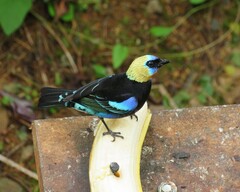
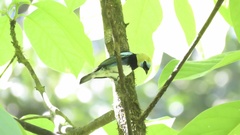
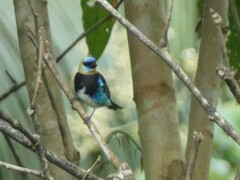
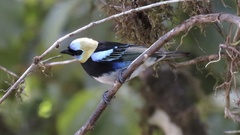
The golden-hooded tanager (Stilpnia larvata) is a medium-sized passerine bird. This tanager is a resident breeder from southern Mexico south to western Ecuador. Adult golden-hooded tanagers are 13 cm (5.1 in) long and weigh 19 g (0.67 oz). The adult male has a golden head with a black eyemask edged with violet blue above and below. The upperparts of the body are black apart from the turquoise shoulders, rump and edgings of the wings and tail. The flanks are blue and the central belly is white. Females have a greenish tinge to the head, sometimes with black speckling on the crown, and more extensively white underparts. Immatures are duller, with a green head, dark grey upperparts, off-white underparts, and little blue in the plumage.

The golden-hooded tanager's call is a sharp tsit and the song is a tuneless rattled series of tick sounds. It resides from sea level to 1,500 metres (4,920 ft) altitude in the canopy of dense forests and semi-open areas like clearings, second growth and well-vegetated gardens.

Golden-hooded tanagers occur in pairs, family groups or as part of a mixed-species feeding flock. They eat certain small fruit (e.g. of Trophis racemosa (Moraceae)) usually swallowed whole, and insects are also taken. The cup nest is built in a tree fork or in a bunch of green bananas, and the normal clutch is two brown-blotched white eggs. This species is often double-brooded, and the young birds from the first clutch assist with feeding the second brood of chicks. Wikipedia →

Sounds

Flight call0:11

Ecuador · 2023

© Manuel Sánchez-Nivicela · XC999167 · CC BY-NC-ND 4.0

Call0:08

Mexico · 2021

© Alán Palacios · XC694431 · CC BY-NC-SA 4.0

Song0:25

Costa Rica · 2021

© Johan Chaves · XC679698 · CC BY-NC-SA 4.0

Global Distribution

Parks Where Found

# Park Country Daily sighting probability
1 Chagres National Park 🇵🇦 Panama
~70%
2 Chirripó National Park 🇨🇷 Costa Rica
~50%
3 Arenal Volcano National Park 🇨🇷 Costa Rica
~50%
4 Tenorio Volcano National Park 🇨🇷 Costa Rica
~40%
5 Piedras Blancas National Park 🇨🇷 Costa Rica
~40%
6 Braulio Carrillo National Park 🇨🇷 Costa Rica
~30%
7 Cockscomb Basin Wildlife Sanctuary 🇧🇿 Belize
~30%
8 Gandoca-Manzanillo Wildlife Refuge 🇨🇷 Costa Rica
~30%
9 Cahuita National Park 🇨🇷 Costa Rica
~30%
10 Cerro Azul Meámbar National Park 🇭🇳 Honduras
~30%
11 Soberanía National Park 🇵🇦 Panama
~30%
12 San Lorenzo Protected Forest 🇵🇦 Panama
~30%
13 Corcovado National Park 🇨🇷 Costa Rica
~30%
14 Marino Ballena National Park 🇨🇷 Costa Rica
~30%
15 Farallones de Cali National Natural Park 🇨🇴 Colombia
~20%
16 Darién National Park 🇵🇦 Panama
~20%
17 La Amistad International Park (Panama) 🇵🇦 Panama
~20%
18 Pico Bonito National Park 🇭🇳 Honduras
~20%
19 Bastimentos Island National Marine Park 🇵🇦 Panama
~20%
20 Tapantí-Macizo de la Muerte National Park 🇨🇷 Costa Rica
~20%
21 Carara National Park 🇨🇷 Costa Rica
~20%
22 Lago de Yojoa 🇭🇳 Honduras
~10%
23 Tortuguero National Park 🇨🇷 Costa Rica
~10%
24 Manuel Antonio National Park 🇨🇷 Costa Rica
~10%
25 Cusuco National Park 🇭🇳 Honduras
~10%
26 Rincón de la Vieja National Park 🇨🇷 Costa Rica
~10%
27 Montes Azules Biosphere Reserve 🇲🇽 Mexico
~10%
28 Volcán Barú National Park 🇵🇦 Panama
<5%
29 Poás Volcano National Park 🇨🇷 Costa Rica
<5%
30 Parque Natural Metropolitano 🇵🇦 Panama
<5%
31 Tikal National Park 🇬🇹 Guatemala
<5%
32 Los Quetzales National Park 🇨🇷 Costa Rica
<5%
33 Monteverde Cloud Forest Reserve 🇨🇷 Costa Rica
<5%

Cities Where Found

# City Country Daily sighting probability
1 Panama City 🇵🇦 Panama
<5%
2 San José 🇨🇷 Costa Rica
<5%

Before you go

What are the chances of seeing a Golden-hooded Tanager in Montes Azules Biosphere Reserve?

With luck

About 10% of wildlife watchers report a Golden-hooded Tanager sighting in Montes Azules Biosphere Reserve on a given day, based on 24 verified sightings from GBIF citizen-science data from 2019 to 2026. It is the 150th most-seen of the 240 birds we can rate there. Over three days the chance rises to about 20%, and over a week to about 40%, if each day is a fresh chance.

When is the best time to see a Golden-hooded Tanager in Montes Azules Biosphere Reserve?

March–August and October–January

In those months about 10% of wildlife watchers report a Golden-hooded Tanager in Montes Azules Biosphere Reserve on a given day, against under 5% in February and September, the lowest months.

What time of day is best to see a Golden-hooded Tanager?

Between 8 and 11 am

Across all the parks we cover, that three-hour window holds the most Golden-hooded Tanager sightings with a recorded time, and about 9 in 10 of them come between 6 am and 6 pm: it is a daytime animal.

Which relatives of the Golden-hooded Tanager live in Montes Azules Biosphere Reserve?

Same family: Thraupidae

The closest relatives of the Golden-hooded Tanager that you can see in Montes Azules Biosphere Reserve (family Thraupidae, Tanagers and Allies) are Black-headed Saltator (about 30%), Morelet's Seedeater (about 30%) and Blue-gray Tanager (about 30%), with each one's daily chance of a sighting.

Where does the Golden-hooded Tanager sighting chance come from?

GBIF citizen-science records

It is estimated from how often the Golden-hooded Tanager is recorded against all the birds logged in Montes Azules Biosphere Reserve (24 verified sightings from 2019 to 2026), calibrated against known sighting rates. Figures are rounded to the nearest 10% because citizen-science data supports honest approximations, not decimals, and months with records from fewer than five people show "—". How it works.

← Back to Montes Azules Biosphere Reserve