Hamerkop

Hamerkop

Scopus umbretta

Silhouette: Arthur Grosset (photo), John E. McCormack, Michael G. Harvey, Brant C. Faircloth, Nicholas G. Crawford, Travis C. Glenn, Robb T. Brumfield & T. Michael Keesey · PhyloPic

LCLeast ConcernNTVUENCR
Daily sighting probability ~20% · Possible
at Samburu National Reserve

In 3 days ~40% in a week ~70%

176 Verified sightings at Samburu National Reserve From 2019 to 2026
14,723 In all 56 parks
June Best month
☀️ Diurnal When it's spotted

About the Hamerkop

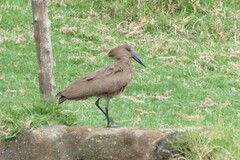
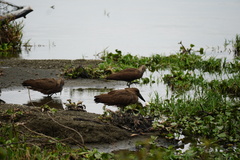
The hamerkop (Scopus umbretta), also called the umbrette, is a medium-sized water bird with brown plumage. It is found in mainland Africa, Madagascar and Arabia, living in a wide variety of wetlands, including estuaries, lakesides, fish ponds, riverbanks, and rocky coasts. The shape of its head, with its long bill and crest at the back, gives this species its name, hamerkop being the Afrikaans word for hammerhead. Long considered to sit with the Ciconiiformes, the species and its family is now placed with the Pelecaniformes, its closest relatives thought to be the pelicans and the shoebill. It is the only living species in the genus Scopus and the family Scopidae.

The hamerkop is a sedentary bird that often shows local movements. Usually hunting in shallow water, either by sight or touch, it feeds mostly on fish and amphibians; however, the species is adaptable and will take any prey it can. The species is renowned for its enormous nests, several of which it builds during the breeding season. Unusually for a wading bird, the species constructs its nest with an internal nesting chamber where the eggs are laid. Both parents incubate the eggs and raise the chicks.

The species is not globally threatened and is locally abundant in mainland Africa and Madagascar. The International Union for Conservation of Nature (IUCN) has assessed it as being of least concern. Wikipedia →

Sounds

Call0:15

Zambia · 2023

© Marc Anderson · XC890678 · CC BY-NC-ND 4.0

Flight call0:15

Zambia · 2023

© Dries Van de Loock · XC858575 · CC BY-NC-ND 4.0

Song0:12

Kenya · 2021

© Simona Inaudi · XC631720 · CC BY-NC-SA 4.0

Global Distribution

Parks Where Found

# Park Country Daily sighting probability
1 Niokolo-Koba National Park 🇸🇳 Senegal
~80%
2 South Luangwa National Park 🇿🇲 Zambia
~60%
3 Queen Elizabeth National Park 🇺🇬 Uganda
~60%
4 Liwonde National Park 🇲🇼 Malawi
~50%
5 Ruaha National Park 🇹🇿 Tanzania
~50%
6 Meru National Park 🇰🇪 Kenya
~50%
7 Lake Mburo National Park 🇺🇬 Uganda
~50%
8 Akagera National Park 🇷🇼 Rwanda
~50%
9 Nairobi National Park 🇰🇪 Kenya
~50%
10 Odzala-Kokoua National Park 🇨🇬 Republic of the Congo
~50%
11 Gonarezhou National Park 🇿🇼 Zimbabwe
~50%
12 Masai Mara National Reserve 🇰🇪 Kenya
~40%
13 Arusha National Park 🇹🇿 Tanzania
~40%
14 Lower Zambezi National Park 🇿🇲 Zambia
~40%
15 Kafue National Park 🇿🇲 Zambia
~40%
16 Lake Manyara National Park 🇹🇿 Tanzania
~40%
17 Tarangire National Park 🇹🇿 Tanzania
~40%
18 Mana Pools National Park 🇿🇼 Zimbabwe
~40%
19 Moremi Game Reserve 🇧🇼 Botswana
~40%
20 Mikumi National Park 🇹🇿 Tanzania
~30%
21 Selous Game Reserve 🇹🇿 Tanzania
~30%
22 Kruger National Park 🇿🇦 South Africa
~30%
23 Virunga National Park 🇨🇩 Democratic Republic of the Congo
~30%
24 Awash National Park 🇪🇹 Ethiopia
~30%
25 Gorongosa National Park 🇲🇿 Mozambique
~20%
26 Lake Nakuru National Park 🇰🇪 Kenya
~20%
27 Ngorongoro Conservation Area 🇹🇿 Tanzania
~20%
28 Murchison Falls National Park 🇺🇬 Uganda
~20%
29 Hluhluwe-Imfolozi Park 🇿🇦 South Africa
~20%
30 Serengeti National Park 🇹🇿 Tanzania
~20%
31 Chobe National Park 🇧🇼 Botswana
~20%
32 Hwange National Park 🇿🇼 Zimbabwe
~20%
33 Samburu National Reserve 🇰🇪 Kenya
~20%
34 Tsavo West National Park 🇰🇪 Kenya
~20%
35 Kidepo Valley National Park 🇺🇬 Uganda
~20%
36 iSimangaliso Wetland Park 🇿🇦 South Africa
~20%
37 Amboseli National Park 🇰🇪 Kenya
~20%
38 Pilanesberg National Park 🇿🇦 South Africa
~20%
39 Bale Mountains National Park 🇪🇹 Ethiopia
~10%
40 uMkhuze Game Reserve 🇿🇦 South Africa
~10%
41 Mkomazi National Park 🇹🇿 Tanzania
~10%
42 Semuliki National Park 🇺🇬 Uganda
~10%
43 Tsavo East National Park 🇰🇪 Kenya
~10%
44 De Hoop Nature Reserve 🇿🇦 South Africa
~10%
45 Kibale National Park 🇺🇬 Uganda
~10%
46 Berenty Reserve 🇲🇬 Madagascar
~10%
47 Waterberg Plateau Park 🇳🇦 Namibia
~10%
48 Bwindi Impenetrable National Park 🇺🇬 Uganda
<5%
49 Ranomafana National Park 🇲🇬 Madagascar
<5%
50 Nyungwe National Park 🇷🇼 Rwanda
<5%
51 Addo Elephant National Park 🇿🇦 South Africa
<5%
52 Aberdare National Park 🇰🇪 Kenya
<5%
53 Etosha National Park 🇳🇦 Namibia
<5%
54 Volcanoes National Park 🇷🇼 Rwanda
<5%
55 Mantadia National Park 🇲🇬 Madagascar
<5%
56 Garden Route National Park 🇿🇦 South Africa
<5%

Cities Where Found

# City Country Daily sighting probability
1 Ouagadougou 🇧🇫 Burkina Faso
~60%
2 Kampala 🇺🇬 Uganda
~50%
3 Kigali 🇷🇼 Rwanda
~50%
4 Serrekunda 🇬🇲 Gambia
~40%
5 Abuja 🇳🇬 Nigeria
~30%
6 Brazzaville 🇨🇬 Republic of the Congo
~30%
7 Dar es-Salaam 🇹🇿 Tanzania
~20%
8 Maputo 🇲🇿 Mozambique
~20%
9 Harare 🇿🇼 Zimbabwe
~20%
10 Lilongwe 🇲🇼 Malawi
~20%

Zoos & Centres Where Found

# Zoo / Centre Country
1 Disney's Animal Kingdom 🇺🇸 United States In captivity
2 San Diego Zoo 🇺🇸 United States In captivity
3 Prague Zoo 🇨🇿 Czechia In captivity
4 Copenhagen Zoo 🇩🇰 Denmark In captivity
5 Tierpark Berlin 🇩🇪 Germany In captivity
6 Natura Artis Magistra 🇳🇱 Netherlands In captivity
7 Cincinnati Zoo and Botanical Garden 🇺🇸 United States In captivity
8 Zürich Zoo 🇨🇭 Switzerland In captivity
9 Dresden Zoo 🇩🇪 Germany In captivity
10 Antwerp Zoo 🇧🇪 Belgium In captivity
11 Barcelona Zoo 🇪🇸 Spain In captivity
12 Zlín-Lešná Zoo 🇨🇿 Czechia In captivity
13 Paris Zoological Park 🇫🇷 France In captivity
14 Réserve africaine de Sigean 🇫🇷 France In captivity
15 Parc des oiseaux 🇫🇷 France In captivity
16 Zoo de Doué 🇫🇷 France In captivity
17 Abilene Zoological Gardens 🇺🇸 United States In captivity
18 San Diego Zoo Safari Park 🇺🇸 United States In captivity
19 Safaripark Beekse Bergen 🇳🇱 Netherlands In captivity
20 Toronto Zoo 🇨🇦 Canada In captivity
21 Safari West 🇺🇸 United States In captivity
22 Columbus Zoo and Aquarium 🇺🇸 United States In captivity
23 Kansas City Zoo 🇺🇸 United States In captivity
24 Chester Zoo 🇬🇧 United Kingdom In captivity
25 Milwaukee County Zoo 🇺🇸 United States In captivity
26 Oakland Zoo 🇺🇸 United States In captivity
27 The Maryland Zoo 🇺🇸 United States In captivity
28 Toledo Zoo 🇺🇸 United States In captivity
29 Detroit Zoo 🇺🇸 United States In captivity
30 Jacksonville Zoo and Gardens 🇺🇸 United States In captivity
31 Marwell Zoo 🇬🇧 United Kingdom In captivity
32 Selwo Aventura 🇪🇸 Spain In captivity
33 Audubon Zoo 🇺🇸 United States In captivity
34 Berlin Zoological Garden 🇩🇪 Germany In captivity
35 Caldwell Zoo 🇺🇸 United States In captivity
36 Wrocław Zoological Garden 🇵🇱 Poland In captivity
37 Calgary Zoo 🇨🇦 Canada In captivity
38 San Francisco Zoo 🇺🇸 United States In captivity
39 ZOOM Erlebniswelt 🇩🇪 Germany In captivity
40 ZooTampa 🇺🇸 United States In captivity
41 Oregon Zoo 🇺🇸 United States In captivity
42 Lisbon Zoo 🇵🇹 Portugal In captivity
43 Memphis Zoo 🇺🇸 United States In captivity
44 Wildlands 🇳🇱 Netherlands In captivity
45 Houston Zoo 🇺🇸 United States In captivity
46 San Antonio Zoo 🇺🇸 United States In captivity
47 Cologne Zoological Garden 🇩🇪 Germany In captivity
48 Philadelphia Zoo 🇺🇸 United States In captivity
49 Honolulu Zoo 🇺🇸 United States In captivity
50 Zoo Atlanta 🇺🇸 United States In captivity

Before you go

What are the chances of seeing a Hamerkop in Samburu National Reserve?

Possible

About 20% of wildlife watchers report a Hamerkop sighting in Samburu National Reserve on a given day, based on 176 verified sightings from GBIF citizen-science data from 2019 to 2026. It is the 113th most-seen of the 341 birds we can rate there. Over three days the chance rises to about 40%, and over a week to about 70%, if each day is a fresh chance.

When is the best time to see a Hamerkop in Samburu National Reserve?

June

In that month about 30% of wildlife watchers report a Hamerkop in Samburu National Reserve on a given day, against about 10% in January, March and September–November, the lowest months. That is one of Samburu National Reserve's driest months, with about 10 mm of rain against 95 mm in April.

What time of day is best to see a Hamerkop?

Between 8 and 11 am

Across all the parks we cover, that three-hour window holds the most Hamerkop sightings with a recorded time, and about 9 in 10 of them come between 6 am and 6 pm: it is a daytime animal.

Which relatives of the Hamerkop live in Samburu National Reserve?

Same order: Pelecaniformes

The closest relatives of the Hamerkop that you can see in Samburu National Reserve (order Pelecaniformes, Pelicans, Herons, Ibises, and Allies) are Black-headed Heron (about 30%), Cattle Egret (about 20%) and Hadada (about 20%), with each one's daily chance of a sighting.

Where does the Hamerkop sighting chance come from?

GBIF citizen-science records

It is estimated from how often the Hamerkop is recorded against all the birds logged in Samburu National Reserve (176 verified sightings from 2019 to 2026), calibrated against known sighting rates. Figures are rounded to the nearest 10% because citizen-science data supports honest approximations, not decimals, and months with records from fewer than five people show "—". How it works.

← Back to Samburu National Reserve