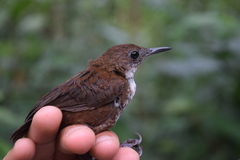

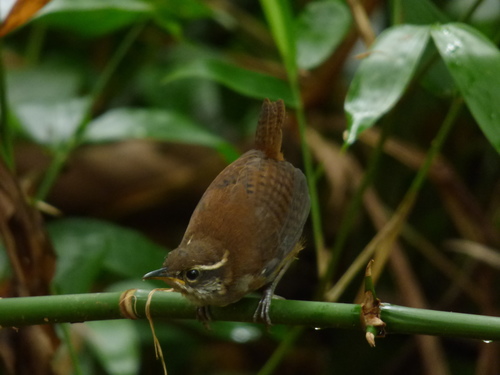
Scaly-breasted Wren

Scaly-breasted Wren

Microcerculus marginatus

Silhouette: Matt Wilkins · PhyloPic

LCLeast ConcernNTVUENCR
Daily sighting probability ~10% · With luck
at San Lorenzo Protected Forest

In 3 days ~20% in a week ~40%

12 Verified sightings at San Lorenzo Protected Forest From 2019 to 2026
3,915 In all 29 parks
March Best month
☀️ Diurnal When it's spotted

About the Scaly-breasted Wren

The southern nightingale-wren (Microcerculus marginatus), also known as the scaly-breasted wren, is a species of bird in the family Troglodytidae. It is found in Bolivia, Brazil, Colombia, Costa Rica, Ecuador, Panama, Peru, and Venezuela.

The southern nightingale-wren forms a species pair with the northern nightingale-wren (Microcerculus philomela) and was in the past considered conspecific with it. It is currently treated as a species in its own right by the International Ornithological Committee (IOC) and the Clements taxonomy, though under different English names.

The southern nightingale-wren has the six subspecies listed below. Subspecies M. m. luscinia is treated by some taxonomists as a separate species. The nominate subspecies M. m. marginatus is also sometimes considered a separate species or even two species divided by the Amazon River.

The southern nightingale-wren's subspecies are: Wikipedia →

Sounds

Song1:10

Ecuador · 2026

© Daan van der Hoeven · XC1105458 · CC BY-NC-SA 4.0

Call0:48

Costa Rica · 2024

© Paul Driver · XC955372 · CC BY-NC-SA 4.0

Alarm call0:58

Brazil · 2022

© JAYRSON ARAUJO DE OLIVEIRA · XC755227 · CC BY-NC-SA 4.0

Global Distribution

Parks Where Found

# Park Country Daily sighting probability
1 Henri Pittier National Park 🇻🇪 Venezuela
~40%
2 Chagres National Park 🇵🇦 Panama
~20%
3 Chirripó National Park 🇨🇷 Costa Rica
~20%
4 Sierra de la Macarena National Park 🇨🇴 Colombia
~20%
5 Utría National Natural Park 🇨🇴 Colombia
~20%
6 Tambopata National Reserve 🇵🇪 Peru
~10%
7 Manu National Park 🇵🇪 Peru
~10%
8 Darién National Park 🇵🇦 Panama
~10%
9 Amacayacu National Natural Park 🇨🇴 Colombia
~10%
10 Tayrona National Natural Park 🇨🇴 Colombia
~10%
11 San Lorenzo Protected Forest 🇵🇦 Panama
~10%
12 Piedras Blancas National Park 🇨🇷 Costa Rica
~10%
13 Corcovado National Park 🇨🇷 Costa Rica
~10%
14 Yasuní National Park 🇪🇨 Ecuador
~10%
15 Farallones de Cali National Natural Park 🇨🇴 Colombia
<5%
16 Carara National Park 🇨🇷 Costa Rica
<5%
17 La Amistad International Park (Panama) 🇵🇦 Panama
<5%
18 Amboró National Park 🇧🇴 Bolivia
<5%
19 Machalilla National Park 🇪🇨 Ecuador
<5%
20 Tapantí-Macizo de la Muerte National Park 🇨🇷 Costa Rica
<5%
21 Soberanía National Park 🇵🇦 Panama
<5%
22 Marino Ballena National Park 🇨🇷 Costa Rica
<5%
23 Volcán Barú National Park 🇵🇦 Panama
<5%
24 Manuel Antonio National Park 🇨🇷 Costa Rica
<5%
25 Gandoca-Manzanillo Wildlife Refuge 🇨🇷 Costa Rica
<5%
26 Bastimentos Island National Marine Park 🇵🇦 Panama
<5%
27 Los Nevados National Natural Park 🇨🇴 Colombia
<5%
28 Monteverde Cloud Forest Reserve 🇨🇷 Costa Rica
<5%
29 Los Quetzales National Park 🇨🇷 Costa Rica
<5%

Cities Where Found

# City Country Daily sighting probability
1 San José 🇨🇷 Costa Rica
<5%

Before you go

What are the chances of seeing a Scaly-breasted Wren in San Lorenzo Protected Forest?

With luck

About 10% of wildlife watchers report a Scaly-breasted Wren sighting in San Lorenzo Protected Forest on a given day, based on 12 verified sightings from GBIF citizen-science data from 2019 to 2026. It is the 183rd most-seen of the 249 birds we can rate there. Over three days the chance rises to about 20%, and over a week to about 40%, if each day is a fresh chance.

When is the best time to see a Scaly-breasted Wren in San Lorenzo Protected Forest?

March to June

In those months about 10% of wildlife watchers report a Scaly-breasted Wren in San Lorenzo Protected Forest on a given day, against under 5% in July to February, the lowest months.

What time of day is best to see a Scaly-breasted Wren?

Between 7 and 10 am

Across all the parks we cover, that three-hour window holds the most Scaly-breasted Wren sightings with a recorded time, and about 8 in 10 of them come between 6 am and 6 pm: it is a daytime animal.

Is San Lorenzo Protected Forest the best place to see a Scaly-breasted Wren?

11th of 29

Of the 29 parks where we can rate Scaly-breasted Wren sightings, San Lorenzo Protected Forest ranks 11th at about 10%. The best odds are in Henri Pittier National Park (Venezuela, about 40%), Chagres National Park (Panama, about 20%) and Chirripó National Park (Costa Rica, about 20%).

Which relatives of the Scaly-breasted Wren live in San Lorenzo Protected Forest?

Same family: Troglodytidae

The closest relatives of the Scaly-breasted Wren that you can see in San Lorenzo Protected Forest (family Troglodytidae, Wrens) are Southern House Wren (about 30%), Bay Wren (about 30%) and Cabanis's Wren (about 20%), with each one's daily chance of a sighting.

Where does the Scaly-breasted Wren sighting chance come from?

GBIF citizen-science records

It is estimated from how often the Scaly-breasted Wren is recorded against all the birds logged in San Lorenzo Protected Forest (12 verified sightings from 2019 to 2026), calibrated against known sighting rates. Figures are rounded to the nearest 10% because citizen-science data supports honest approximations, not decimals, and months with records from fewer than five people show "—". How it works.

← Back to San Lorenzo Protected Forest