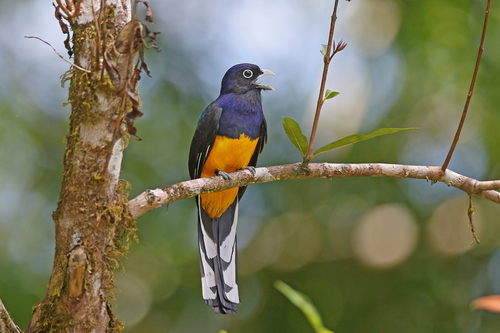
Black-throated Trogon

Black-throated Trogon

Trogon rufus

Silhouette: Edwin Price · PhyloPic

LCLeast ConcernNTVUENCR
Daily sighting probability <5% · Rare
at Yasuní National Park

In 3 days ~10% in a week ~30%

149 Verified sightings at Yasuní National Park From 2019 to 2026
12,347 In all 34 parks
March Best month
☀️ Diurnal When it's spotted

About the Black-throated Trogon

The Amazonian black-throated trogon (Trogon rufus) is a bird in the family Trogonidae, the trogons and quetzals. Although it has also been called "yellow-bellied trogon" it is not the only trogon with a yellow belly (such a description would apply to the Black-headed trogon, or the Citreoline trogon as well). It is found in every mainland South American country except Argentina, Chile, Paraguay, and Uruguay.

The Amazonian black-throated trogon was formally described in 1788 by the German naturalist Johann Friedrich Gmelin in his revised and expanded edition of Carl Linnaeus's Systema Naturae. He placed it with the other trogons in the genus Trogon and coined the binomial name Trogon rufus. Gmelin based his description on the "Couroucou à queue rousse de Cayenne" that had been described and illustrated in 1779 by the French polymath Comte de Buffon in his Histoire Naturelle des Oiseaux. Buffon's specimen was a female with brown upperparts that had been collected in Cayenne. It later gained the English name "black-throated trogon". The specific epithet rufus is Latin for "red" or "ruddy".

The black-throated trogon was long treated as having six subspecies... Wikipedia →

Sounds

Song0:21

Brazil · 2026

© Miguel Angelo Biz · XC1178519 · CC BY-NC-SA 4.0

Uncertain1:07

Argentina · 2024

© Marcos E. Sosa · XC900395 · CC BY-NC-SA 4.0

Call1:06

Brazil · 2024

© Lia Nahomi Kajiki · XC897593 · CC BY-NC-SA 4.0

Global Distribution

Parks Where Found

# Park Country Daily sighting probability
1 Corcovado National Park 🇨🇷 Costa Rica
~40%
2 Soberanía National Park 🇵🇦 Panama
~30%
3 Brownsberg Nature Park 🇸🇷 Suriname
~20%
4 Iguaçu National Park 🇧🇷 Brazil
~20%
5 Carara National Park 🇨🇷 Costa Rica
~20%
6 Iguazú National Park 🇦🇷 Argentina
~20%
7 Tenorio Volcano National Park 🇨🇷 Costa Rica
~20%
8 Piedras Blancas National Park 🇨🇷 Costa Rica
~20%
9 San Lorenzo Protected Forest 🇵🇦 Panama
~20%
10 Braulio Carrillo National Park 🇨🇷 Costa Rica
~10%
11 Chagres National Park 🇵🇦 Panama
~10%
12 Pico Bonito National Park 🇭🇳 Honduras
~10%
13 Darién National Park 🇵🇦 Panama
~10%
14 Tortuguero National Park 🇨🇷 Costa Rica
~10%
15 Amacayacu National Natural Park 🇨🇴 Colombia
~10%
16 Serra dos Órgãos National Park 🇧🇷 Brazil
~10%
17 Manuel Antonio National Park 🇨🇷 Costa Rica
~10%
18 Monteverde Cloud Forest Reserve 🇨🇷 Costa Rica
~10%
19 Parque Natural Metropolitano 🇵🇦 Panama
~10%
20 Arenal Volcano National Park 🇨🇷 Costa Rica
~10%
21 Yasuní National Park 🇪🇨 Ecuador
<5%
22 Gandoca-Manzanillo Wildlife Refuge 🇨🇷 Costa Rica
<5%
23 Rincón de la Vieja National Park 🇨🇷 Costa Rica
<5%
24 Marino Ballena National Park 🇨🇷 Costa Rica
<5%
25 Cuyabeno Wildlife Reserve 🇪🇨 Ecuador
<5%
26 Itatiaia National Park 🇧🇷 Brazil
<5%
27 Cahuita National Park 🇨🇷 Costa Rica
<5%
28 Anavilhanas National Park 🇧🇷 Brazil
<5%
29 Poás Volcano National Park 🇨🇷 Costa Rica
<5%
30 La Amistad International Park (Panama) 🇵🇦 Panama
<5%
31 Chirripó National Park 🇨🇷 Costa Rica
<5%
32 Farallones de Cali National Natural Park 🇨🇴 Colombia
<5%
33 Tapantí-Macizo de la Muerte National Park 🇨🇷 Costa Rica
<5%
34 Bastimentos Island National Marine Park 🇵🇦 Panama
<5%

Before you go

What are the chances of seeing a Black-throated Trogon in Yasuní National Park?

Rare

Under 5% of wildlife watchers report a Black-throated Trogon sighting in Yasuní National Park on a given day, based on 149 verified sightings from GBIF citizen-science data from 2019 to 2026. It is the 259th most-seen of the 533 birds we can rate there. Over three days the chance rises to about 10%, and over a week to about 30%, if each day is a fresh chance.

When is the best time to see a Black-throated Trogon in Yasuní National Park?

March–July and December

In those months about 10% of wildlife watchers report a Black-throated Trogon in Yasuní National Park on a given day, against under 5% in January–February and August–November, the lowest months.

What time of day is best to see a Black-throated Trogon?

Between 8 and 11 am

Across all the parks we cover, that three-hour window holds the most Black-throated Trogon sightings with a recorded time, and about 9 in 10 of them come between 6 am and 6 pm: it is a daytime animal.

Which relatives of the Black-throated Trogon live in Yasuní National Park?

Same genus: Trogon

The closest relatives of the Black-throated Trogon that you can see in Yasuní National Park (genus Trogon, New World Trogons) are Green-backed Trogon (about 40%), Black-tailed Trogon (about 10%) and Amazonian Trogon (about 10%), with each one's daily chance of a sighting.

Where does the Black-throated Trogon sighting chance come from?

GBIF citizen-science records

It is estimated from how often the Black-throated Trogon is recorded against all the birds logged in Yasuní National Park (149 verified sightings from 2019 to 2026), calibrated against known sighting rates. Figures are rounded to the nearest 10% because citizen-science data supports honest approximations, not decimals, and months with records from fewer than five people show "—". How it works.

← Back to Yasuní National Park