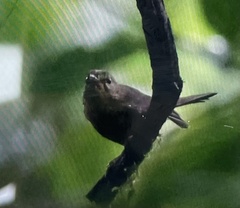
Buff-rumped Warbler

Buff-rumped Warbler

Myiothlypis fulvicauda

Silhouette: Andy Wilson · PhyloPic

LCLeast ConcernNTVUENCR
Daily sighting probability ~20% · Possible
at Carara National Park

In 3 days ~60% in a week ~90%

1,875 Verified sightings at Carara National Park From 2019 to 2026
15,790 In all 32 parks
June Best month
☀️ Diurnal When it's spotted

About the Buff-rumped Warbler

The buff-rumped warbler (Myiothlypis fulvicauda) is a species of bird in the family Parulidae, the New World warblers. It is found from Honduras south to Bolivia. The buff-rumped warbler was formally described in 1825 with the binomial Muscicapa fulvicauda.

The buff-rumped warbler has a complicated taxonomic history since its original description. At some time in the nineteenth century it was reassigned to genus Basileuterus that had been erected in 1848. In 1929 W. E. Clyde Todd erected a new genus, Phaeothlypis, with it as the type species. However, many authors retained it in Basileuterus. In the early twenty-first century several studies confirmed that many species in Phaeothlypis were nested within Basileuterus but that the latter was polyphyletic. By 2007 taxonomic systems had begun to resurrect genus Myiothlypis, which had been erected in 1850, for the buff-rumped warbler and many other species.

The buff-rumped warbler has these six subspecies: Wikipedia →

Sounds

Call0:38

Ecuador · 2020

© Manuel Sánchez-Nivicela · XC1176695 · CC BY-NC-ND 4.0

Song0:31

Colombia · 2025

© Sofía Vargas Gómez · XC1174546 · CC BY-NC-SA 4.0

Recording0:24

Colombia · 2024

© Antonio David Riaño Cortés · XC1043290 · CC BY-NC-SA 4.0

Global Distribution

Parks Where Found

# Park Country Daily sighting probability
1 Farallones de Cali National Natural Park 🇨🇴 Colombia
~50%
2 Arenal Volcano National Park 🇨🇷 Costa Rica
~40%
3 Braulio Carrillo National Park 🇨🇷 Costa Rica
~30%
4 Darién National Park 🇵🇦 Panama
~30%
5 Tenorio Volcano National Park 🇨🇷 Costa Rica
~30%
6 Carara National Park 🇨🇷 Costa Rica
~20%
7 Piedras Blancas National Park 🇨🇷 Costa Rica
~20%
8 Chirripó National Park 🇨🇷 Costa Rica
~10%
9 Rincón de la Vieja National Park 🇨🇷 Costa Rica
~10%
10 Manu National Park 🇵🇪 Peru
~10%
11 Chagres National Park 🇵🇦 Panama
~10%
12 Corcovado National Park 🇨🇷 Costa Rica
~10%
13 Tapantí-Macizo de la Muerte National Park 🇨🇷 Costa Rica
~10%
14 Machalilla National Park 🇪🇨 Ecuador
~10%
15 La Amistad International Park (Panama) 🇵🇦 Panama
<5%
16 Yasuní National Park 🇪🇨 Ecuador
<5%
17 Amacayacu National Natural Park 🇨🇴 Colombia
<5%
18 Gandoca-Manzanillo Wildlife Refuge 🇨🇷 Costa Rica
<5%
19 Tambopata National Reserve 🇵🇪 Peru
<5%
20 Podocarpus National Park 🇪🇨 Ecuador
<5%
21 Sierra de la Macarena National Park 🇨🇴 Colombia
<5%
22 Poás Volcano National Park 🇨🇷 Costa Rica
<5%
23 Pico Bonito National Park 🇭🇳 Honduras
<5%
24 Tortuguero National Park 🇨🇷 Costa Rica
<5%
25 Manuel Antonio National Park 🇨🇷 Costa Rica
<5%
26 Marino Ballena National Park 🇨🇷 Costa Rica
<5%
27 Monteverde Cloud Forest Reserve 🇨🇷 Costa Rica
<5%
28 Cahuita National Park 🇨🇷 Costa Rica
<5%
29 Parque Estadual Encontro das Águas 🇧🇷 Brazil
<5%
30 Los Nevados National Natural Park 🇨🇴 Colombia
<5%
31 Volcán Barú National Park 🇵🇦 Panama
<5%
32 Soberanía National Park 🇵🇦 Panama
<5%

Cities Where Found

# City Country Daily sighting probability
1 Cali 🇨🇴 Colombia
~10%
2 Medellín 🇨🇴 Colombia
<5%
3 San José 🇨🇷 Costa Rica
<5%

Before you go

What are the chances of seeing a Buff-rumped Warbler in Carara National Park?

Possible

About 20% of wildlife watchers report a Buff-rumped Warbler sighting in Carara National Park on a given day, based on 1,875 verified sightings from GBIF citizen-science data from 2019 to 2026. It is the 68th most-seen of the 414 birds we can rate there. Over three days the chance rises to about 60%, and over a week to about 90%, if each day is a fresh chance.

When is the best time to see a Buff-rumped Warbler in Carara National Park?

June

In that month about 40% of wildlife watchers report a Buff-rumped Warbler in Carara National Park on a given day, against about 20% in July and September–March, the lowest months. That is one of Carara National Park's wettest months, with about 580 mm of rain against 35 mm in February.

What time of day is best to see a Buff-rumped Warbler?

Between 6 and 9 am

Across all the parks we cover, that three-hour window holds the most Buff-rumped Warbler sightings with a recorded time, and about 9 in 10 of them come between 6 am and 6 pm: it is a daytime animal.

Which relatives of the Buff-rumped Warbler live in Carara National Park?

Same family: Parulidae

The closest relatives of the Buff-rumped Warbler that you can see in Carara National Park (family Parulidae, New World Warblers) are Yellow Warbler (about 40%), Northern Waterthrush (about 30%) and Chestnut-sided Warbler (about 30%), with each one's daily chance of a sighting.

Where does the Buff-rumped Warbler sighting chance come from?

GBIF citizen-science records

It is estimated from how often the Buff-rumped Warbler is recorded against all the birds logged in Carara National Park (1,875 verified sightings from 2019 to 2026), calibrated against known sighting rates. Figures are rounded to the nearest 10% because citizen-science data supports honest approximations, not decimals, and months with records from fewer than five people show "—". How it works.

← Back to Carara National Park