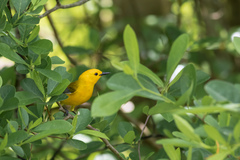
Prothonotary Warbler

Prothonotary Warbler

Protonotaria citrea

Silhouette: Andy Wilson · PhyloPic

LCLeast ConcernNTVUENCR
Daily sighting probability ~20% · Possible
at Carara National Park

In 3 days ~40% in a week ~70%

1,299 Verified sightings at Carara National Park From 2019 to 2026
15,028 In all 47 parks
January Best month
☀️ Diurnal When it's spotted

About the Prothonotary Warbler

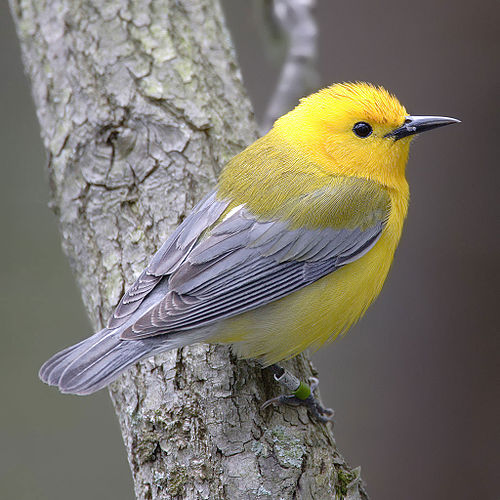
The prothonotary warbler (Protonotaria citrea) is a small songbird of the New World warbler family. It is named for its plumage, which resembles the yellow robes once worn by papal clerks (named prothonotaries) in the Roman Catholic Church.

The prothonotary warbler is the only member of the genus Protonotaria and the only eastern warbler that nests in natural or artificial cavities. These warblers often move with quick, jerky, movements and will even crawl upside down on sticks or trees. During the spring they are often seen in wetlands gathering nesting material, or food, for their mate.

The prothonotary warbler was described by the French polymath Georges-Louis Leclerc, Comte de Buffon in 1779 in his Histoire Naturelle des Oiseaux from a specimen collected in Louisiana. Buffon coined the French name Le figuier protonotaire. The bird was also illustrated in a hand-coloured plate engraved by François-Nicolas Martinet in the Planches Enluminées D'Histoire Naturelle, which was produced under the supervision of Edme-Louis Daubenton to accompany Buffon's text. Neither the plate caption nor Buffon's description included a scientific name but in 1783 the Dutch naturalist... Wikipedia →

Sounds

Call0:33

Costa Rica · 2022

© Johan Chaves · XC749763 · CC BY-NC-SA 4.0

Song0:35

United States · 2021

© David A. Brinkman · XC645989 · CC BY-NC-SA 4.0

Flight call0:04

United States · 2014

© Paul Marvin · XC173800 · CC BY-NC-SA 4.0

Global Distribution

Parks Where Found

# Park Country Daily sighting probability
1 Bastimentos Island National Marine Park 🇵🇦 Panama
~40%
2 Point Pelee National Park 🇨🇦 Canada
~40%
3 Utría National Natural Park 🇨🇴 Colombia
~30%
4 Congaree National Park 🇺🇸 United States
~30%
5 Carara National Park 🇨🇷 Costa Rica
~20%
6 La Amistad International Park (Panama) 🇵🇦 Panama
~10%
7 Tayrona National Natural Park 🇨🇴 Colombia
~10%
8 Soberanía National Park 🇵🇦 Panama
~10%
9 Darién National Park 🇵🇦 Panama
~10%
10 Tortuguero National Park 🇨🇷 Costa Rica
~10%
11 Gandoca-Manzanillo Wildlife Refuge 🇨🇷 Costa Rica
~10%
12 Pico Bonito National Park 🇭🇳 Honduras
~10%
13 Cahuita National Park 🇨🇷 Costa Rica
~10%
14 Las Baulas Marine National Park 🇨🇷 Costa Rica
~10%
15 Manuel Antonio National Park 🇨🇷 Costa Rica
~10%
16 Ostional Wildlife Refuge 🇨🇷 Costa Rica
~10%
17 Parque Natural Metropolitano 🇵🇦 Panama
~10%
18 San Lorenzo Protected Forest 🇵🇦 Panama
~10%
19 Palo Verde National Park 🇨🇷 Costa Rica
~10%
20 Sian Ka'an Biosphere Reserve 🇲🇽 Mexico
~10%
21 Santa Rosa National Park 🇨🇷 Costa Rica
~10%
22 Isla del Coco National Park 🇨🇷 Costa Rica
~10%
23 Celestún Biosphere Reserve 🇲🇽 Mexico
<5%
24 Ciénaga de Zapata 🇨🇺 Cuba
<5%
25 Marino Ballena National Park 🇨🇷 Costa Rica
<5%
26 Arrecifes de Cozumel National Park 🇲🇽 Mexico
<5%
27 Tikal National Park 🇬🇹 Guatemala
<5%
28 Chagres National Park 🇵🇦 Panama
<5%
29 Cabo Blanco Absolute Nature Reserve 🇨🇷 Costa Rica
<5%
30 Cockscomb Basin Wildlife Sanctuary 🇧🇿 Belize
<5%
31 Lago de Yojoa 🇭🇳 Honduras
<5%
32 Big Cypress National Preserve 🇺🇸 United States
<5%
33 Calakmul Biosphere Reserve 🇲🇽 Mexico
<5%
34 Piedras Blancas National Park 🇨🇷 Costa Rica
<5%
35 Ría Lagartos Biosphere Reserve 🇲🇽 Mexico
<5%
36 Cerro Azul Meámbar National Park 🇭🇳 Honduras
<5%
37 Everglades National Park 🇺🇸 United States
<5%
38 Braulio Carrillo National Park 🇨🇷 Costa Rica
<5%
39 Corcovado National Park 🇨🇷 Costa Rica
<5%
40 Volcán Barú National Park 🇵🇦 Panama
<5%
41 Great Smoky Mountains National Park 🇺🇸 United States
<5%
42 Merritt Island National Wildlife Refuge 🇺🇸 United States
<5%
43 Tenorio Volcano National Park 🇨🇷 Costa Rica
<5%
44 Arenal Volcano National Park 🇨🇷 Costa Rica
<5%
45 Monteverde Cloud Forest Reserve 🇨🇷 Costa Rica
<5%
46 Shenandoah National Park 🇺🇸 United States
<5%
47 Tapantí-Macizo de la Muerte National Park 🇨🇷 Costa Rica
<5%

Cities Where Found

# City Country Daily sighting probability
1 Barranquilla 🇨🇴 Colombia
~10%
2 Panama City 🇵🇦 Panama
~10%
3 Havana 🇨🇺 Cuba
<5%
4 Santo Domingo 🇩🇴 Dominican Republic
<5%
5 Washington 🇺🇸 United States
<5%
6 Orlando 🇺🇸 United States
<5%
7 Medellín 🇨🇴 Colombia
<5%
8 San José 🇨🇷 Costa Rica
<5%
9 Bogota 🇨🇴 Colombia
<5%
10 Chicago 🇺🇸 United States
<5%

Zoos & Centres Where Found

# Zoo / Centre Country
1 Como Park Zoo and Conservatory 🇺🇸 United States In captivity
2 Como Zoo 🇺🇸 United States In captivity

Before you go

What are the chances of seeing a Prothonotary Warbler in Carara National Park?

Possible

About 20% of wildlife watchers report a Prothonotary Warbler sighting in Carara National Park on a given day, based on 1,299 verified sightings from GBIF citizen-science data from 2019 to 2026. It is the 107th most-seen of the 414 birds we can rate there. Over three days the chance rises to about 40%, and over a week to about 70%, if each day is a fresh chance.

When is the best time to see a Prothonotary Warbler in Carara National Park?

December to February

In those months about 30% of wildlife watchers report a Prothonotary Warbler in Carara National Park on a given day, against under 5% in April to August, the lowest months. Those are among Carara National Park's driest months, with about 85 mm of rain a month against 730 mm in October.

What time of day is best to see a Prothonotary Warbler?

Between 8 and 11 am

Across all the parks we cover, that three-hour window holds the most Prothonotary Warbler sightings with a recorded time, and about 9 in 10 of them come between 6 am and 6 pm: it is a daytime animal.

Which relatives of the Prothonotary Warbler live in Carara National Park?

Same family: Parulidae

The closest relatives of the Prothonotary Warbler that you can see in Carara National Park (family Parulidae, New World Warblers) are Yellow Warbler (about 40%), Northern Waterthrush (about 30%) and Chestnut-sided Warbler (about 30%), with each one's daily chance of a sighting.

Where does the Prothonotary Warbler sighting chance come from?

GBIF citizen-science records

It is estimated from how often the Prothonotary Warbler is recorded against all the birds logged in Carara National Park (1,299 verified sightings from 2019 to 2026), calibrated against known sighting rates. Figures are rounded to the nearest 10% because citizen-science data supports honest approximations, not decimals, and months with records from fewer than five people show "—". How it works.
← Back to Carara National Park