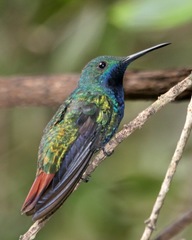
Black-throated Mango

Black-throated Mango

Anthracothorax nigricollis

Silhouette: Ferran Sayol · PhyloPic

LCLeast ConcernNTVUENCR
Daily sighting probability <5% · Rare
at Maceió

In 3 days <5% in a week ~10%

10 Verified sightings at Maceió
3,352 In all 27 parks From 2019 to 2026
September Best month
☀️ Diurnal When it's spotted

About the Black-throated Mango

The black-throated mango (Anthracothorax nigricollis) is a species in subfamily Polytminae of the hummingbird family Trochilidae. It is found in Panama, in every mainland South American country except Chile, and in Trinidad and Tobago.

The black-throated mango, like many hummingbirds, bounced among several genera before settling in its present Anthracothorax. Subspecies A. n. iridescens had previously been assigned to the green-breasted mango (A. prevostii).

The black-throated mango is 10.2 to 14 cm (4.0 to 5.5 in) long and weighs 6 to 9 g (0.21 to 0.32 oz). Both sexes of both subspecies have a slightly decurved black bill. Adult males of the nominate subspecies have a metallic bronze-green crown, nape, and upperparts. Their innermost pair of tail feathers are dusky bronze green and the outer four pairs are metallic magenta-rufous with dark blue edges and a violet sheen. Their wings are grayish brown. They have a black chin, throat, and middle of the chest with metallic bluish green... Wikipedia →

Sounds

Call0:04

Brazil · 2026

© JAYRSON ARAUJO DE OLIVEIRA · XC1186316 · CC BY-NC-SA 4.0

Song0:14

Ecuador · 2024

© Jonas Nilsson · XC1175925 · CC BY-NC-SA 4.0

Call1:15

Ecuador · 2024

© Manuel Sánchez-Nivicela · XC1036631 · CC BY-NC-ND 4.0

Global Distribution

Parks Where Found

# Park Country Daily sighting probability
1 Main Ridge Forest Reserve 🇹🇹 Trinidad and Tobago
~30%
2 Chapada dos Guimarães National Park 🇧🇷 Brazil
~20%
3 Soberanía National Park 🇵🇦 Panama
~10%
4 Cuyabeno Wildlife Reserve 🇪🇨 Ecuador
~10%
5 Henri Pittier National Park 🇻🇪 Venezuela
~10%
6 Tayrona National Natural Park 🇨🇴 Colombia
~10%
7 Manu National Park 🇵🇪 Peru
~10%
8 Sierra de la Macarena National Park 🇨🇴 Colombia
~10%
9 Iguazú National Park 🇦🇷 Argentina
~10%
10 San Lorenzo Protected Forest 🇵🇦 Panama
~10%
11 Farallones de Cali National Natural Park 🇨🇴 Colombia
~10%
12 Serra dos Órgãos National Park 🇧🇷 Brazil
~10%
13 Yasuní National Park 🇪🇨 Ecuador
<5%
14 Amacayacu National Natural Park 🇨🇴 Colombia
<5%
15 Caroni Swamp 🇹🇹 Trinidad and Tobago
<5%
16 Parque Natural Metropolitano 🇵🇦 Panama
<5%
17 Darién National Park 🇵🇦 Panama
<5%
18 Parque Estadual Encontro das Águas 🇧🇷 Brazil
<5%
19 Tambopata National Reserve 🇵🇪 Peru
<5%
20 Iguaçu National Park 🇧🇷 Brazil
<5%
21 Chapada Diamantina National Park 🇧🇷 Brazil
<5%
22 Machalilla National Park 🇪🇨 Ecuador
<5%
23 Itatiaia National Park 🇧🇷 Brazil
<5%
24 Iberá National Park 🇦🇷 Argentina
<5%
25 Chagres National Park 🇵🇦 Panama
<5%
26 Podocarpus National Park 🇪🇨 Ecuador
<5%
27 Los Nevados National Natural Park 🇨🇴 Colombia
<5%

Cities Where Found

# City Country Daily sighting probability
1 Belém 🇧🇷 Brazil
~60%
2 Medellín 🇨🇴 Colombia
~20%
3 Cali 🇨🇴 Colombia
~20%
4 Caracas 🇻🇪 Venezuela
~10%
5 Campo Grande 🇧🇷 Brazil
~10%
6 Panama City 🇵🇦 Panama
~10%
7 João Pessoa 🇧🇷 Brazil
~10%
8 Valencia 🇻🇪 Venezuela
<5%
9 Curitiba 🇧🇷 Brazil
<5%
10 Guayaquil 🇪🇨 Ecuador
<5%

Zoos & Centres Where Found

# Zoo / Centre Country
1 Parque das Aves 🇧🇷 Brazil In captivity

Before you go

What are the chances of seeing a Black-throated Mango in Maceió?

Rare

Under 5% of wildlife watchers report a Black-throated Mango sighting in Maceió on a given day, based on 10 verified sightings from GBIF citizen-science data. It is the 102nd most-seen of the 127 birds we can rate there. Over three days the chance rises to under 5%, and over a week to about 10%, if each day is a fresh chance.

When is the best time to see a Black-throated Mango in Maceió?

September and November

In those months about 10% of wildlife watchers report a Black-throated Mango in Maceió on a given day, against under 5% in October and December–August, the lowest months. Those are among Maceió's driest months, with about 45 mm of rain a month against 200 mm in June.

What time of day is best to see a Black-throated Mango?

Between 8 and 11 am

Across all the parks we cover, that three-hour window holds the most Black-throated Mango sightings with a recorded time, and about 9 in 10 of them come between 6 am and 6 pm: it is a daytime animal.

Is Maceió the best place to see a Black-throated Mango?

12th of 15

Of the 15 cities where we can rate Black-throated Mango sightings, Maceió ranks 12th at under 5%. The best odds are in Belém (Brazil, about 60%), Medellín (Colombia, about 20%) and Cali (Colombia, about 20%).

Where does the Black-throated Mango sighting chance come from?

GBIF citizen-science records

It is estimated from how often the Black-throated Mango is recorded against all the birds logged in Maceió (10 verified sightings), calibrated against known sighting rates. Figures are rounded to the nearest 10% because citizen-science data supports honest approximations, not decimals, and months with records from fewer than five people show "—". How it works.

← Back to Maceió