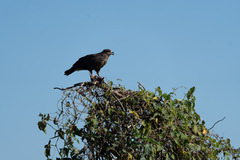
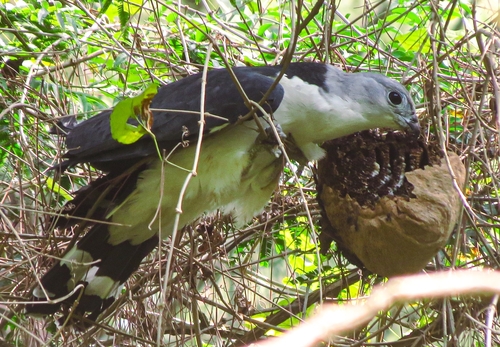
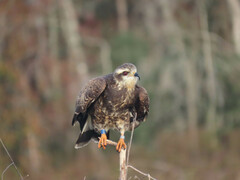
Snail Kite

Snail Kite

Rostrhamus sociabilis

Silhouette: Sharon Wegner-Larsen · PhyloPic

LCLeast ConcernNTVUENCR
Daily sighting probability <5% · Rare
at Cuyabeno Wildlife Reserve

In 3 days ~10% in a week ~20%

17 Verified sightings at Cuyabeno Wildlife Reserve From 2019 to 2026
8,374 In all 30 parks
October Best month
☀️ Diurnal When it's spotted

About the Snail Kite

The snail kite (Rostrhamus sociabilis) is a bird of prey within the family Accipitridae, which also includes the eagles, hawks, and Old World vultures. Its relative, the slender-billed kite, is now again placed in Helicolestes, making the genus Rostrhamus monotypic. Usually, it is placed in the Milvine kites, but the validity of that grouping is under investigation.

Lerner and Mindell (2005) found R. sociabilis sister to Geranospiza caerulescens, and that those two along with Ictinea plumbea were basal to both the Buteogallus and Buteo clades. They concluded that Rostrhamus belonged in Buteoninae (sensu stricto) and not in Milvinae, but noted that more investigation was needed.

The snail kite breeds in tropical South America, the Caribbean, and central and southern Florida in the United States. It is resident all-year round in most of its range, but the southernmost population migrates north in winter and the Caribbean birds disperse widely outside the breeding season.

Snail kites are 36 to 48 cm (14 to 19 in) long with a 99–120 cm (39–47 in) wingspan. They weigh from 300 to 570 g (11 to 20 oz). There is very limited sexual dimorphism... Wikipedia →

Sounds

Song0:23

Brazil · 2023

© Douglas Meyer · XC779845 · CC BY-NC-SA 4.0

Recording0:04

United States · 2022

© Matthew Dunning · XC770533 · CC BY-NC-SA 4.0

Uncertain0:42

United States · 2022

© PT xiao · XC742090 · CC BY-NC-SA 4.0

Global Distribution

Parks Where Found

# Park Country Daily sighting probability
1 Lago de Yojoa 🇭🇳 Honduras
~60%
2 Palo Verde National Park 🇨🇷 Costa Rica
~30%
3 Parque Estadual Encontro das Águas 🇧🇷 Brazil
~30%
4 Cerro Azul Meámbar National Park 🇭🇳 Honduras
~30%
5 Iberá National Park 🇦🇷 Argentina
~20%
6 Biotopo Cerro Cahuí 🇬🇹 Guatemala
~20%
7 Soberanía National Park 🇵🇦 Panama
~20%
8 Iguaçu National Park 🇧🇷 Brazil
~20%
9 Iguazú National Park 🇦🇷 Argentina
~10%
10 Yasuní National Park 🇪🇨 Ecuador
~10%
11 Bastimentos Island National Marine Park 🇵🇦 Panama
~10%
12 Manu National Park 🇵🇪 Peru
~10%
13 Sian Ka'an Biosphere Reserve 🇲🇽 Mexico
<5%
14 El Palmar National Park 🇦🇷 Argentina
<5%
15 Cuyabeno Wildlife Reserve 🇪🇨 Ecuador
<5%
16 La Amistad International Park (Panama) 🇵🇦 Panama
<5%
17 Calakmul Biosphere Reserve 🇲🇽 Mexico
<5%
18 Big Cypress National Preserve 🇺🇸 United States
<5%
19 Tortuguero National Park 🇨🇷 Costa Rica
<5%
20 Anavilhanas National Park 🇧🇷 Brazil
<5%
21 Chagres National Park 🇵🇦 Panama
<5%
22 Ciénaga de Zapata 🇨🇺 Cuba
<5%
23 Everglades National Park 🇺🇸 United States
<5%
24 Carara National Park 🇨🇷 Costa Rica
<5%
25 Tayrona National Natural Park 🇨🇴 Colombia
<5%
26 Amacayacu National Natural Park 🇨🇴 Colombia
<5%
27 Tambopata National Reserve 🇵🇪 Peru
<5%
28 Celestún Biosphere Reserve 🇲🇽 Mexico
<5%
29 Tikal National Park 🇬🇹 Guatemala
<5%
30 Merritt Island National Wildlife Refuge 🇺🇸 United States
<5%

Cities Where Found

# City Country Daily sighting probability
1 Barranquilla 🇨🇴 Colombia
~60%
2 Santa Cruz de la Sierra 🇧🇴 Bolivia
~30%
3 Asuncion 🇵🇾 Paraguay
~10%
4 Maceió 🇧🇷 Brazil
~10%
5 Fortaleza 🇧🇷 Brazil
~10%
6 Belo Horizonte 🇧🇷 Brazil
~10%
7 Guayaquil 🇪🇨 Ecuador
~10%
8 Curitiba 🇧🇷 Brazil
~10%
9 Buenos Aires 🇦🇷 Argentina
~10%
10 Belém 🇧🇷 Brazil
~10%

Before you go

What are the chances of seeing a Snail Kite in Cuyabeno Wildlife Reserve?

Rare

Under 5% of wildlife watchers report a Snail Kite sighting in Cuyabeno Wildlife Reserve on a given day, based on 17 verified sightings from GBIF citizen-science data from 2019 to 2026. It is the 197th most-seen of the 328 birds we can rate there. Over three days the chance rises to about 10%, and over a week to about 20%, if each day is a fresh chance.

When is the best time to see a Snail Kite in Cuyabeno Wildlife Reserve?

May, July and October

In those months about 10% of wildlife watchers report a Snail Kite in Cuyabeno Wildlife Reserve on a given day, against under 5% in June, August–September and November–April, the lowest months.

What time of day is best to see a Snail Kite?

Between 8 and 11 am

Across all the parks we cover, that three-hour window holds the most Snail Kite sightings with a recorded time, and about 9 in 10 of them come between 6 am and 6 pm: it is a daytime animal.

Which relatives of the Snail Kite live in Cuyabeno Wildlife Reserve?

Same family: Accipitridae

The closest relatives of the Snail Kite that you can see in Cuyabeno Wildlife Reserve (family Accipitridae, Hawks, Eagles, and Kites) are Roadside Hawk (about 40%), Plumbeous Kite (about 30%) and American Swallow-tailed Kite (about 20%), with each one's daily chance of a sighting.

Where does the Snail Kite sighting chance come from?

GBIF citizen-science records

It is estimated from how often the Snail Kite is recorded against all the birds logged in Cuyabeno Wildlife Reserve (17 verified sightings from 2019 to 2026), calibrated against known sighting rates. Figures are rounded to the nearest 10% because citizen-science data supports honest approximations, not decimals, and months with records from fewer than five people show "—". How it works.

← Back to Cuyabeno Wildlife Reserve