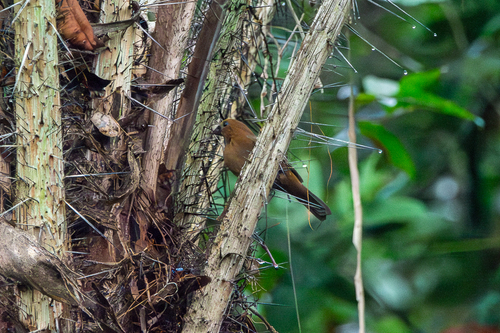
Red-crowned Ant-Tanager

Red-crowned Ant-Tanager

Habia rubica

Silhouette: Sheatherius · PhyloPic

LCLeast ConcernNTVUENCR
Daily sighting probability ~10% · With luck
at Manu National Park

In 3 days ~20% in a week ~30%

209 Verified sightings at Manu National Park From 2019 to 2026
6,038 In all 32 parks
December Best month
☀️ Diurnal When it's spotted

About the Red-crowned Ant-Tanager

The red-crowned ant tanager (Habia rubica) is a medium-sized passerine bird from tropical America. It is the only species now placed in the genus Habia. This species was long placed with the tanagers (Thraupidae), but it is actually closer to the cardinals (Cardinalidae).

The red-crowned ant tanager was formally described in 1817 by the French ornithologist Louis Pierre Vieillot. He placed it in the genus Saltator (which he misspelled as Staltator) and coined the binomial name Saltator rubicus. He specified the locality as Paraguay. The specific epithet is from Medieval Latin rubicus meaning "reddish". The red-crowned ant tanager is now the only species placed in the genus Habia that was introduced in 1840 by Edward Blyth. The genus name is a word used for various finches and tanagers in the Guarani language of Paraguay.

There are 17 recognised subspecies: H... Wikipedia →

Sounds

Song0:19

Argentina · 2026

© Marcos E. Sosa · XC1143059 · CC BY-NC-SA 4.0

Recording0:52

Argentina · 2025

© Sabrina Andrea Rendon Anaya · XC981837 · CC BY-NC-SA 4.0

Call0:15

Brazil · 2025

© JAYRSON ARAUJO DE OLIVEIRA · XC978359 · CC BY-NC-SA 4.0

Global Distribution

Parks Where Found

# Park Country Daily sighting probability
1 Iguaçu National Park 🇧🇷 Brazil
~30%
2 Serra dos Órgãos National Park 🇧🇷 Brazil
~20%
3 Iguazú National Park 🇦🇷 Argentina
~20%
4 El Triunfo 🇲🇽 Mexico
~20%
5 Tikal National Park 🇬🇹 Guatemala
~20%
6 Cockscomb Basin Wildlife Sanctuary 🇧🇿 Belize
~20%
7 Rincón de la Vieja National Park 🇨🇷 Costa Rica
~20%
8 Tambopata National Reserve 🇵🇪 Peru
~10%
9 Parque Natural Metropolitano 🇵🇦 Panama
~10%
10 Montes Azules Biosphere Reserve 🇲🇽 Mexico
~10%
11 Calakmul Biosphere Reserve 🇲🇽 Mexico
~10%
12 Sian Ka'an Biosphere Reserve 🇲🇽 Mexico
~10%
13 Cabo Blanco Absolute Nature Reserve 🇨🇷 Costa Rica
~10%
14 Tijuca National Park 🇧🇷 Brazil
~10%
15 Manu National Park 🇵🇪 Peru
~10%
16 Pico Bonito National Park 🇭🇳 Honduras
~10%
17 Cerro Azul Meámbar National Park 🇭🇳 Honduras
~10%
18 Amacayacu National Natural Park 🇨🇴 Colombia
<5%
19 Cusuco National Park 🇭🇳 Honduras
<5%
20 Cañón del Sumidero National Park 🇲🇽 Mexico
<5%
21 Carara National Park 🇨🇷 Costa Rica
<5%
22 La Amistad International Park (Panama) 🇵🇦 Panama
<5%
23 Itatiaia National Park 🇧🇷 Brazil
<5%
24 Biotopo Cerro Cahuí 🇬🇹 Guatemala
<5%
25 Chirripó National Park 🇨🇷 Costa Rica
<5%
26 Amboró National Park 🇧🇴 Bolivia
<5%
27 Monteverde Cloud Forest Reserve 🇨🇷 Costa Rica
<5%
28 Lago de Yojoa 🇭🇳 Honduras
<5%
29 Yasuní National Park 🇪🇨 Ecuador
<5%
30 Marino Ballena National Park 🇨🇷 Costa Rica
<5%
31 Tenorio Volcano National Park 🇨🇷 Costa Rica
<5%
32 Poás Volcano National Park 🇨🇷 Costa Rica
<5%

Cities Where Found

# City Country Daily sighting probability
1 Panama City 🇵🇦 Panama
<5%
2 Santos 🇧🇷 Brazil
<5%
3 Rio de Janeiro 🇧🇷 Brazil
<5%
4 San José 🇨🇷 Costa Rica
<5%
5 São Paulo 🇧🇷 Brazil
<5%

Before you go

What are the chances of seeing a Red-crowned Ant-Tanager in Manu National Park?

With luck

About 10% of wildlife watchers report a Red-crowned Ant-Tanager sighting in Manu National Park on a given day, based on 209 verified sightings from GBIF citizen-science data from 2019 to 2026. It is the 263rd most-seen of the 641 birds we can rate there. Over three days the chance rises to about 20%, and over a week to about 30%, if each day is a fresh chance.

When is the best time to see a Red-crowned Ant-Tanager in Manu National Park?

July to January

In those months about 10% of wildlife watchers report a Red-crowned Ant-Tanager in Manu National Park on a given day, against under 5% in February to June, the lowest months.

What time of day is best to see a Red-crowned Ant-Tanager?

Between 8 and 11 am

Across all the parks we cover, that three-hour window holds the most Red-crowned Ant-Tanager sightings with a recorded time, and about 9 in 10 of them come between 6 am and 6 pm: it is a daytime animal.

Where does the Red-crowned Ant-Tanager sighting chance come from?

GBIF citizen-science records

It is estimated from how often the Red-crowned Ant-Tanager is recorded against all the birds logged in Manu National Park (209 verified sightings from 2019 to 2026), calibrated against known sighting rates. Figures are rounded to the nearest 10% because citizen-science data supports honest approximations, not decimals, and months with records from fewer than five people show "—". How it works.

← Back to Manu National Park