Black Stork

Black Stork

Ciconia nigra

Silhouette: Andy Wilson · PhyloPic

LCLeast ConcernNTVUENCR
Daily sighting probability <5% · Rare
at Ngorongoro Conservation Area

In 3 days <5% in a week ~10%

29 Verified sightings at Ngorongoro Conservation Area From 2019 to 2026
6,839 In all 45 parks
December Best month
☀️ Diurnal When it's spotted

About the Black Stork

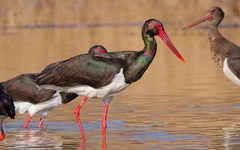
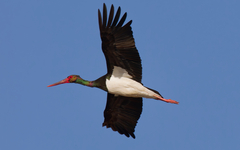
The black stork (Ciconia nigra) is a large bird in the stork family Ciconiidae. It was first described by Carl Linnaeus in the 10th edition of his Systema Naturae. Measuring on average 95 to 100 cm (37 to 39 in) from beak tip to end of tail with a 145-to-155 cm (57-to-61 in) wingspan, the adult black stork has mainly black plumage, with white underparts, long red legs and a long pointed red beak. A widespread but uncommon species, it breeds in scattered locations across Europe (predominantly in Portugal and Spain, and central and eastern parts), and east across the Palearctic to the Pacific Ocean. It is a long-distance migrant, with European populations wintering in tropical Sub-Saharan Africa, and Asian populations in the Indian subcontinent. When migrating between Europe and Africa, it avoids crossing broad expanses of the Mediterranean Sea and detours via the Levant in the east, the Strait of Sicily in the center, or the Strait of Gibraltar in the west. An isolated non-migratory population lives in Southern Africa.

Unlike the closely related white stork, the black stork is a shy and wary species. It is seen singly or in pairs, usually in marshy areas, rivers or inland waters. It feeds on amphibians, small fish and insects, generally wading slowly in shallow water stalking its prey. Breeding pairs usually build nests in large forest trees—most commonly deciduous but also coniferous—which can be seen from long distances, as well as on large boulders, or under overhanging ledges in mountainous areas. The female lays two to five greyish-white eggs, which become soiled over time in the nest. Incubation takes 32 to 38 days, with both sexes sharing duties, and fledging takes 60 to 71 days.

The black stork is considered to be a species of least concern by the International Union for Conservation of Nature, but its actual status is uncertain. Despite its large range, it is nowhere abundant, and it appears to be declining in parts of its range, such as in India, China and parts of Western Europe, though increasing in others such as the Iberian Peninsula. Various conservation measures have been taken for the black stork, like the Conservation Action Plan for African black storks by Wetlands International. It is also protected under the African-Eurasian Waterbird Agreement and the Convention on International Trade in Endangered Species of Wild Fauna and Flora. On 31 May 1968, South Korea designated the species as natural monument 200. Wikipedia →

Sounds

Alarm call0:05

Italy · 2025

© Francesco Sottile · XC998350 · CC BY-NC-SA 4.0

Begging call1:30

Estonia · 2018

© Livon · XC421078 · CC BY-NC-ND 4.0

Flight call0:18

Poland · 2015

© Jarek Matusiak · XC254678 · CC BY-NC-SA 4.0

Global Distribution

Parks Where Found

# Park Country Daily sighting probability
1 Monfragüe National Park 🇪🇸 Spain
~30%
2 Chitwan National Park 🇳🇵 Nepal
~20%
3 Ranthambore National Park 🇮🇳 India
~20%
4 Namdapha National Park 🇮🇳 India
~20%
5 Jim Corbett National Park 🇮🇳 India
~20%
6 Biebrza National Park 🇵🇱 Poland
~20%
7 Kiskunság National Park 🇭🇺 Hungary
~10%
8 Royal Bardia National Park 🇳🇵 Nepal
~10%
9 Camargue 🇫🇷 France
~10%
10 Manas National Park 🇮🇳 India
~10%
11 Hortobágy National Park 🇭🇺 Hungary
~10%
12 Arusha National Park 🇹🇿 Tanzania
~10%
13 Doñana National Park 🇪🇸 Spain
~10%
14 Gonarezhou National Park 🇿🇼 Zimbabwe
~10%
15 Białowieża National Park 🇵🇱 Poland
~10%
16 Fertő-Hanság National Park 🇭🇺 Hungary
~10%
17 Nairobi National Park 🇰🇪 Kenya
~10%
18 Kaziranga National Park 🇮🇳 India
~10%
19 Kruger National Park 🇿🇦 South Africa
~10%
20 Kanha National Park 🇮🇳 India
~10%
21 Hwange National Park 🇿🇼 Zimbabwe
<5%
22 Tarangire National Park 🇹🇿 Tanzania
<5%
23 Bandhavgarh National Park 🇮🇳 India
<5%
24 Satpura National Park 🇮🇳 India
<5%
25 Mana Pools National Park 🇿🇼 Zimbabwe
<5%
26 Lower Zambezi National Park 🇿🇲 Zambia
<5%
27 Royal Manas National Park 🇧🇹 Bhutan
<5%
28 Pilanesberg National Park 🇿🇦 South Africa
<5%
29 Lake Nakuru National Park 🇰🇪 Kenya
<5%
30 Liwonde National Park 🇲🇼 Malawi
<5%
31 Pyrénées National Park 🇫🇷 France
<5%
32 Aberdare National Park 🇰🇪 Kenya
<5%
33 Hluhluwe-Imfolozi Park 🇿🇦 South Africa
<5%
34 Masai Mara National Reserve 🇰🇪 Kenya
<5%
35 Keoladeo National Park 🇮🇳 India
<5%
36 Sierra de Guadarrama National Park 🇪🇸 Spain
<5%
37 Lake Manyara National Park 🇹🇿 Tanzania
<5%
38 Ngorongoro Conservation Area 🇹🇿 Tanzania
<5%
39 Bandipur National Park 🇮🇳 India
<5%
40 Tsavo East National Park 🇰🇪 Kenya
<5%
41 Chobe National Park 🇧🇼 Botswana
<5%
42 Nagarhole National Park 🇮🇳 India
<5%
43 Serengeti National Park 🇹🇿 Tanzania
<5%
44 Etosha National Park 🇳🇦 Namibia
<5%
45 Wadden Sea National Park 🇩🇪 Germany
<5%

Cities Where Found

# City Country Daily sighting probability
1 Taiyuan 🇨🇳 China
~20%
2 Shijiazhuang 🇨🇳 China
~10%
3 Istanbul 🇹🇷 Turkey
~10%
4 Ulaanbaatar 🇲🇳 Mongolia
~10%
5 Beijing 🇨🇳 China
<5%
6 Ramallah 🇵🇸 Palestine
<5%
7 Kyiv 🇺🇦 Ukraine
<5%
8 Jerusalem 🇮🇱 Israel
<5%
9 Belgrade 🇷🇸 Serbia
<5%
10 Warsaw 🇵🇱 Poland
<5%

Zoos & Centres Where Found

# Zoo / Centre Country
1 Moscow Zoo 🇷🇺 Russia In captivity
2 Pairi Daiza 🇧🇪 Belgium In captivity
3 Zlín-Lešná Zoo 🇨🇿 Czechia In captivity
4 Ostrava Zoo 🇨🇿 Czechia In captivity
5 Parc des oiseaux 🇫🇷 France In captivity
6 Zoobotánico Jerez 🇪🇸 Spain In captivity
7 Lusen National Park Centre 🇩🇪 Germany In captivity
8 Parc animalier de Sainte-Croix 🇫🇷 France In captivity
9 Wisentgehege Springe 🇩🇪 Germany In captivity
10 Tallinn Zoo 🇪🇪 Estonia In captivity
11 Parc ornithologique de Pont-de-Gau 🇫🇷 France In captivity
12 Nuremberg Zoo 🇩🇪 Germany In captivity
13 Suzhou Shangfangshan Forest Zoo 🇨🇳 China In captivity
14 Tianjin Zoo 🇨🇳 China In captivity
15 南昌新动物园 🇨🇳 China In captivity
16 Louisville Zoo 🇺🇸 United States In captivity
17 Warsaw Zoo 🇵🇱 Poland In captivity
18 Hellabrunn Zoo 🇩🇪 Germany In captivity
19 Kyiv Zoo 🇺🇦 Ukraine In captivity
20 Berlin Zoological Garden 🇩🇪 Germany In captivity
21 Edinburgh Zoo 🇬🇧 United Kingdom In captivity
22 Catoctin Wildlife Preserve and Zoo 🇺🇸 United States In captivity
23 Wildparadies Tripsdrill 🇩🇪 Germany In captivity
24 Fort Wayne Children's Zoo 🇺🇸 United States In captivity
25 Parc Zoologique et Botanique de Mulhouse 🇫🇷 France In captivity
26 Zoo Opole 🇵🇱 Poland In captivity
27 Tashkent Zoo 🇺🇿 Uzbekistan In captivity
28 Bad Mergentheim Wildlife Park 🇩🇪 Germany In captivity
29 Cologne Zoological Garden 🇩🇪 Germany In captivity
30 Langenberg Wildlife Park 🇨🇭 Switzerland In captivity
31 Łódź Zoo 🇵🇱 Poland In captivity
32 Zoo Santo Inácio 🇵🇹 Portugal In captivity
33 Terra Natura Murcia 🇪🇸 Spain In captivity
34 Reserva Zoológica Oasys MiniHollywood 🇪🇸 Spain In captivity
35 Le Cornelle 🇮🇹 Italy In captivity
36 Zoologischer Garten Halle 🇩🇪 Germany In captivity
37 Zagreb Zoo 🇭🇷 Croatia In captivity
38 Zoopark Limpopo 🇷🇺 Russia In captivity
39 Zoo de Córdoba 🇪🇸 Spain In captivity
40 Parco Zoo 🇮🇹 Italy In captivity
41 Lutsk Zoo 🇺🇦 Ukraine In captivity
42 Alpenzoo Innsbruck 🇦🇹 Austria In captivity
43 Tel Aviv University Zoo 🇮🇱 Israel In captivity
44 Zoo Lagos 🇵🇹 Portugal In captivity
45 Záchranná stanice Pavlov 🇨🇿 Czechia In captivity
46 Parc zoologique de Fort-Mardyck Dunkerque Grand Littoral 🇫🇷 France In captivity
47 Storchenstation 🇨🇭 Switzerland In captivity
48 Zoo de Lourosa 🇵🇹 Portugal In captivity
49 Aquarium Berlin 🇩🇪 Germany In captivity
50 herpetarium warszawskiego ZOO 🇵🇱 Poland In captivity

Before you go

What are the chances of seeing a Black Stork in Ngorongoro Conservation Area?

Rare

Under 5% of wildlife watchers report a Black Stork sighting in Ngorongoro Conservation Area on a given day, based on 29 verified sightings from GBIF citizen-science data from 2019 to 2026. It is the 389th most-seen of the 519 birds we can rate there. Over three days the chance rises to under 5%, and over a week to about 10%, if each day is a fresh chance.

When is the best time to see a Black Stork in Ngorongoro Conservation Area?

Any time of year

In every month with enough records, under 5% of wildlife watchers report a Black Stork in Ngorongoro Conservation Area on a given day, so our monthly data shows no clear season.

What time of day is best to see a Black Stork?

Between 9 am and noon

Across all the parks we cover, that three-hour window holds the most Black Stork sightings with a recorded time, and about 8 in 10 of them come between 6 am and 6 pm: it is a daytime animal.

Which relatives of the Black Stork live in Ngorongoro Conservation Area?

Same genus: Ciconia

The closest relatives of the Black Stork that you can see in Ngorongoro Conservation Area (genus Ciconia, Ciconia Storks) are White Stork (about 20%) and Abdim's Stork (about 20%), with each one's daily chance of a sighting.

Where does the Black Stork sighting chance come from?

GBIF citizen-science records

It is estimated from how often the Black Stork is recorded against all the birds logged in Ngorongoro Conservation Area (29 verified sightings from 2019 to 2026), calibrated against known sighting rates. Figures are rounded to the nearest 10% because citizen-science data supports honest approximations, not decimals, and months with records from fewer than five people show "—". How it works.

← Back to Ngorongoro Conservation Area