Sacred Kingfisher

Sacred Kingfisher

Todiramphus sanctus

Silhouette: Steven Traver · PhyloPic

LCLeast ConcernNTVUENCR
Daily sighting probability ~20% · Possible
at Noosa National Park

In 3 days ~40% in a week ~70%

95 Verified sightings at Noosa National Park From 2019 to 2026
4,775 In all 26 parks
March Best month
☀️ Diurnal When it's spotted

About the Sacred Kingfisher

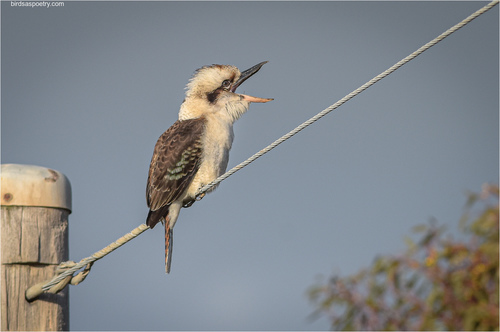
The sacred kingfisher (Todiramphus sanctus) is a medium-sized woodland kingfisher that occurs in mangroves, woodlands, forests and river valleys in Australia, New Zealand and other parts of the western Pacific. The binomial name Halcyon sanctus was introduced by Nicholas Aylward Vigors and Thomas Horsfield in 1827 who described a sacred kingfisher zoological specimen from New Holland, Australia. Vigors and Horsfield compare it with Alcedo sacra described by Johann Friedrich Gmelin in 1788. Gmelin in turn based his description on John Latham's "Sacred King's Fisher" published in 1782. Latham described several varieties, one of which was illustrated in Arthur Phillip's The Voyage of Governor Phillip to Botany Bay published in 1789. The genus Halcyon was split and the sacred kingfisher was placed in the genus Todiramphus that had been erected by the French surgeon and naturalist René Lesson in 1827. The generic name is derived from the genus Todus (Brisson, 1760), 'tody' (a West Indian insectivorous bird) and Ancient Greek rhamphos (ῥάμφος), 'bill'. The specific epithet is the Latin sanctus 'sacred'.

Five subspecies are recognised: Wikipedia →

Sounds

Call0:11

Solomon Islands · 2026

© Marc Anderson · XC1146344 · CC BY-NC-ND 4.0

Song0:11

Australia · 2025

© Étienne Leroy · XC1069720 · CC BY-NC-SA 4.0

Recording0:53

Australia · 2025

© Mengshuai Ge · XC1050930 · CC BY-NC-SA 4.0

Global Distribution

Parks Where Found

# Park Country Daily sighting probability
1 Egmont National Park 🇳🇿 New Zealand
~40%
2 Daintree National Park 🇦🇺 Australia
~40%
3 Rottnest Island 🇦🇺 Australia
~30%
4 Raja Ampat 🇮🇩 Indonesia
~30%
5 Bali Barat National Park 🇮🇩 Indonesia
~20%
6 Abel Tasman National Park 🇳🇿 New Zealand
~20%
7 Nitmiluk National Park 🇦🇺 Australia
~20%
8 Kakadu National Park 🇦🇺 Australia
~20%
9 Royal National Park 🇦🇺 Australia
~20%
10 Noosa National Park 🇦🇺 Australia
~20%
11 Komodo National Park 🇮🇩 Indonesia
~10%
12 Hattah-Kulkyne National Park 🇦🇺 Australia
~10%
13 Blue Mountains National Park 🇦🇺 Australia
~10%
14 Cape Range 🇦🇺 Australia
~10%
15 Rakiura National Park 🇳🇿 New Zealand
~10%
16 Ningaloo Marine Park 🇦🇺 Australia
~10%
17 Grampians National Park 🇦🇺 Australia
~10%
18 Flinders Ranges National Park 🇦🇺 Australia
~10%
19 Kosciuszko National Park 🇦🇺 Australia
~10%
20 Fiordland National Park 🇳🇿 New Zealand
~10%
21 Tangkoko Nature Reserve 🇮🇩 Indonesia
~10%
22 Great Otway National Park 🇦🇺 Australia
~10%
23 Booderee National Park 🇦🇺 Australia
<5%
24 Litchfield National Park 🇦🇺 Australia
<5%
25 Springbrook National Park 🇦🇺 Australia
<5%
26 Lamington National Park 🇦🇺 Australia
<5%

Cities Where Found

# City Country Daily sighting probability
1 Auckland 🇳🇿 New Zealand
~60%
2 Brisbane 🇦🇺 Australia
~40%
3 Makassar 🇮🇩 Indonesia
~30%
4 Semarang 🇮🇩 Indonesia
~10%
5 Jakarta 🇮🇩 Indonesia
~10%
6 Denpasar 🇮🇩 Indonesia
~10%
7 Sydney 🇦🇺 Australia
~10%
8 Melbourne 🇦🇺 Australia
~10%
9 Perth 🇦🇺 Australia
<5%
10 Kuching 🇲🇾 Malaysia
<5%

Zoos & Centres Where Found

# Zoo / Centre Country
1 Australia Zoo 🇦🇺 Australia In captivity
2 Alice Springs Desert Park 🇦🇺 Australia In captivity
3 Cleland Wildlife Park 🇦🇺 Australia In captivity
4 Currumbin Wildlife Sanctuary 🇦🇺 Australia In captivity
5 Auckland Zoo 🇳🇿 New Zealand In captivity
6 Moonlit Sanctuary Wildlife Conservation Park 🇦🇺 Australia In captivity
7 Willowbank Wildlife Reserve 🇳🇿 New Zealand In captivity
8 Featherdale Sydney Wildlife Park 🇦🇺 Australia In captivity
9 Rockhampton Zoo 🇦🇺 Australia In captivity
10 Wagga Zoo 🇦🇺 Australia In captivity
11 Ōtorohanga Kiwi House 🇳🇿 New Zealand In captivity
12 Cairns Zoom and Wildlife Dome 🇦🇺 Australia In captivity
13 Caversham Wildlife Park 🇦🇺 Australia In captivity

Before you go

What are the chances of seeing a Sacred Kingfisher in Noosa National Park?

Possible

About 20% of wildlife watchers report a Sacred Kingfisher sighting in Noosa National Park on a given day, based on 95 verified sightings from GBIF citizen-science data from 2019 to 2026. It is the 40th most-seen of the 128 birds we can rate there. Over three days the chance rises to about 40%, and over a week to about 70%, if each day is a fresh chance.

When is the best time to see a Sacred Kingfisher in Noosa National Park?

March

In that month about 30% of wildlife watchers report a Sacred Kingfisher in Noosa National Park on a given day, against under 5% in September, the lowest month. That is one of Noosa National Park's wettest months, with about 170 mm of rain against 30 mm in August.

What time of day is best to see a Sacred Kingfisher?

Between 9 am and noon

Across all the parks we cover, that three-hour window holds the most Sacred Kingfisher sightings with a recorded time, and nearly all of them come between 6 am and 6 pm: it is a daytime animal.

Where does the Sacred Kingfisher sighting chance come from?

GBIF citizen-science records

It is estimated from how often the Sacred Kingfisher is recorded against all the birds logged in Noosa National Park (95 verified sightings from 2019 to 2026), calibrated against known sighting rates. Figures are rounded to the nearest 10% because citizen-science data supports honest approximations, not decimals, and months with records from fewer than five people show "—". How it works.

← Back to Noosa National Park