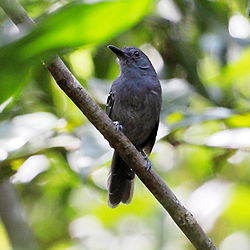

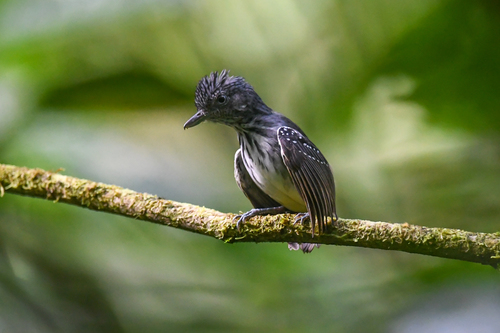
Dusky Antbird

Dusky Antbird

Cercomacra tyrannina

Silhouette: Sheatherius · PhyloPic

LCLeast ConcernNTVUENCR
Daily sighting probability <5% · Rare
at Tapantí-Macizo de la Muerte National Park

In 3 days ~10% in a week ~20%

215 Verified sightings at Tapantí-Macizo de la Muerte National Park From 2019 to 2026
9,976 In all 36 parks
October Best month
☀️ Diurnal When it's spotted

About the Dusky Antbird

The dusky antbird or tyrannine antbird (Cercomacroides tyrannina) is a passerine bird in subfamily Thamnophilinae of family Thamnophilidae, the "typical antbirds". It is found from Mexico south through Central America and in Brazil, Colombia, Ecuador, French Guiana, Guyana, Suriname, and Venezuela.

The dusky antbird was described by the English zoologist Philip Sclater in 1855 and given the binomial name Pyriglena tyrannina. The species was subsequently placed in genus Cercomacra but a molecular phylogenetic study published in 2014 found that Cercomacra, as then defined, was polyphyletic. The genus was split to create two monophyletic genera, and six species including the dusky antbird were moved to the newly erected genus Cercomacroides.

The dusky antbird has these four subspecies: What is now Willis's antbird (C. laeta) was originally described as a fifth subspecies. A 1997 study found that Willis's antbird differed from the other dusky antbird subspecies in both plumage and voice and as a result, Willis's antbird was promoted... Wikipedia →

Sounds

Song0:33

Ecuador · 2025

© Manuel Sánchez-Nivicela · XC1155516 · CC BY-NC-ND 4.0

Duet0:07

Brazil · 2024

© JAYRSON ARAUJO DE OLIVEIRA · XC939998 · CC BY-NC-SA 4.0

Call0:15

Colombia · 2021

© Peter Boesman · XC693391 · CC BY-NC-ND 4.0

Global Distribution

Parks Where Found

# Park Country Daily sighting probability
1 Cockscomb Basin Wildlife Sanctuary 🇧🇿 Belize
~40%
2 Brownsberg Nature Park 🇸🇷 Suriname
~40%
3 Soberanía National Park 🇵🇦 Panama
~30%
4 Montes Azules Biosphere Reserve 🇲🇽 Mexico
~30%
5 Carara National Park 🇨🇷 Costa Rica
~20%
6 Parque Natural Metropolitano 🇵🇦 Panama
~20%
7 Arenal Volcano National Park 🇨🇷 Costa Rica
~10%
8 Utría National Natural Park 🇨🇴 Colombia
~10%
9 Cerro Azul Meámbar National Park 🇭🇳 Honduras
~10%
10 Anavilhanas National Park 🇧🇷 Brazil
~10%
11 Sierra de la Macarena National Park 🇨🇴 Colombia
~10%
12 Lago de Yojoa 🇭🇳 Honduras
~10%
13 San Lorenzo Protected Forest 🇵🇦 Panama
~10%
14 Bastimentos Island National Marine Park 🇵🇦 Panama
<5%
15 Chagres National Park 🇵🇦 Panama
<5%
16 Darién National Park 🇵🇦 Panama
<5%
17 Tenorio Volcano National Park 🇨🇷 Costa Rica
<5%
18 Pico Bonito National Park 🇭🇳 Honduras
<5%
19 Tortuguero National Park 🇨🇷 Costa Rica
<5%
20 Piedras Blancas National Park 🇨🇷 Costa Rica
<5%
21 Tapantí-Macizo de la Muerte National Park 🇨🇷 Costa Rica
<5%
22 Chirripó National Park 🇨🇷 Costa Rica
<5%
23 La Amistad International Park (Panama) 🇵🇦 Panama
<5%
24 Calakmul Biosphere Reserve 🇲🇽 Mexico
<5%
25 Rincón de la Vieja National Park 🇨🇷 Costa Rica
<5%
26 Cahuita National Park 🇨🇷 Costa Rica
<5%
27 Corcovado National Park 🇨🇷 Costa Rica
<5%
28 Cabo Blanco Absolute Nature Reserve 🇨🇷 Costa Rica
<5%
29 Gandoca-Manzanillo Wildlife Refuge 🇨🇷 Costa Rica
<5%
30 Braulio Carrillo National Park 🇨🇷 Costa Rica
<5%
31 Monteverde Cloud Forest Reserve 🇨🇷 Costa Rica
<5%
32 Manuel Antonio National Park 🇨🇷 Costa Rica
<5%
33 Chingaza National Natural Park 🇨🇴 Colombia
<5%
34 Tikal National Park 🇬🇹 Guatemala
<5%
35 Poás Volcano National Park 🇨🇷 Costa Rica
<5%
36 Farallones de Cali National Natural Park 🇨🇴 Colombia
<5%

Cities Where Found

# City Country Daily sighting probability
1 Panama City 🇵🇦 Panama
<5%

Before you go

What are the chances of seeing a Dusky Antbird in Tapantí-Macizo de la Muerte National Park?

Rare

Under 5% of wildlife watchers report a Dusky Antbird sighting in Tapantí-Macizo de la Muerte National Park on a given day, based on 215 verified sightings from GBIF citizen-science data from 2019 to 2026. It is the 261st most-seen of the 467 birds we can rate there. Over three days the chance rises to about 10%, and over a week to about 20%, if each day is a fresh chance.

When is the best time to see a Dusky Antbird in Tapantí-Macizo de la Muerte National Park?

October

In that month about 10% of wildlife watchers report a Dusky Antbird in Tapantí-Macizo de la Muerte National Park on a given day, against under 5% in November to September, the lowest months. That is one of Tapantí-Macizo de la Muerte National Park's wettest months, with about 570 mm of rain against 160 mm in February.

What time of day is best to see a Dusky Antbird?

Between 7 and 10 am

Across all the parks we cover, that three-hour window holds the most Dusky Antbird sightings with a recorded time, and about 9 in 10 of them come between 6 am and 6 pm: it is a daytime animal.

Where does the Dusky Antbird sighting chance come from?

GBIF citizen-science records

It is estimated from how often the Dusky Antbird is recorded against all the birds logged in Tapantí-Macizo de la Muerte National Park (215 verified sightings from 2019 to 2026), calibrated against known sighting rates. Figures are rounded to the nearest 10% because citizen-science data supports honest approximations, not decimals, and months with records from fewer than five people show "—". How it works.

← Back to Tapantí-Macizo de la Muerte National Park