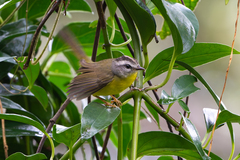
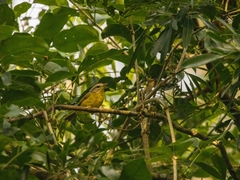
Golden-crowned Warbler

Golden-crowned Warbler

Basileuterus culicivorus

Silhouette: Andy Wilson · PhyloPic

LCLeast ConcernNTVUENCR
Daily sighting probability <5% · Rare
at Biotopo Cerro Cahuí

In 3 days ~10% in a week ~30%

16 Verified sightings at Biotopo Cerro Cahuí From 2019 to 2026
20,269 In all 39 parks
August Best month
☀️ Diurnal When it's spotted

About the Golden-crowned Warbler

The golden-crowned warbler (Basileuterus culicivorus) is a small insectivorous bird in the New World warbler family Parulidae. It has a large geographic range that extends from northeastern Mexico south to northern Argentina. The white-bellied warbler was formerly treated as a separate species but is now considered to be conspecific with the golden-crowned warbler.

The golden-crowned warbler was formally described in 1830 under the binomial name Sylvia culicivora by the German accountant Wilhelm Deppe in a price list of specimens that had been collected in Mexico by Wilhelm's brother Ferdinand Deppe. The specific epithet combines the Latin culex, culicis meaning "midge" and -vorus meaning "eating". The golden-crowned warbler is now one of 12 species placed in the genus Basileuterus that was introduced in 1848 by the German ornithologist Jean Cabanis. The genus name is from Ancient Greek βασιλευτερος/basileuteros meaning "more kingly".

Fourteen subspecies are recognised: Basileuterus culicivorus flavescens Ridgway, 1902 – central west Mexico Basileuterus culicivorus brasierii (Giraud Jr, 1841) – northeast, central east Mexico Basileuterus culicivorus culicivorus (Deppe... Wikipedia →

Sounds

Song0:26

Uruguay · 2010

© Pedro Rinaldi · XC1163143 · CC BY-NC-SA 4.0

Call0:08

Argentina · 2026

© Marcos E. Sosa · XC1156754 · CC BY-NC-SA 4.0

Alarm call0:06

Brazil · 2023

© JAYRSON ARAUJO DE OLIVEIRA · XC857570 · CC BY-NC-SA 4.0

Global Distribution

Parks Where Found

# Park Country Daily sighting probability
1 Itatiaia National Park 🇧🇷 Brazil
~70%
2 Iguazú National Park 🇦🇷 Argentina
~60%
3 Iguaçu National Park 🇧🇷 Brazil
~60%
4 El Palmar National Park 🇦🇷 Argentina
~40%
5 Serra dos Órgãos National Park 🇧🇷 Brazil
~40%
6 Chapada dos Guimarães National Park 🇧🇷 Brazil
~40%
7 Chapada Diamantina National Park 🇧🇷 Brazil
~30%
8 Monteverde Cloud Forest Reserve 🇨🇷 Costa Rica
~30%
9 El Triunfo 🇲🇽 Mexico
~30%
10 Serra da Canastra National Park 🇧🇷 Brazil
~20%
11 Henri Pittier National Park 🇻🇪 Venezuela
~20%
12 Cumbres de Monterrey National Park 🇲🇽 Mexico
~20%
13 Arenal Volcano National Park 🇨🇷 Costa Rica
~20%
14 Tijuca National Park 🇧🇷 Brazil
~20%
15 Volcán Barú National Park 🇵🇦 Panama
~20%
16 Emas National Park 🇧🇷 Brazil
~20%
17 Rincón de la Vieja National Park 🇨🇷 Costa Rica
~10%
18 La Amistad International Park (Panama) 🇵🇦 Panama
~10%
19 Chirripó National Park 🇨🇷 Costa Rica
~10%
20 Amboró National Park 🇧🇴 Bolivia
~10%
21 Tenorio Volcano National Park 🇨🇷 Costa Rica
~10%
22 Cusuco National Park 🇭🇳 Honduras
~10%
23 Sierra de la Macarena National Park 🇨🇴 Colombia
~10%
24 Calakmul Biosphere Reserve 🇲🇽 Mexico
~10%
25 Iberá National Park 🇦🇷 Argentina
~10%
26 Cerro Azul Meámbar National Park 🇭🇳 Honduras
~10%
27 Tikal National Park 🇬🇹 Guatemala
~10%
28 Farallones de Cali National Natural Park 🇨🇴 Colombia
<5%
29 Biotopo Cerro Cahuí 🇬🇹 Guatemala
<5%
30 Tapantí-Macizo de la Muerte National Park 🇨🇷 Costa Rica
<5%
31 Cañón del Sumidero National Park 🇲🇽 Mexico
<5%
32 Pico Bonito National Park 🇭🇳 Honduras
<5%
33 Poás Volcano National Park 🇨🇷 Costa Rica
<5%
34 Braulio Carrillo National Park 🇨🇷 Costa Rica
<5%
35 Cockscomb Basin Wildlife Sanctuary 🇧🇿 Belize
<5%
36 Parque Estadual Encontro das Águas 🇧🇷 Brazil
<5%
37 Chingaza National Natural Park 🇨🇴 Colombia
<5%
38 Los Nevados National Natural Park 🇨🇴 Colombia
<5%
39 Los Quetzales National Park 🇨🇷 Costa Rica
<5%

Cities Where Found

# City Country Daily sighting probability
1 Buenos Aires 🇦🇷 Argentina
~30%
2 Curitiba 🇧🇷 Brazil
~20%
3 Porto Alegre 🇧🇷 Brazil
~20%
4 Campo Grande 🇧🇷 Brazil
~10%
5 São Paulo 🇧🇷 Brazil
~10%
6 Campinas 🇧🇷 Brazil
~10%
7 Santos 🇧🇷 Brazil
~10%
8 Rio de Janeiro 🇧🇷 Brazil
~10%
9 Belo Horizonte 🇧🇷 Brazil
~10%
10 Maceió 🇧🇷 Brazil
~10%

Before you go

What are the chances of seeing a Golden-crowned Warbler in Biotopo Cerro Cahuí?

Rare

Under 5% of wildlife watchers report a Golden-crowned Warbler sighting in Biotopo Cerro Cahuí on a given day, based on 16 verified sightings from GBIF citizen-science data from 2019 to 2026. It is the 128th most-seen of the 191 birds we can rate there. Over three days the chance rises to about 10%, and over a week to about 30%, if each day is a fresh chance.

When is the best time to see a Golden-crowned Warbler in Biotopo Cerro Cahuí?

August

In that month about 40% of wildlife watchers report a Golden-crowned Warbler in Biotopo Cerro Cahuí on a given day, against under 5% in September and November–June, the lowest months. That is one of Biotopo Cerro Cahuí's wettest months, with about 170 mm of rain against 25 mm in March.

What time of day is best to see a Golden-crowned Warbler?

Between 10 am and 1 pm

Across all the parks we cover, that three-hour window holds the most Golden-crowned Warbler sightings with a recorded time, and about 9 in 10 of them come between 6 am and 6 pm: it is a daytime animal.

Which relatives of the Golden-crowned Warbler live in Biotopo Cerro Cahuí?

Same family: Parulidae

The closest relatives of the Golden-crowned Warbler that you can see in Biotopo Cerro Cahuí (family Parulidae, New World Warblers) are Magnolia Warbler (about 40%), Black-and-white Warbler (about 40%) and American Redstart (about 30%), with each one's daily chance of a sighting.

Where does the Golden-crowned Warbler sighting chance come from?

GBIF citizen-science records

It is estimated from how often the Golden-crowned Warbler is recorded against all the birds logged in Biotopo Cerro Cahuí (16 verified sightings from 2019 to 2026), calibrated against known sighting rates. Figures are rounded to the nearest 10% because citizen-science data supports honest approximations, not decimals, and months with records from fewer than five people show "—". How it works.

← Back to Biotopo Cerro Cahuí