About the Magnolia Warbler
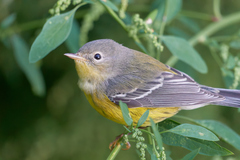
The magnolia warbler (Setophaga magnolia) is a member of the wood warbler family Parulidae. The genus name Setophaga is from Ancient Greek ses, "moth", and phagos, "eating", and the specific magnolia refers to the type locality. American ornithologist Alexander Wilson found this species in magnolias near Fort Adams, Mississippi.
This species is a moderately small New World warbler. It measures 11 to 13 cm (4.3 to 5.1 in) in length and spans 16 to 20 cm (6.3 to 7.9 in) across the wings. Body mass in adult birds can range from 6.6 to 12.6 g (0.23 to 0.44 oz), though weights have reportedly ranged up to 15 g (0.53 oz) prior to migration. Among standard measurements, the wing chord is 5.4 to 6.4 cm (2.1 to 2.5 in), the tail is 4.6 to 5.2 cm (1.8 to 2.0 in), the bill is 0.8 to 1 cm (0.31 to 0.39 in) and the tarsus is 1.7 to 1.85 cm (0.67 to 0.73 in). The magnolia warbler can be distinguished by its coloration. The breeding males often have white, gray, and black backs with yellow on the sides; yellow and black-striped stomachs; white, gray, and black foreheads and beaks; distinct black tails with white stripes on the underside; and defined white patches... Wikipedia →