Limpkin

Limpkin

Aramus guarauna

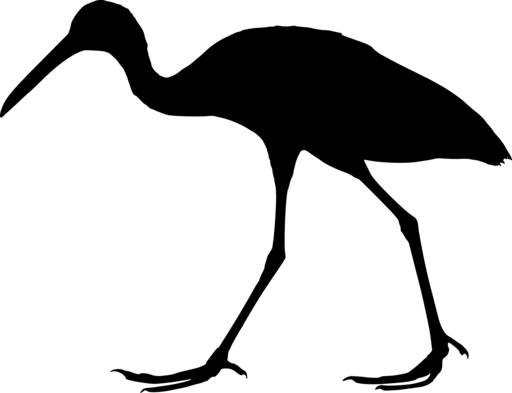
Silhouette: lwolfartist (photograph), T. Michael Keesey (vectorization) · PhyloPic

LCLeast ConcernNTVUENCR
Daily sighting probability ~10% · With luck
at Santo Domingo

In 3 days ~20% in a week ~30%

58 Verified sightings at Santo Domingo
7,662 In all 39 parks From 2019 to 2026
October Best month
☀️ Diurnal When it's spotted

About the Limpkin

The limpkin (Aramus guarauna) is a large wading bird related to rails and cranes, and the only extant species in the family Aramidae. It is found mostly in wetlands in warm parts of the Americas, from Florida to northern Argentina, but individuals have been reported as far north as Wisconsin, and Southern Ontario. It feeds on molluscs, with the diet dominated by apple snails of the genus Pomacea. Its name derives from its seeming limp when it walks. It has also been called "carrao", "courlan", and "crying bird".

The limpkin is placed in the family Aramidae, which is in turn placed within the crane and rail order Gruiformes. The limpkin had been suggested to be close to the ibis and spoonbill family Threskiornithidae, based upon shared bird lice. The Sibley–Ahlquist taxonomy of birds, based upon DNA–DNA hybridization, suggested that the limpkin's closest relatives were the Heliornithidae finfoots, and Sibley and Monroe even placed the species in that family in 1990. More recent studies have found little support for this relationship. More recent DNA studies have confirmed a close relationship with particularly the cranes, with the limpkin remaining as... Wikipedia →

Sounds

Call0:10

Argentina · 2026

© Marcos E. Sosa · XC1120047 · CC BY-NC-SA 4.0

Song0:53

Argentina · 2023

© Guillermo Treboux · XC897447 · CC BY-NC-SA 4.0

Uncertain0:18

United States · 2022

© PT xiao · XC742091 · CC BY-NC-SA 4.0

Global Distribution

Parks Where Found

# Park Country Daily sighting probability
1 Palo Verde National Park 🇨🇷 Costa Rica
~50%
2 Los Haitises National Park 🇩🇴 Dominican Republic
~50%
3 Lago de Yojoa 🇭🇳 Honduras
~40%
4 Parque Estadual Encontro das Águas 🇧🇷 Brazil
~20%
5 Manu National Park 🇵🇪 Peru
~20%
6 Caroni Swamp 🇹🇹 Trinidad and Tobago
~20%
7 Tikal National Park 🇬🇹 Guatemala
~20%
8 Iberá National Park 🇦🇷 Argentina
~20%
9 Cerro Azul Meámbar National Park 🇭🇳 Honduras
~20%
10 Yasuní National Park 🇪🇨 Ecuador
~10%
11 Big Cypress National Preserve 🇺🇸 United States
~10%
12 Biotopo Cerro Cahuí 🇬🇹 Guatemala
~10%
13 Ciénaga de Zapata 🇨🇺 Cuba
~10%
14 Bastimentos Island National Marine Park 🇵🇦 Panama
~10%
15 Iguaçu National Park 🇧🇷 Brazil
~10%
16 Iguazú National Park 🇦🇷 Argentina
~10%
17 Calakmul Biosphere Reserve 🇲🇽 Mexico
<5%
18 Soberanía National Park 🇵🇦 Panama
<5%
19 Everglades National Park 🇺🇸 United States
<5%
20 El Impenetrable National Park 🇦🇷 Argentina
<5%
21 La Amistad International Park (Panama) 🇵🇦 Panama
<5%
22 Tortuguero National Park 🇨🇷 Costa Rica
<5%
23 Darién National Park 🇵🇦 Panama
<5%
24 Montes Azules Biosphere Reserve 🇲🇽 Mexico
<5%
25 Anavilhanas National Park 🇧🇷 Brazil
<5%
26 Serra dos Órgãos National Park 🇧🇷 Brazil
<5%
27 Tambopata National Reserve 🇵🇪 Peru
<5%
28 Merritt Island National Wildlife Refuge 🇺🇸 United States
<5%
29 Machalilla National Park 🇪🇨 Ecuador
<5%
30 Sian Ka'an Biosphere Reserve 🇲🇽 Mexico
<5%
31 Cockscomb Basin Wildlife Sanctuary 🇧🇿 Belize
<5%
32 Ría Lagartos Biosphere Reserve 🇲🇽 Mexico
<5%
33 Celestún Biosphere Reserve 🇲🇽 Mexico
<5%
34 Santa Rosa National Park 🇨🇷 Costa Rica
<5%
35 Sierra de la Macarena National Park 🇨🇴 Colombia
<5%
36 Tayrona National Natural Park 🇨🇴 Colombia
<5%
37 Chagres National Park 🇵🇦 Panama
<5%
38 Great Smoky Mountains National Park 🇺🇸 United States
<5%
39 Tijuca National Park 🇧🇷 Brazil
<5%

Cities Where Found

# City Country Daily sighting probability
1 Santa Cruz de la Sierra 🇧🇴 Bolivia
~40%
2 Barranquilla 🇨🇴 Colombia
~40%
3 Buenos Aires 🇦🇷 Argentina
~30%
4 Belém 🇧🇷 Brazil
~30%
5 Orlando 🇺🇸 United States
~20%
6 Asuncion 🇵🇾 Paraguay
~20%
7 Fortaleza 🇧🇷 Brazil
~20%
8 Miami 🇺🇸 United States
~10%
9 Salvador 🇧🇷 Brazil
~10%
10 Campinas 🇧🇷 Brazil
~10%

Zoos & Centres Where Found

# Zoo / Centre Country
1 Amazon Rescue Center 🇵🇪 Peru In captivity

Before you go

What are the chances of seeing a Limpkin in Santo Domingo?

With luck

About 10% of wildlife watchers report a Limpkin sighting in Santo Domingo on a given day, based on 58 verified sightings from GBIF citizen-science data. It is the 57th most-seen of the 110 birds we can rate there. Over three days the chance rises to about 20%, and over a week to about 30%, if each day is a fresh chance.

When is the best time to see a Limpkin in Santo Domingo?

February–March, May–June and August–December

In those months about 10% of wildlife watchers report a Limpkin in Santo Domingo on a given day, against under 5% in January, April and July, the lowest months.

What time of day is best to see a Limpkin?

Between 10 am and 1 pm

Across all the parks we cover, that three-hour window holds the most Limpkin sightings with a recorded time, and about 9 in 10 of them come between 6 am and 6 pm: it is a daytime animal.

Is Santo Domingo the best place to see a Limpkin?

16th of 30

Of the 30 cities where we can rate Limpkin sightings, Santo Domingo ranks 16th at about 10%. The best odds are in Santa Cruz de la Sierra (Bolivia, about 40%), Barranquilla (Colombia, about 40%) and Buenos Aires (Argentina, about 30%).

Where does the Limpkin sighting chance come from?

GBIF citizen-science records

It is estimated from how often the Limpkin is recorded against all the birds logged in Santo Domingo (58 verified sightings), calibrated against known sighting rates. Figures are rounded to the nearest 10% because citizen-science data supports honest approximations, not decimals, and months with records from fewer than five people show "—". How it works.

← Back to Santo Domingo