Oriental Honey-buzzard

Oriental Honey-buzzard

Pernis ptilorhynchus

Silhouette: Andy Wilson · PhyloPic

LCLeast ConcernNTVUENCR
Daily sighting probability <5% · Rare
at Thiruvananthapuram

In 3 days <5% in a week ~10%

18 Verified sightings at Thiruvananthapuram
9,819 In all 44 parks From 2019 to 2026
January Best month
🌅 Crepuscular When it's spotted

About the Oriental Honey-buzzard

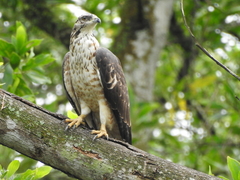
The crested honey buzzard (Pernis ptilorhynchus), also known as the Oriental, Asiatic, or Eastern honey buzzard, is a bird of prey in the family Accipitridae, which also includes many other diurnal raptors such as kites, eagles, and harriers. It is a fairly large raptor, larger than the European honey buzzard. The name honey buzzard is derived from their diets, which consist mainly of the larvae of bees and wasps extracted from honey combs. It is sexually dimorphic and has six subspecies.

Crested honey buzzards migrate for breeding to Siberia and Japan during the summer. They then spend the winter in Southeast Asia and the Indian subcontinent. They are also a year-round resident in these latter areas. They prefer well-forested areas with open spaces and are found from sea level up to 1,800 m (5,900 ft).

The species has several adaptations for its specialist diet. These include an elongated head for foraging on underground nests and a groove in the tongue for extracting wasp grubs from their comb cells. A mass of short, dense feathers on the head and neck protect against stinging attacks by social wasps. Juveniles may have adopted Batesian mimicry to deter predators.

The... Wikipedia →

Sounds

Call0:34

Singapore · 2022

© Ding Li Yong · XC763190 · CC BY-NC-ND 4.0

Begging call0:10

Singapore · 2020

© Hantuyk · XC554876 · CC BY-NC-SA 4.0

Call0:19

Taiwan · 2021

© Raptor Research Group of Taiwan · XC662669 · CC BY-NC-ND 4.0

Global Distribution

Parks Where Found

# Park Country Daily sighting probability
1 Gir National Park 🇮🇳 India
~50%
2 Royal Bardia National Park 🇳🇵 Nepal
~30%
3 Chitwan National Park 🇳🇵 Nepal
~30%
4 Manas National Park 🇮🇳 India
~30%
5 Khao Sok National Park 🇹🇭 Thailand
~30%
6 Bandhavgarh National Park 🇮🇳 India
~20%
7 Nagarhole National Park 🇮🇳 India
~20%
8 Kaeng Krachan National Park 🇹🇭 Thailand
~20%
9 Horton Plains National Park 🇱🇰 Sri Lanka
~20%
10 Periyar National Park 🇮🇳 India
~20%
11 Bandipur National Park 🇮🇳 India
~20%
12 Ranthambore National Park 🇮🇳 India
~20%
13 Kaziranga National Park 🇮🇳 India
~20%
14 Khao Luang National Park 🇹🇭 Thailand
~20%
15 Doi Inthanon National Park 🇹🇭 Thailand
~20%
16 Kanha National Park 🇮🇳 India
~20%
17 Satpura National Park 🇮🇳 India
~20%
18 Royal Manas National Park 🇧🇹 Bhutan
~20%
19 Khao Yai National Park 🇹🇭 Thailand
~20%
20 Mudumalai National Park 🇮🇳 India
~20%
21 Sundarbans National Park 🇮🇳 India
~10%
22 Sinharaja Forest Reserve 🇱🇰 Sri Lanka
~10%
23 Way Kambas National Park 🇮🇩 Indonesia
~10%
24 Jim Corbett National Park 🇮🇳 India
~10%
25 Udawalawe National Park 🇱🇰 Sri Lanka
~10%
26 Keoladeo National Park 🇮🇳 India
~10%
27 Yala National Park 🇱🇰 Sri Lanka
~10%
28 Danum Valley Conservation Area 🇲🇾 Malaysia
~10%
29 Bali Barat National Park 🇮🇩 Indonesia
~10%
30 Wilpattu National Park 🇱🇰 Sri Lanka
~10%
31 Namdapha National Park 🇮🇳 India
~10%
32 Cat Tien National Park 🇻🇳 Vietnam
~10%
33 Sepilok 🇲🇾 Malaysia
~10%
34 Taroko National Park 🇹🇼 Taiwan
~10%
35 Taman Negara National Park 🇲🇾 Malaysia
~10%
36 Kerinci Seblat National Park 🇮🇩 Indonesia
~10%
37 Minneriya National Park 🇱🇰 Sri Lanka
~10%
38 Kinabalu Park 🇲🇾 Malaysia
~10%
39 Cuc Phuong National Park 🇻🇳 Vietnam
<5%
40 Kinabatangan Wildlife Sanctuary 🇲🇾 Malaysia
<5%
41 Eravikulam National Park 🇮🇳 India
<5%
42 Gobi Gurvansaikhan National Park 🇲🇳 Mongolia
<5%
43 Gunung Leuser National Park 🇮🇩 Indonesia
<5%
44 Tangkoko Nature Reserve 🇮🇩 Indonesia
<5%

Cities Where Found

# City Country Daily sighting probability
1 Ludhiana 🇮🇳 India
~40%
2 Asansol 🇮🇳 India
~30%
3 Singapore 🇸🇬 Singapore
~20%
4 Berhampore 🇮🇳 India
~20%
5 Chhatrapati Sambhajinagar 🇮🇳 India
~20%
6 Savar 🇧🇩 Bangladesh
~20%
7 Nagpur 🇮🇳 India
~10%
8 Lucknow 🇮🇳 India
~10%
9 Colachel 🇮🇳 India
~10%
10 Kuching 🇲🇾 Malaysia
~10%

Zoos & Centres Where Found

# Zoo / Centre Country
1 Heinola bird sanctuary 🇫🇮 Finland In captivity
2 Taipei Zoo 🇹🇼 Taiwan In captivity
3 Shanghai Zoo 🇨🇳 China In captivity
4 Bandung Zoo 🇮🇩 Indonesia In captivity
5 Albay Park and Wildlife 🇵🇭 Philippines In captivity
6 Himeji City Zoo 🇯🇵 Japan In captivity
7 Bali Bird Park 🇮🇩 Indonesia In captivity
8 野森動物學校 🇹🇼 Taiwan In captivity

Before you go

What are the chances of seeing an Oriental Honey-buzzard in Thiruvananthapuram?

Rare

Under 5% of wildlife watchers report an Oriental Honey-buzzard sighting in Thiruvananthapuram on a given day, based on 18 verified sightings from GBIF citizen-science data. It is the 129th most-seen of the 174 birds we can rate there. Over three days the chance rises to under 5%, and over a week to about 10%, if each day is a fresh chance.

When is the best time to see an Oriental Honey-buzzard in Thiruvananthapuram?

Any time of year

In every month with enough records, under 5% of wildlife watchers report an Oriental Honey-buzzard in Thiruvananthapuram on a given day, so our monthly data shows no clear season.

What time of day is best to see an Oriental Honey-buzzard?

Between 4 and 7 am

Across all the parks we cover, that three-hour window holds the most Oriental Honey-buzzard sightings with a recorded time, and about half of them come between 6 am and 6 pm: it is most active around dawn and dusk.

Is Thiruvananthapuram the best place to see an Oriental Honey-buzzard?

65th of 82

Of the 82 cities where we can rate Oriental Honey-buzzard sightings, Thiruvananthapuram ranks 65th at under 5%. The best odds are in Ludhiana (India, about 40%), Asansol (India, about 30%) and Singapore (Singapore, about 20%).

Which relatives of the Oriental Honey-buzzard live in Thiruvananthapuram?

Same family: Accipitridae

The closest relatives of the Oriental Honey-buzzard that you can see in Thiruvananthapuram (family Accipitridae, Hawks, Eagles, and Kites) are Black Kite (about 80%), Brahminy Kite (about 80%) and Booted Eagle (about 10%), with each one's daily chance of a sighting.

Where does the Oriental Honey-buzzard sighting chance come from?

GBIF citizen-science records

It is estimated from how often the Oriental Honey-buzzard is recorded against all the birds logged in Thiruvananthapuram (18 verified sightings), calibrated against known sighting rates. Figures are rounded to the nearest 10% because citizen-science data supports honest approximations, not decimals, and months with records from fewer than five people show "—". How it works.

← Back to Thiruvananthapuram