White Hawk

White Hawk

Leucopternis albicollis

Silhouette: Sheatherius · PhyloPic

LCLeast ConcernNTVUENCR
Daily sighting probability <5% · Rare
at Coiba National Park

In 3 days ~10% in a week ~20%

6 Verified sightings at Coiba National Park From 2019 to 2026
5,124 In all 37 parks
March Best month
☀️ Diurnal When it's spotted

About the White Hawk

The white hawk (Pseudastur albicollis) is a bird of prey breeding in the tropical New World of the family Accipitridae. Though it is commonly placed in the subfamily Buteoninae, the validity of this group is doubtful and currently under review.

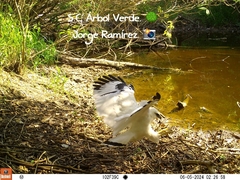
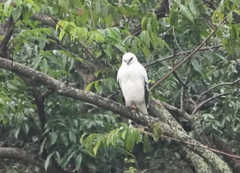
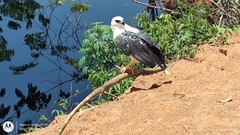
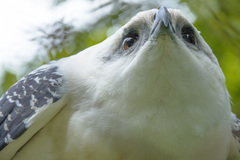
The adult white hawk ranges from 46–56 cm (18–22 in) long with very broad wings and has a white head, body and underwings. The upper wings are black, and the very short tail is black with a broad white band. The bill is black and the legs are yellow.

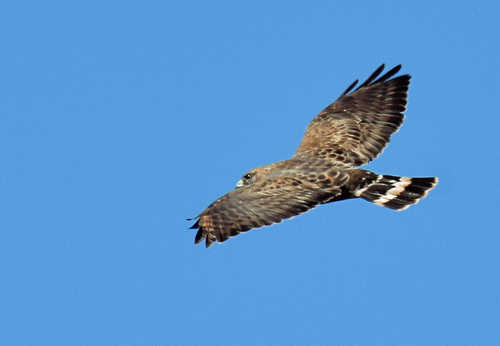
The sexes are similar, but females are larger and heavier—840 g (1.85 lb) compared to the male's 650 g (1.43 lb). Immature birds have extensive black spotting on the upperparts and dark-streaked whitish underparts. The call of the white hawk is a plaintive kerwee.

There are four subspecies: Pseudastur albicollis ghiesbreghti – Southern Mexico to Nicaragua Entirely white, except for black markings on the outer primaries, and a black sub-terminal tail bar. The eyes are yellow. Pseudastur albicollis costaricensis – Honduras to Panama and Colombia.

Similar to ghiesbreghti but with more distinct black markings on the wings and tail. The eyes are brown. Pseudastur albicollis... Wikipedia →

Sounds

Song1:00

Ecuador · 2025

© Marc Anderson · XC982142 · CC BY-NC-ND 4.0

Call0:42

Brazil · 2023

© JAYRSON ARAUJO DE OLIVEIRA · XC817271 · CC BY-NC-SA 4.0

Alarm call0:32

Peru · 2022

© Fabrice Schmitt · XC813713 · CC BY-NC-SA 4.0

Global Distribution

Parks Where Found

# Park Country Daily sighting probability
1 Brownsberg Nature Park 🇸🇷 Suriname
~30%
2 Darién National Park 🇵🇦 Panama
~20%
3 Tenorio Volcano National Park 🇨🇷 Costa Rica
~10%
4 Arenal Volcano National Park 🇨🇷 Costa Rica
~10%
5 Pico Bonito National Park 🇭🇳 Honduras
~10%
6 Cockscomb Basin Wildlife Sanctuary 🇧🇿 Belize
~10%
7 Cusuco National Park 🇭🇳 Honduras
~10%
8 Chagres National Park 🇵🇦 Panama
~10%
9 Corcovado National Park 🇨🇷 Costa Rica
~10%
10 Montes Azules Biosphere Reserve 🇲🇽 Mexico
~10%
11 Rincón de la Vieja National Park 🇨🇷 Costa Rica
~10%
12 Braulio Carrillo National Park 🇨🇷 Costa Rica
~10%
13 Poás Volcano National Park 🇨🇷 Costa Rica
<5%
14 Piedras Blancas National Park 🇨🇷 Costa Rica
<5%
15 El Triunfo 🇲🇽 Mexico
<5%
16 Coiba National Park 🇵🇦 Panama
<5%
17 Anavilhanas National Park 🇧🇷 Brazil
<5%
18 Chapada dos Guimarães National Park 🇧🇷 Brazil
<5%
19 Yasuní National Park 🇪🇨 Ecuador
<5%
20 Soberanía National Park 🇵🇦 Panama
<5%
21 Tikal National Park 🇬🇹 Guatemala
<5%
22 San Lorenzo Protected Forest 🇵🇦 Panama
<5%
23 Cahuita National Park 🇨🇷 Costa Rica
<5%
24 La Amistad International Park (Panama) 🇵🇦 Panama
<5%
25 Marino Ballena National Park 🇨🇷 Costa Rica
<5%
26 Tortuguero National Park 🇨🇷 Costa Rica
<5%
27 Sierra de la Macarena National Park 🇨🇴 Colombia
<5%
28 Monteverde Cloud Forest Reserve 🇨🇷 Costa Rica
<5%
29 Cuyabeno Wildlife Reserve 🇪🇨 Ecuador
<5%
30 Bastimentos Island National Marine Park 🇵🇦 Panama
<5%
31 Gandoca-Manzanillo Wildlife Refuge 🇨🇷 Costa Rica
<5%
32 Carara National Park 🇨🇷 Costa Rica
<5%
33 Cerro Azul Meámbar National Park 🇭🇳 Honduras
<5%
34 Manuel Antonio National Park 🇨🇷 Costa Rica
<5%
35 Manu National Park 🇵🇪 Peru
<5%
36 Podocarpus National Park 🇪🇨 Ecuador
<5%
37 Tapantí-Macizo de la Muerte National Park 🇨🇷 Costa Rica
<5%

Cities Where Found

# City Country Daily sighting probability
1 San José 🇨🇷 Costa Rica
<5%

Zoos & Centres Where Found

# Zoo / Centre Country
1 Zoo de Guyane 🇫🇷 France In captivity
2 Zoológico do CIGS 🇧🇷 Brazil In captivity
3 Zoológico Thomas Belt 🇳🇮 Nicaragua In captivity
4 El Nispero Zoo 🇵🇦 Panama In captivity
5 Zoo Criadero Tarqui 🇪🇨 Ecuador In captivity
6 Parque Cóndor 🇪🇨 Ecuador In captivity

Before you go

What are the chances of seeing a White Hawk in Coiba National Park?

Rare

Under 5% of wildlife watchers report a White Hawk sighting in Coiba National Park on a given day, based on 6 verified sightings from GBIF citizen-science data from 2019 to 2026. It is the 109th most-seen of the 118 birds we can rate there. Over three days the chance rises to about 10%, and over a week to about 20%, if each day is a fresh chance.

When is the best time to see a White Hawk in Coiba National Park?

February and March

In those months about 10% of wildlife watchers report a White Hawk in Coiba National Park on a given day, against under 5% in April, June–September and November–January, the lowest months. Those are among Coiba National Park's driest months, with about 45 mm of rain a month against 590 mm in November. May and October have too few records to rate.

What time of day is best to see a White Hawk?

Between 10 am and 1 pm

Across all the parks we cover, that three-hour window holds the most White Hawk sightings with a recorded time, and about 9 in 10 of them come between 6 am and 6 pm: it is a daytime animal.

Which relatives of the White Hawk live in Coiba National Park?

Same family: Accipitridae

The closest relatives of the White Hawk that you can see in Coiba National Park (family Accipitridae, Hawks, Eagles, and Kites) are Common Black-Hawk (about 50%) and Roadside Hawk (about 10%), with each one's daily chance of a sighting.

Where does the White Hawk sighting chance come from?

GBIF citizen-science records

It is estimated from how often the White Hawk is recorded against all the birds logged in Coiba National Park (6 verified sightings from 2019 to 2026), calibrated against known sighting rates. Figures are rounded to the nearest 10% because citizen-science data supports honest approximations, not decimals, and months with records from fewer than five people show "—". How it works.

← Back to Coiba National Park