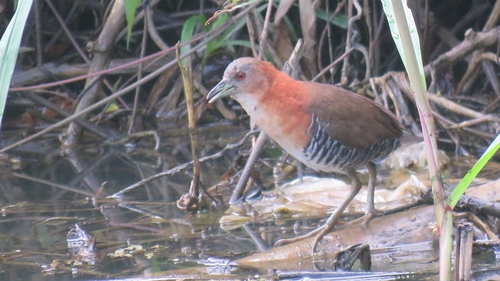
American Purple Gallinule

American Purple Gallinule

Porphyrio martinica

Silhouette: Sheatherius · PhyloPic

Daily sighting probability <5% · Rare
at Gandoca-Manzanillo Wildlife Refuge

In 3 days ~10% in a week ~20%

59 Verified sightings at Gandoca-Manzanillo Wildlife Refuge From 2019 to 2026
15,625 In all 47 parks
June Best month
☀️ Diurnal When it's spotted

About the American Purple Gallinule

The purple gallinule (Porphyrio martinica) is a species of swamphen found in the Americas. It is in the order Gruiformes, meaning "crane-like", an order which also contains cranes, rails, and crakes. The purple gallinule is a rail species, placing it into the family Rallidae. It is also known locally as the yellow-legged gallinule. The specific name martinica denotes "of Martinique".

The purple gallinule is a medium-sized rail, measuring 26–37 cm (10–15 in) in length, spanning 50–61 cm (20–24 in) across the wings and weighing 141–305 g (5.0–10.8 oz). Males, averaging 257 g (9.1 oz) in mass, are slightly larger than females, at 215 g (7.6 oz) on average. An adult purple gallinule has purple-blue plumage that will shine green and turquoise when in good lighting. Adults also have a pale blue shield on their forehead, which connects with the red and yellow bill. Darkness or low light can dim the bright purple-blue plumage of the adult to make them look dusky or brownish, although the forehead shield color differentiates them from similar species such as common gallinules. Immature purple gallinules are a brown-bronze color, with purple feathers on chest, and the bill and... Wikipedia →

Sounds

Call1:14

Brazil · 2026

© JAYRSON ARAUJO DE OLIVEIRA · XC1080165 · CC BY-NC-SA 4.0

Alarm call0:08

Costa Rica · 2022

© AUDEVARD Aurélien · XC1071737 · CC BY-NC-SA 4.0

Flight call0:08

Ecuador · 2003

© John V. Moore · XC257459 · CC BY-NC-SA 4.0

Global Distribution

Parks Where Found

# Park Country Daily sighting probability
1 Palo Verde National Park 🇨🇷 Costa Rica
~40%
2 Lago de Yojoa 🇭🇳 Honduras
~40%
3 Biotopo Cerro Cahuí 🇬🇹 Guatemala
~40%
4 Soberanía National Park 🇵🇦 Panama
~40%
5 Tortuguero National Park 🇨🇷 Costa Rica
~30%
6 Piedras Blancas National Park 🇨🇷 Costa Rica
~30%
7 Everglades National Park 🇺🇸 United States
~20%
8 Manu National Park 🇵🇪 Peru
~20%
9 Cerro Azul Meámbar National Park 🇭🇳 Honduras
~20%
10 Caroni Swamp 🇹🇹 Trinidad and Tobago
~20%
11 Manuel Antonio National Park 🇨🇷 Costa Rica
~10%
12 Carara National Park 🇨🇷 Costa Rica
~10%
13 Iberá National Park 🇦🇷 Argentina
~10%
14 La Amistad International Park (Panama) 🇵🇦 Panama
~10%
15 Bastimentos Island National Marine Park 🇵🇦 Panama
~10%
16 Tikal National Park 🇬🇹 Guatemala
~10%
17 Ciénaga de Zapata 🇨🇺 Cuba
~10%
18 Amacayacu National Natural Park 🇨🇴 Colombia
~10%
19 San Lorenzo Protected Forest 🇵🇦 Panama
~10%
20 Braulio Carrillo National Park 🇨🇷 Costa Rica
~10%
21 Marino Ballena National Park 🇨🇷 Costa Rica
<5%
22 Big Cypress National Preserve 🇺🇸 United States
<5%
23 Chapada Diamantina National Park 🇧🇷 Brazil
<5%
24 Santa Rosa National Park 🇨🇷 Costa Rica
<5%
25 Gandoca-Manzanillo Wildlife Refuge 🇨🇷 Costa Rica
<5%
26 Parque Estadual Encontro das Águas 🇧🇷 Brazil
<5%
27 Celaque National Park 🇭🇳 Honduras
<5%
28 Galápagos Islands 🇪🇨 Ecuador
<5%
29 Los Haitises National Park 🇩🇴 Dominican Republic
<5%
30 Calakmul Biosphere Reserve 🇲🇽 Mexico
<5%
31 Main Ridge Forest Reserve 🇹🇹 Trinidad and Tobago
<5%
32 Corcovado National Park 🇨🇷 Costa Rica
<5%
33 Arrecifes de Cozumel National Park 🇲🇽 Mexico
<5%
34 Iguaçu National Park 🇧🇷 Brazil
<5%
35 Merritt Island National Wildlife Refuge 🇺🇸 United States
<5%
36 Chagres National Park 🇵🇦 Panama
<5%
37 Sierra de la Macarena National Park 🇨🇴 Colombia
<5%
38 Arenal Volcano National Park 🇨🇷 Costa Rica
<5%
39 Yasuní National Park 🇪🇨 Ecuador
<5%
40 Iguazú National Park 🇦🇷 Argentina
<5%
41 Ría Lagartos Biosphere Reserve 🇲🇽 Mexico
<5%
42 Las Baulas Marine National Park 🇨🇷 Costa Rica
<5%
43 Sian Ka'an Biosphere Reserve 🇲🇽 Mexico
<5%
44 Tambopata National Reserve 🇵🇪 Peru
<5%
45 Parque Natural Metropolitano 🇵🇦 Panama
<5%
46 Tenorio Volcano National Park 🇨🇷 Costa Rica
<5%
47 Table Mountain National Park 🇿🇦 South Africa
<5%

Cities Where Found

# City Country Daily sighting probability
1 Bogota 🇨🇴 Colombia
~30%
2 Fortaleza 🇧🇷 Brazil
~20%
3 Recife 🇧🇷 Brazil
~20%
4 Barranquilla 🇨🇴 Colombia
~20%
5 Santa Cruz de la Sierra 🇧🇴 Bolivia
~20%
6 Miami 🇺🇸 United States
~10%
7 San Pedro Sula 🇭🇳 Honduras
~10%
8 Maracaibo 🇻🇪 Venezuela
<5%
9 Panama City 🇵🇦 Panama
<5%
10 João Pessoa 🇧🇷 Brazil
<5%

Zoos & Centres Where Found

# Zoo / Centre Country
1 Parque das Aves 🇧🇷 Brazil In captivity
2 Toronto Zoo 🇨🇦 Canada In captivity
3 Phoenix Zoo 🇺🇸 United States In captivity
4 Aviario Nacional de Colombia 🇨🇴 Colombia In captivity
5 Mangal das Garças 🇧🇷 Brazil In captivity
6 Parque Zoológico Miguel Ángel de Quevedo 🇲🇽 Mexico In captivity
7 Parque Zoobotânico Orquidário Municipal de Santos 🇧🇷 Brazil In captivity
8 Parque museo La Venta 🇲🇽 Mexico In captivity
9 Wiwa Quito 🇪🇨 Ecuador In captivity

Before you go

What are the chances of seeing an American Purple Gallinule in Gandoca-Manzanillo Wildlife Refuge?

Rare

Under 5% of wildlife watchers report an American Purple Gallinule sighting in Gandoca-Manzanillo Wildlife Refuge on a given day, based on 59 verified sightings from GBIF citizen-science data from 2019 to 2026. It is the 203rd most-seen of the 329 birds we can rate there. Over three days the chance rises to about 10%, and over a week to about 20%, if each day is a fresh chance.

When is the best time to see an American Purple Gallinule in Gandoca-Manzanillo Wildlife Refuge?

June

In that month about 20% of wildlife watchers report an American Purple Gallinule in Gandoca-Manzanillo Wildlife Refuge on a given day, against under 5% in August and October–April, the lowest months.

What time of day is best to see an American Purple Gallinule?

Between 8 and 11 am

Across all the parks we cover, that three-hour window holds the most American Purple Gallinule sightings with a recorded time, and about 9 in 10 of them come between 6 am and 6 pm: it is a daytime animal.

Is Gandoca-Manzanillo Wildlife Refuge the best place to see an American Purple Gallinule?

25th of 47

Of the 47 parks where we can rate American Purple Gallinule sightings, Gandoca-Manzanillo Wildlife Refuge ranks 25th at under 5%. The best odds are in Palo Verde National Park (Costa Rica, about 40%), Lago de Yojoa (Honduras, about 40%) and Biotopo Cerro Cahuí (Guatemala, about 40%). All parks ranked.

Which relatives of the American Purple Gallinule live in Gandoca-Manzanillo Wildlife Refuge?

Same family: Rallidae

The closest relatives of the American Purple Gallinule that you can see in Gandoca-Manzanillo Wildlife Refuge (family Rallidae, Rails, Gallinules, and Coots) are Gray-cowled Wood-Rail (about 10%) and White-throated Crake (about 10%), with each one's daily chance of a sighting.

Where does the American Purple Gallinule sighting chance come from?

GBIF citizen-science records

It is estimated from how often the American Purple Gallinule is recorded against all the birds logged in Gandoca-Manzanillo Wildlife Refuge (59 verified sightings from 2019 to 2026), calibrated against known sighting rates. Figures are rounded to the nearest 10% because citizen-science data supports honest approximations, not decimals, and months with records from fewer than five people show "—". How it works.

← Back to Gandoca-Manzanillo Wildlife Refuge