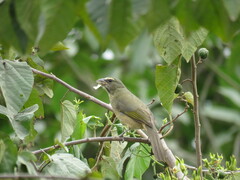
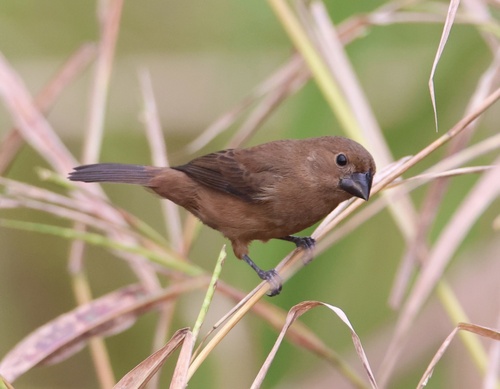
Cinnamon-bellied Saltator

Cinnamon-bellied Saltator

Saltator grandis

Silhouette: Sheatherius · PhyloPic

LCLeast ConcernNTVUENCR
Daily sighting probability ~10% · With luck
at Gandoca-Manzanillo Wildlife Refuge

In 3 days ~20% in a week ~40%

102 Verified sightings at Gandoca-Manzanillo Wildlife Refuge From 2019 to 2026
9,616 In all 36 parks
June Best month
☀️ Diurnal When it's spotted

About the Cinnamon-bellied Saltator

The cinnamon-bellied saltator (Saltator grandis) is a passerine bird in the family Thraupidae, the tanagers and allies. It is found from Mexico to Panama. The cinnamon-bellied saltator has a complicated taxonomic history. It was formally described in 1830 with the binomial Tanagra grandis. By 1938 it had been reassigned to its present genus Saltator. In that year Carl Eduard Hellmayr merged what are now the cinnamon-bellied saltator and many other species and subspecies into S. coerulescens under the English name grey saltator. At the time the genus Saltator was in the subfamily Richmondeninae, the cardinals, within the very large family Fringillidae. By the late twentieth century the cardinals, with Saltator, had been split as the family Cardinalidae. In the mid-2010s taxonomic systems began to move Saltator to its present tanager family Thraupidae. And in the early 2020s systems began splitting S. coerulescens into the cinnamon-bellied, olive-grey (S. olivascens), and bluish-grey (S. coerulescens sensu stricto) saltators.

The cinnamon-bellied saltator has these six subspecies: The cinnamon-bellied saltator is 22 to 24 cm (8.7 to 9.4... Wikipedia →

Sounds

Song0:53

Mexico · 2022

© Manuel Grosselet · XC742587 · CC BY-NC-SA 4.0

Call0:40

Mexico · 2020

© Isain Contreras Rodríguez · XC567776 · CC BY-NC-SA 4.0

Duet1:14

Mexico · 2019

© Richard E. Webster · XC500330 · CC BY-NC-SA 4.0

Global Distribution

Parks Where Found

# Park Country Daily sighting probability
1 Masaya Volcano National Park 🇳🇮 Nicaragua
~80%
2 Sian Ka'an Biosphere Reserve 🇲🇽 Mexico
~40%
3 Cerro Azul Meámbar National Park 🇭🇳 Honduras
~30%
4 Lago de Yojoa 🇭🇳 Honduras
~20%
5 El Triunfo 🇲🇽 Mexico
~20%
6 Montes Azules Biosphere Reserve 🇲🇽 Mexico
~20%
7 La Tigra National Park 🇭🇳 Honduras
~20%
8 Celaque National Park 🇭🇳 Honduras
~20%
9 Celestún Biosphere Reserve 🇲🇽 Mexico
~10%
10 Arenal Volcano National Park 🇨🇷 Costa Rica
~10%
11 Cockscomb Basin Wildlife Sanctuary 🇧🇿 Belize
~10%
12 Calakmul Biosphere Reserve 🇲🇽 Mexico
~10%
13 Bastimentos Island National Marine Park 🇵🇦 Panama
~10%
14 Poás Volcano National Park 🇨🇷 Costa Rica
~10%
15 Braulio Carrillo National Park 🇨🇷 Costa Rica
~10%
16 Gandoca-Manzanillo Wildlife Refuge 🇨🇷 Costa Rica
~10%
17 La Amistad International Park (Panama) 🇵🇦 Panama
~10%
18 Monteverde Cloud Forest Reserve 🇨🇷 Costa Rica
~10%
19 Cahuita National Park 🇨🇷 Costa Rica
~10%
20 Cañón del Sumidero National Park 🇲🇽 Mexico
<5%
21 Tenorio Volcano National Park 🇨🇷 Costa Rica
<5%
22 Rincón de la Vieja National Park 🇨🇷 Costa Rica
<5%
23 Tortuguero National Park 🇨🇷 Costa Rica
<5%
24 Biotopo Cerro Cahuí 🇬🇹 Guatemala
<5%
25 Carara National Park 🇨🇷 Costa Rica
<5%
26 Cabo Blanco Absolute Nature Reserve 🇨🇷 Costa Rica
<5%
27 Tapantí-Macizo de la Muerte National Park 🇨🇷 Costa Rica
<5%
28 Pico Bonito National Park 🇭🇳 Honduras
<5%
29 Marino Ballena National Park 🇨🇷 Costa Rica
<5%
30 Cusuco National Park 🇭🇳 Honduras
<5%
31 Las Baulas Marine National Park 🇨🇷 Costa Rica
<5%
32 Chirripó National Park 🇨🇷 Costa Rica
<5%
33 Manuel Antonio National Park 🇨🇷 Costa Rica
<5%
34 Palo Verde National Park 🇨🇷 Costa Rica
<5%
35 Tikal National Park 🇬🇹 Guatemala
<5%
36 Los Quetzales National Park 🇨🇷 Costa Rica
<5%

Cities Where Found

# City Country Daily sighting probability
1 Managua 🇳🇮 Nicaragua
~70%
2 San Salvador 🇸🇻 El Salvador
~60%
3 Tegucigalpa 🇭🇳 Honduras
~60%
4 Guatemala City 🇬🇹 Guatemala
~50%
5 San José 🇨🇷 Costa Rica
~50%
6 San Pedro Sula 🇭🇳 Honduras
~30%

Before you go

What are the chances of seeing a Cinnamon-bellied Saltator in Gandoca-Manzanillo Wildlife Refuge?

With luck

About 10% of wildlife watchers report a Cinnamon-bellied Saltator sighting in Gandoca-Manzanillo Wildlife Refuge on a given day, based on 102 verified sightings from GBIF citizen-science data from 2019 to 2026. It is the 146th most-seen of the 329 birds we can rate there. Over three days the chance rises to about 20%, and over a week to about 40%, if each day is a fresh chance.

When is the best time to see a Cinnamon-bellied Saltator in Gandoca-Manzanillo Wildlife Refuge?

June

In that month about 20% of wildlife watchers report a Cinnamon-bellied Saltator in Gandoca-Manzanillo Wildlife Refuge on a given day, against under 5% in February–March, October and December, the lowest months.

What time of day is best to see a Cinnamon-bellied Saltator?

Between 7 and 10 am

Across all the parks we cover, that three-hour window holds the most Cinnamon-bellied Saltator sightings with a recorded time, and about 9 in 10 of them come between 6 am and 6 pm: it is a daytime animal.

Where does the Cinnamon-bellied Saltator sighting chance come from?

GBIF citizen-science records

It is estimated from how often the Cinnamon-bellied Saltator is recorded against all the birds logged in Gandoca-Manzanillo Wildlife Refuge (102 verified sightings from 2019 to 2026), calibrated against known sighting rates. Figures are rounded to the nearest 10% because citizen-science data supports honest approximations, not decimals, and months with records from fewer than five people show "—". How it works.

← Back to Gandoca-Manzanillo Wildlife Refuge