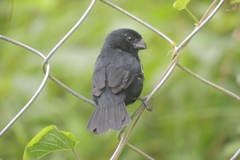
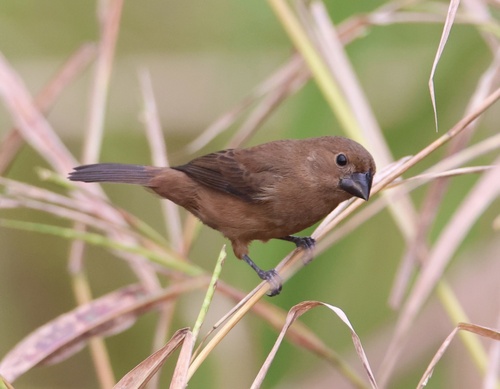
Variable Seedeater

Variable Seedeater

Sporophila corvina

Silhouette: Sheatherius · PhyloPic

LCLeast ConcernNTVUENCR
Daily sighting probability ~40% · Likely
at Gandoca-Manzanillo Wildlife Refuge

In 3 days ~80% in a week >90%

768 Verified sightings at Gandoca-Manzanillo Wildlife Refuge From 2019 to 2026
35,769 In all 38 parks
July Best month
☀️ Diurnal When it's spotted

About the Variable Seedeater

The variable seedeater (Sporophila corvina) is a passerine bird which breeds from southern Mexico through Central America to the Chocó of northwestern South America. The taxonomy is confusing, and it was formerly considered a subspecies of Sporophila americana (see Taxonomy). Even within the variable seedeater as presently defined, there are great variations in plumage.

The variable seedeater is a small, robust bird with a black conical bill. It is 10.5 cm (4.1 in) long and weighs 11 g (0.39 oz). Adult males are entirely black apart from a small white wing-speculum and white wing linings.

Males resemble males S. c. corvina, but with white half-collar, rump and belly (the rump often intermixed with grey and the flanks retain some black mottling or barring). Males resemble S. c... Wikipedia →

Sounds

Call0:30

Ecuador · 2025

© Charlie Vogt · XC1039474 · CC BY-NC-SA 4.0

Song0:20

Ecuador · 2020

© Manuel Sanchez-Nivicela · XC951700 · CC BY-NC-ND 4.0

Begging call0:15

Ecuador · 1996

© Olaf Jahn · XC262688 · CC BY-NC-SA 4.0

Global Distribution

Parks Where Found

# Park Country Daily sighting probability
1 Piedras Blancas National Park 🇨🇷 Costa Rica
~60%
2 Chagres National Park 🇵🇦 Panama
~50%
3 Bastimentos Island National Marine Park 🇵🇦 Panama
~50%
4 Arenal Volcano National Park 🇨🇷 Costa Rica
~50%
5 Gandoca-Manzanillo Wildlife Refuge 🇨🇷 Costa Rica
~40%
6 Tenorio Volcano National Park 🇨🇷 Costa Rica
~40%
7 Soberanía National Park 🇵🇦 Panama
~40%
8 Parque Natural Metropolitano 🇵🇦 Panama
~40%
9 Braulio Carrillo National Park 🇨🇷 Costa Rica
~40%
10 La Amistad International Park (Panama) 🇵🇦 Panama
~30%
11 Tortuguero National Park 🇨🇷 Costa Rica
~30%
12 Cahuita National Park 🇨🇷 Costa Rica
~30%
13 Machalilla National Park 🇪🇨 Ecuador
~30%
14 Carara National Park 🇨🇷 Costa Rica
~20%
15 Marino Ballena National Park 🇨🇷 Costa Rica
~20%
16 Chirripó National Park 🇨🇷 Costa Rica
~20%
17 San Lorenzo Protected Forest 🇵🇦 Panama
~20%
18 Corcovado National Park 🇨🇷 Costa Rica
~20%
19 Montes Azules Biosphere Reserve 🇲🇽 Mexico
~20%
20 Cockscomb Basin Wildlife Sanctuary 🇧🇿 Belize
~20%
21 Darién National Park 🇵🇦 Panama
~10%
22 Tapantí-Macizo de la Muerte National Park 🇨🇷 Costa Rica
~10%
23 Utría National Natural Park 🇨🇴 Colombia
~10%
24 Manuel Antonio National Park 🇨🇷 Costa Rica
~10%
25 Volcán Barú National Park 🇵🇦 Panama
~10%
26 Cerro Azul Meámbar National Park 🇭🇳 Honduras
~10%
27 Cusuco National Park 🇭🇳 Honduras
~10%
28 Rincón de la Vieja National Park 🇨🇷 Costa Rica
~10%
29 Coiba National Park 🇵🇦 Panama
~10%
30 Lago de Yojoa 🇭🇳 Honduras
~10%
31 Poás Volcano National Park 🇨🇷 Costa Rica
<5%
32 Farallones de Cali National Natural Park 🇨🇴 Colombia
<5%
33 Monteverde Cloud Forest Reserve 🇨🇷 Costa Rica
<5%
34 Palo Verde National Park 🇨🇷 Costa Rica
<5%
35 Pico Bonito National Park 🇭🇳 Honduras
<5%
36 Cabo Blanco Absolute Nature Reserve 🇨🇷 Costa Rica
<5%
37 Tikal National Park 🇬🇹 Guatemala
<5%
38 Los Quetzales National Park 🇨🇷 Costa Rica
<5%

Cities Where Found

# City Country Daily sighting probability
1 Panama City 🇵🇦 Panama
~30%
2 Guayaquil 🇪🇨 Ecuador
~20%
3 San Pedro Sula 🇭🇳 Honduras
<5%
4 San José 🇨🇷 Costa Rica
<5%

Before you go

What are the chances of seeing a Variable Seedeater in Gandoca-Manzanillo Wildlife Refuge?

Likely

About 40% of wildlife watchers report a Variable Seedeater sighting in Gandoca-Manzanillo Wildlife Refuge on a given day, based on 768 verified sightings from GBIF citizen-science data from 2019 to 2026. It is the 17th most-seen of the 329 birds we can rate there. Over three days the chance rises to about 80%, and over a week to over 90%, if each day is a fresh chance.

When is the best time to see a Variable Seedeater in Gandoca-Manzanillo Wildlife Refuge?

February, May, July and September

In those months about 50% of wildlife watchers report a Variable Seedeater in Gandoca-Manzanillo Wildlife Refuge on a given day, against about 20% in December, the lowest month.

What time of day is best to see a Variable Seedeater?

Between 8 and 11 am

Across all the parks we cover, that three-hour window holds the most Variable Seedeater sightings with a recorded time, and about 9 in 10 of them come between 6 am and 6 pm: it is a daytime animal.

Which relatives of the Variable Seedeater live in Gandoca-Manzanillo Wildlife Refuge?

Same genus: Sporophila

The closest relatives of the Variable Seedeater that you can see in Gandoca-Manzanillo Wildlife Refuge (genus Sporophila, Typical Seedeaters and Seed-Finches) are Thick-billed Seed-Finch (about 10%) and Morelet's Seedeater (about 10%), with each one's daily chance of a sighting.

Where does the Variable Seedeater sighting chance come from?

GBIF citizen-science records

It is estimated from how often the Variable Seedeater is recorded against all the birds logged in Gandoca-Manzanillo Wildlife Refuge (768 verified sightings from 2019 to 2026), calibrated against known sighting rates. Figures are rounded to the nearest 10% because citizen-science data supports honest approximations, not decimals, and months with records from fewer than five people show "—". How it works.

← Back to Gandoca-Manzanillo Wildlife Refuge