Magnolia Warbler

Magnolia Warbler

Setophaga magnolia

Silhouette: Dylan GE Gomes · PhyloPic

LCLeast ConcernNTVUENCR
Daily sighting probability ~30% · Possible
at Montes Azules Biosphere Reserve

In 3 days ~70% in a week ~90%

115 Verified sightings at Montes Azules Biosphere Reserve From 2019 to 2026
19,396 In all 49 parks
January Best month
☀️ Diurnal When it's spotted

About the Magnolia Warbler

The magnolia warbler (Setophaga magnolia) is a member of the wood warbler family Parulidae. The genus name Setophaga is from Ancient Greek ses, "moth", and phagos, "eating", and the specific magnolia refers to the type locality. American ornithologist Alexander Wilson found this species in magnolias near Fort Adams, Mississippi.

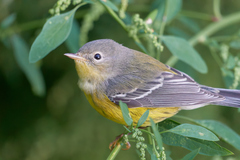
This species is a moderately small New World warbler. It measures 11 to 13 cm (4.3 to 5.1 in) in length and spans 16 to 20 cm (6.3 to 7.9 in) across the wings. Body mass in adult birds can range from 6.6 to 12.6 g (0.23 to 0.44 oz), though weights have reportedly ranged up to 15 g (0.53 oz) prior to migration. Among standard measurements, the wing chord is 5.4 to 6.4 cm (2.1 to 2.5 in), the tail is 4.6 to 5.2 cm (1.8 to 2.0 in), the bill is 0.8 to 1 cm (0.31 to 0.39 in) and the tarsus is 1.7 to 1.85 cm (0.67 to 0.73 in). The magnolia warbler can be distinguished by its coloration. The breeding males often have white, gray, and black backs with yellow on the sides; yellow and black-striped stomachs; white, gray, and black foreheads and beaks; distinct black tails with white stripes on the underside; and defined white patches... Wikipedia →

Sounds

Call0:49

United States · 2026

© Valerie Heemstra · XC1175432 · CC BY-NC-SA 4.0

Song1:05

United States · 2026

© Scott Olmstead · XC1141306 · CC BY-NC-SA 4.0

Aberrant0:42

United States · 2023

© Brian Henderson · XC893267 · CC BY-NC-SA 4.0

Global Distribution

Parks Where Found

# Park Country Daily sighting probability
1 Cañón del Sumidero National Park 🇲🇽 Mexico
~60%
2 Tikal National Park 🇬🇹 Guatemala
~60%
3 Calakmul Biosphere Reserve 🇲🇽 Mexico
~60%
4 Gros Morne National Park 🇨🇦 Canada
~50%
5 Biotopo Cerro Cahuí 🇬🇹 Guatemala
~40%
6 Arrecifes de Cozumel National Park 🇲🇽 Mexico
~40%
7 Point Pelee National Park 🇨🇦 Canada
~40%
8 Sian Ka'an Biosphere Reserve 🇲🇽 Mexico
~40%
9 Pico Bonito National Park 🇭🇳 Honduras
~40%
10 Isle Royale National Park 🇺🇸 United States
~40%
11 Cockscomb Basin Wildlife Sanctuary 🇧🇿 Belize
~40%
12 Cerro Azul Meámbar National Park 🇭🇳 Honduras
~40%
13 Montes Azules Biosphere Reserve 🇲🇽 Mexico
~30%
14 Cusuco National Park 🇭🇳 Honduras
~30%
15 Lago de Yojoa 🇭🇳 Honduras
~30%
16 Cape Breton Highlands National Park 🇨🇦 Canada
~30%
17 El Triunfo 🇲🇽 Mexico
~20%
18 Celestún Biosphere Reserve 🇲🇽 Mexico
~20%
19 Riding Mountain National Park 🇨🇦 Canada
~20%
20 Celaque National Park 🇭🇳 Honduras
~20%
21 Acadia National Park 🇺🇸 United States
~10%
22 Voyageurs National Park 🇺🇸 United States
~10%
23 Ría Lagartos Biosphere Reserve 🇲🇽 Mexico
~10%
24 La Tigra National Park 🇭🇳 Honduras
<5%
25 Ciénaga de Zapata 🇨🇺 Cuba
<5%
26 Soberanía National Park 🇵🇦 Panama
<5%
27 Everglades National Park 🇺🇸 United States
<5%
28 Chagres National Park 🇵🇦 Panama
<5%
29 Jasper National Park 🇨🇦 Canada
<5%
30 Great Smoky Mountains National Park 🇺🇸 United States
<5%
31 Big Cypress National Preserve 🇺🇸 United States
<5%
32 Shenandoah National Park 🇺🇸 United States
<5%
33 Congaree National Park 🇺🇸 United States
<5%
34 Blue and John Crow Mountains National Park 🇯🇲 Jamaica
<5%
35 Parque Natural Metropolitano 🇵🇦 Panama
<5%
36 Elk Island National Park 🇨🇦 Canada
<5%
37 Rincón de la Vieja National Park 🇨🇷 Costa Rica
<5%
38 Tortuguero National Park 🇨🇷 Costa Rica
<5%
39 Banff National Park 🇨🇦 Canada
<5%
40 Bastimentos Island National Marine Park 🇵🇦 Panama
<5%
41 Cahuita National Park 🇨🇷 Costa Rica
<5%
42 Gandoca-Manzanillo Wildlife Refuge 🇨🇷 Costa Rica
<5%
43 Tenorio Volcano National Park 🇨🇷 Costa Rica
<5%
44 Merritt Island National Wildlife Refuge 🇺🇸 United States
<5%
45 La Amistad International Park (Panama) 🇵🇦 Panama
<5%
46 Tayrona National Natural Park 🇨🇴 Colombia
<5%
47 Monteverde Cloud Forest Reserve 🇨🇷 Costa Rica
<5%
48 Arenal Volcano National Park 🇨🇷 Costa Rica
<5%
49 Carara National Park 🇨🇷 Costa Rica
<5%

Cities Where Found

# City Country Daily sighting probability
1 San Pedro Sula 🇭🇳 Honduras
~10%
2 Chicago 🇺🇸 United States
~10%
3 New York City 🇺🇸 United States
~10%
4 Detroit 🇺🇸 United States
~10%
5 Baltimore 🇺🇸 United States
~10%
6 Havana 🇨🇺 Cuba
~10%
7 Toronto 🇨🇦 Canada
~10%
8 Montreal 🇨🇦 Canada
~10%
9 Minneapolis [Saint Paul] 🇺🇸 United States
~10%
10 Philadelphia 🇺🇸 United States
~10%

Zoos & Centres Where Found

# Zoo / Centre Country
1 National Zoological Park 🇺🇸 United States In captivity
2 Xcaret 🇲🇽 Mexico In captivity
3 Ralph Perkins II Wildlife Center and Woods Garden 🇺🇸 United States In captivity

Before you go

What are the chances of seeing a Magnolia Warbler in Montes Azules Biosphere Reserve?

Possible

About 30% of wildlife watchers report a Magnolia Warbler sighting in Montes Azules Biosphere Reserve on a given day, based on 115 verified sightings from GBIF citizen-science data from 2019 to 2026. It is the 27th most-seen of the 240 birds we can rate there. Over three days the chance rises to about 70%, and over a week to about 90%, if each day is a fresh chance.

When is the best time to see a Magnolia Warbler in Montes Azules Biosphere Reserve?

January

In that month about 70% of wildlife watchers report a Magnolia Warbler in Montes Azules Biosphere Reserve on a given day, against about 10% in June to August, the lowest months. That is one of Montes Azules Biosphere Reserve's driest months, with about 80 mm of rain against 370 mm in June.

What time of day is best to see a Magnolia Warbler?

Between 8 and 11 am

Across all the parks we cover, that three-hour window holds the most Magnolia Warbler sightings with a recorded time, and about 9 in 10 of them come between 6 am and 6 pm: it is a daytime animal.

Which relatives of the Magnolia Warbler live in Montes Azules Biosphere Reserve?

Same genus: Setophaga

The closest relatives of the Magnolia Warbler that you can see in Montes Azules Biosphere Reserve (genus Setophaga, Setophaga Warblers) are American Redstart (about 30%), Northern Yellow Warbler (about 30%) and Hooded Warbler (about 20%), with each one's daily chance of a sighting.

Where does the Magnolia Warbler sighting chance come from?

GBIF citizen-science records

It is estimated from how often the Magnolia Warbler is recorded against all the birds logged in Montes Azules Biosphere Reserve (115 verified sightings from 2019 to 2026), calibrated against known sighting rates. Figures are rounded to the nearest 10% because citizen-science data supports honest approximations, not decimals, and months with records from fewer than five people show "—". How it works.

← Back to Montes Azules Biosphere Reserve