Eurasian Tree Sparrow

Eurasian Tree Sparrow

Passer montanus

Silhouette: Laitche · PhyloPic

LCLeast ConcernNTVUENCR
Daily sighting probability ~50% · Likely
at Semarang

In 3 days ~90% in a week >90%

32 Verified sightings at Semarang
10,239 In all 51 parks From 2019 to 2026
July Best month
☀️ Diurnal When it's spotted

About the Eurasian Tree Sparrow

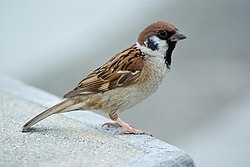
The tree sparrow (Passer montanus Latin pronunciation: [pas.ser mon.ta.nus]) is a passerine bird in the sparrow family with a rich chestnut crown and nape and a black patch on each pure white cheek. The sexes have similar plumage, and young birds are duller versions of the adult. This sparrow breeds across much of temperate Eurasia and Southeast Asia and has been introduced elsewhere, including the United States, where it is known as the Eurasian tree sparrow or German sparrow to differentiate it from the native American tree sparrow. Although several subspecies are recognised, the appearance of this bird varies little across its extensive range.

The untidy nest of the tree sparrow is built in a natural cavity, a hole in a building, or the disused nest of a European magpie or white stork. The typical clutch is five or six eggs, which hatch in under two weeks. This sparrow mainly feeds on seeds, but also consumes invertebrates, particularly during the breeding season. As with other small birds, infection by parasites and diseases, as well as predation by birds of prey, take their toll, and the typical lifespan is about two years.

The tree sparrow is widespread in the towns and cities of eastern Asia, but in Europe, it inhabits lightly wooded open countryside, while the house sparrow breeds in more urban areas. The tree sparrow's extensive range and large population mean it is not globally endangered, although there have been significant population declines in Western Europe, partly due to changes in farming practices involving increased use of herbicides and the loss of winter stubble fields. In eastern Asia and western Australia, this species is sometimes considered a pest, though it is also widely celebrated in oriental art. Wikipedia →

Sounds

Call0:19

France · 2026

© Thierry THOMAS · XC1186021 · CC BY-NC-SA 4.0

Song1:11

Mongolia · 2025

© Richard E. Webster · XC1027898 · CC BY-NC-SA 4.0

Alarm call0:57

China · 2012

© Geoff Carey · XC899193 · CC BY-NC-SA 4.0

Global Distribution

Parks Where Found

# Park Country Daily sighting probability
1 Gauja National Park 🇱🇻 Latvia
~70%
2 Hortobágy National Park 🇭🇺 Hungary
~70%
3 Kiskunság National Park 🇭🇺 Hungary
~60%
4 Fertő-Hanság National Park 🇭🇺 Hungary
~50%
5 Bako National Park 🇲🇾 Malaysia
~40%
6 Biebrza National Park 🇵🇱 Poland
~40%
7 Sepilok 🇲🇾 Malaysia
~40%
8 Bali Barat National Park 🇮🇩 Indonesia
~40%
9 Gobi Gurvansaikhan National Park 🇲🇳 Mongolia
~30%
10 Tangkoko Nature Reserve 🇮🇩 Indonesia
~30%
11 Way Kambas National Park 🇮🇩 Indonesia
~20%
12 Gunung Leuser National Park 🇮🇩 Indonesia
~20%
13 Doi Inthanon National Park 🇹🇭 Thailand
~20%
14 Bavarian Forest National Park 🇩🇪 Germany
~20%
15 Nikko National Park 🇯🇵 Japan
~20%
16 Kinabalu Park 🇲🇾 Malaysia
~20%
17 Białowieża National Park 🇵🇱 Poland
~20%
18 Komodo National Park 🇮🇩 Indonesia
~20%
19 Royal Manas National Park 🇧🇹 Bhutan
~20%
20 Hohe Tauern National Park 🇦🇹 Austria
~20%
21 Kinabatangan Wildlife Sanctuary 🇲🇾 Malaysia
~10%
22 Raja Ampat 🇮🇩 Indonesia
~10%
23 Langtang National Park 🇳🇵 Nepal
~10%
24 Kaziranga National Park 🇮🇳 India
~10%
25 Khao Luang National Park 🇹🇭 Thailand
~10%
26 Taman Negara National Park 🇲🇾 Malaysia
~10%
27 Taroko National Park 🇹🇼 Taiwan
~10%
28 Doñana National Park 🇪🇸 Spain
~10%
29 Triglav National Park 🇸🇮 Slovenia
~10%
30 Sierra de Guadarrama National Park 🇪🇸 Spain
~10%
31 Manas National Park 🇮🇳 India
~10%
32 Camargue 🇫🇷 France
~10%
33 Wadden Sea National Park 🇩🇪 Germany
~10%
34 Khao Sok National Park 🇹🇭 Thailand
~10%
35 Tatra National Park 🇸🇰 Slovakia
~10%
36 Kerinci Seblat National Park 🇮🇩 Indonesia
<5%
37 Jiuzhaigou National Park 🇨🇳 China
<5%
38 Cuc Phuong National Park 🇻🇳 Vietnam
<5%
39 Cat Tien National Park 🇻🇳 Vietnam
<5%
40 Danum Valley Conservation Area 🇲🇾 Malaysia
<5%
41 Pyrénées National Park 🇫🇷 France
<5%
42 Khao Yai National Park 🇹🇭 Thailand
<5%
43 Plitvice Lakes National Park 🇭🇷 Croatia
<5%
44 Chitwan National Park 🇳🇵 Nepal
<5%
45 Aigüestortes National Park 🇪🇸 Spain
<5%
46 Sierra Nevada National Park 🇪🇸 Spain
<5%
47 Royal Bardia National Park 🇳🇵 Nepal
<5%
48 Namdapha National Park 🇮🇳 India
<5%
49 Cairngorms National Park 🇬🇧 United Kingdom
<5%
50 Kaeng Krachan National Park 🇹🇭 Thailand
<5%
51 Monfragüe National Park 🇪🇸 Spain
<5%

Cities Where Found

# City Country Daily sighting probability
1 Shijiazhuang 🇨🇳 China
>90%
2 Tianjin 🇨🇳 China
~90%
3 Davao City 🇵🇭 Philippines
~90%
4 Ulaanbaatar 🇲🇳 Mongolia
~90%
5 Đà Nẵng 🇻🇳 Vietnam
~90%
6 Phnom Penh 🇰🇭 Cambodia
~90%
7 Tainan 🇹🇼 Taiwan
~90%
8 Surakarta 🇮🇩 Indonesia
~90%
9 Qingdao 🇨🇳 China
~90%
10 Kuching 🇲🇾 Malaysia
~90%

Zoos & Centres Where Found

# Zoo / Centre Country
1 Kadoorie Farm and Botanic Garden 🇭🇰 Hong Kong SAR China In captivity
2 Leofoo Village Theme Park 🇹🇼 Taiwan In captivity
3 Reptile House 🇭🇰 Hong Kong SAR China In captivity
4 Bangkok Aquarium 🇹🇭 Thailand In captivity

Before you go

What are the chances of seeing a Eurasian Tree Sparrow in Semarang?

Likely

About 50% of wildlife watchers report a Eurasian Tree Sparrow sighting in Semarang on a given day, based on 32 verified sightings from GBIF citizen-science data. It is the 3rd most-seen of the 41 birds we can rate there. Over three days the chance rises to about 90%, and over a week to over 90%, if each day is a fresh chance.

What time of day is best to see a Eurasian Tree Sparrow?

Between 10 am and 1 pm

Across all the parks we cover, that three-hour window holds the most Eurasian Tree Sparrow sightings with a recorded time, and about 9 in 10 of them come between 6 am and 6 pm: it is a daytime animal.

Is Semarang the best place to see a Eurasian Tree Sparrow?

76th of 140

Of the 140 cities where we can rate Eurasian Tree Sparrow sightings, Semarang ranks 76th at about 50%. The best odds are in Shijiazhuang (China, over 90%), Tianjin (China, about 90%) and Davao City (Philippines, about 90%).

Which relatives of the Eurasian Tree Sparrow live in Semarang?

Same order: Passeriformes

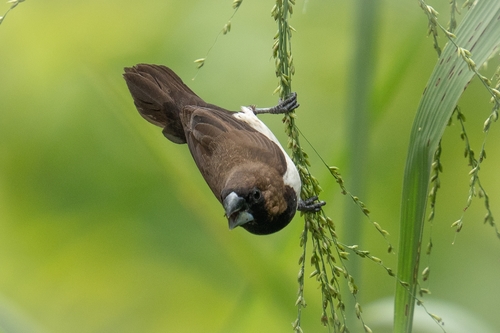
The closest relatives of the Eurasian Tree Sparrow that you can see in Semarang (order Passeriformes, Perching Birds) are White-headed Munia (about 40%), Nutmeg Mannikin (about 40%) and Pacific Swallow (about 40%), with each one's daily chance of a sighting.

Where does the Eurasian Tree Sparrow sighting chance come from?

GBIF citizen-science records

It is estimated from how often the Eurasian Tree Sparrow is recorded against all the birds logged in Semarang (32 verified sightings), calibrated against known sighting rates. Figures are rounded to the nearest 10% because citizen-science data supports honest approximations, not decimals, and months with records from fewer than five people show "—". How it works.

← Back to Semarang