
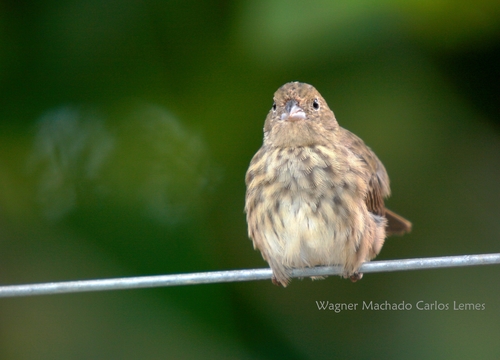
Gray-headed Tanager

Gray-headed Tanager

Eucometis penicillata

Silhouette: Sheatherius · PhyloPic

LCLeast ConcernNTVUENCR
Daily sighting probability <5% · Rare
at Serra da Canastra National Park

In 3 days <5% in a week ~10%

7 Verified sightings at Serra da Canastra National Park From 2019 to 2026
8,770 In all 33 parks
March Best month
☀️ Diurnal When it's spotted

About the Gray-headed Tanager

The grey-headed tanager (Eucometis penicillata) is a species of bird in the family Thraupidae, the tanagers and allies. It is found in Mexico, every Central American country except El Salvador, and every mainland South American country except Argentina, Chile, French Guiana, and Uruguay.

The grey-headed tanager was formally described in 1825 by the German naturalist Johann Baptist von Spix under the binomial name Tanagra penicillata. Spix did not specify a type locality but this was later designated as Fonte Boa in the Brazilian state of Amazonas. The grey-headed tanager is now the only species in the genus Eucometis that was introduced by the English zoologist Philip Sclater in 1856. The genus name is derived from Ancient Greek eukomēs meaning "with lovely hair". The specific epithet penicillata is from the Latin diminutive of peniculus meaning "brush".

Within the Thraupidae the grey-headed tanager is a member of the subfamily Tachyphoninae and is the sister species to the black-goggled tanager (Trichothraupis melanops). The grey-headed tanager has these seven subspecies Wikipedia →

Sounds

Call0:51

Brazil · 2026

© JAYRSON ARAUJO DE OLIVEIRA · XC1164952 · CC BY-NC-SA 4.0

Song1:28

Brazil · 2019

© Fernando Igor de Godoy · XC705457 · CC BY-NC-SA 4.0

Canto0:37

Brazil · 2018

© Caio Brito · XC556305 · CC BY-NC-SA 4.0

Global Distribution

Parks Where Found

# Park Country Daily sighting probability
1 Soberanía National Park 🇵🇦 Panama
~30%
2 Rincón de la Vieja National Park 🇨🇷 Costa Rica
~30%
3 Carara National Park 🇨🇷 Costa Rica
~20%
4 Tayrona National Natural Park 🇨🇴 Colombia
~20%
5 Cockscomb Basin Wildlife Sanctuary 🇧🇿 Belize
~20%
6 Henri Pittier National Park 🇻🇪 Venezuela
~20%
7 Corcovado National Park 🇨🇷 Costa Rica
~20%
8 Tikal National Park 🇬🇹 Guatemala
~20%
9 Sian Ka'an Biosphere Reserve 🇲🇽 Mexico
~20%
10 Calakmul Biosphere Reserve 🇲🇽 Mexico
~20%
11 San Lorenzo Protected Forest 🇵🇦 Panama
~10%
12 Chapada dos Guimarães National Park 🇧🇷 Brazil
~10%
13 Chirripó National Park 🇨🇷 Costa Rica
~10%
14 Yasuní National Park 🇪🇨 Ecuador
~10%
15 Piedras Blancas National Park 🇨🇷 Costa Rica
~10%
16 Marino Ballena National Park 🇨🇷 Costa Rica
~10%
17 Cabo Blanco Absolute Nature Reserve 🇨🇷 Costa Rica
~10%
18 Emas National Park 🇧🇷 Brazil
<5%
19 Parque Estadual Encontro das Águas 🇧🇷 Brazil
<5%
20 Santa Rosa National Park 🇨🇷 Costa Rica
<5%
21 Montes Azules Biosphere Reserve 🇲🇽 Mexico
<5%
22 Manuel Antonio National Park 🇨🇷 Costa Rica
<5%
23 Amacayacu National Natural Park 🇨🇴 Colombia
<5%
24 Darién National Park 🇵🇦 Panama
<5%
25 La Amistad International Park (Panama) 🇵🇦 Panama
<5%
26 Parque Natural Metropolitano 🇵🇦 Panama
<5%
27 Ostional Wildlife Refuge 🇨🇷 Costa Rica
<5%
28 Serra da Canastra National Park 🇧🇷 Brazil
<5%
29 Sierra de la Macarena National Park 🇨🇴 Colombia
<5%
30 Tambopata National Reserve 🇵🇪 Peru
<5%
31 Chagres National Park 🇵🇦 Panama
<5%
32 Tenorio Volcano National Park 🇨🇷 Costa Rica
<5%
33 Monteverde Cloud Forest Reserve 🇨🇷 Costa Rica
<5%

Cities Where Found

# City Country Daily sighting probability
1 Campo Grande 🇧🇷 Brazil
~10%
2 Goiânia 🇧🇷 Brazil
<5%
3 Belo Horizonte 🇧🇷 Brazil
<5%
4 Managua 🇳🇮 Nicaragua
<5%
5 Caracas 🇻🇪 Venezuela
<5%
6 San José 🇨🇷 Costa Rica
<5%

Zoos & Centres Where Found

# Zoo / Centre Country
1 Schönbrunn Zoo 🇦🇹 Austria In captivity

Before you go

What are the chances of seeing a Gray-headed Tanager in Serra da Canastra National Park?

Rare

Under 5% of wildlife watchers report a Gray-headed Tanager sighting in Serra da Canastra National Park on a given day, based on 7 verified sightings from GBIF citizen-science data from 2019 to 2026. It is the 286th most-seen of the 294 birds we can rate there. Over three days the chance rises to under 5%, and over a week to about 10%, if each day is a fresh chance.

When is the best time to see a Gray-headed Tanager in Serra da Canastra National Park?

March

In that month about 10% of wildlife watchers report a Gray-headed Tanager in Serra da Canastra National Park on a given day, against under 5% in April to February, the lowest months.

What time of day is best to see a Gray-headed Tanager?

Between 8 and 11 am

Across all the parks we cover, that three-hour window holds the most Gray-headed Tanager sightings with a recorded time, and about 9 in 10 of them come between 6 am and 6 pm: it is a daytime animal.

Which relatives of the Gray-headed Tanager live in Serra da Canastra National Park?

Same family: Thraupidae

The closest relatives of the Gray-headed Tanager that you can see in Serra da Canastra National Park (family Thraupidae, Tanagers and Allies) are Saffron Finch (about 80%), Sayaca Tanager (about 60%) and Burnished-buff Tanager (about 60%), with each one's daily chance of a sighting.

Where does the Gray-headed Tanager sighting chance come from?

GBIF citizen-science records

It is estimated from how often the Gray-headed Tanager is recorded against all the birds logged in Serra da Canastra National Park (7 verified sightings from 2019 to 2026), calibrated against known sighting rates. Figures are rounded to the nearest 10% because citizen-science data supports honest approximations, not decimals, and months with records from fewer than five people show "—". How it works.

← Back to Serra da Canastra National Park