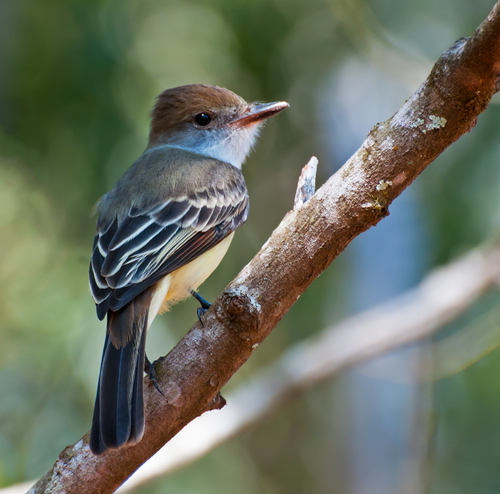
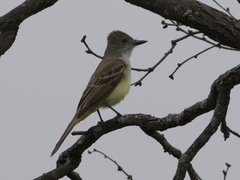
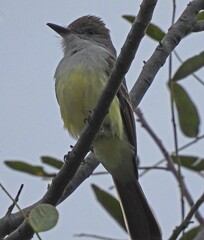
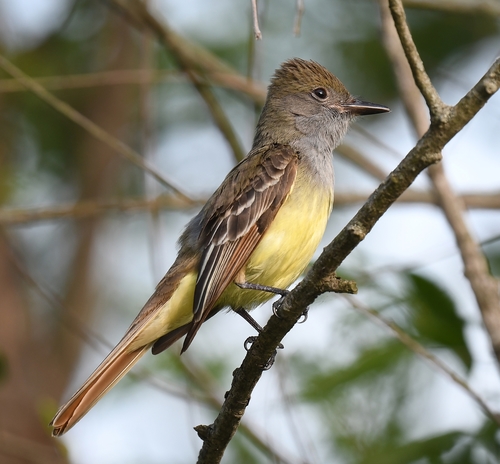
Brown-crested Flycatcher

Brown-crested Flycatcher

Myiarchus tyrannulus

Silhouette: Ferran Sayol · PhyloPic

LCLeast ConcernNTVUENCR
Daily sighting probability ~20% · Possible
at Calakmul Biosphere Reserve

In 3 days ~50% in a week ~80%

141 Verified sightings at Calakmul Biosphere Reserve From 2019 to 2026
7,596 In all 47 parks
March Best month
☀️ Diurnal When it's spotted

About the Brown-crested Flycatcher

The brown-crested flycatcher (Myiarchus tyrannulus) is a passerine bird in the tyrant flycatcher family Tyrannidae. It is found from the southwestern United States south through Mexico and Central America to Costa Rica; on Aruba, Bonaire, Curaçao, Trinidad, and Tobago; and in every mainland South American country except Chile and possibly Ecuador.

The brown-crested flycatcher has a complicated taxonomic history. Its formal description is credited to Statius Müller in his 1776 supplement to earlier work by Carl Linnaeus and Martinus Houttuyn. He coined the binomial Muscicapa tyrannulus, placing it in the Old World flycatcher family.

As of 2025 the brown-crested flycatcher has these seven subspecies: Subspecies M. t. magister was originally named M. mexicanus magister. Wikipedia →

Sounds

Dawn song0:46

Brazil · 2026

© JAYRSON ARAUJO DE OLIVEIRA · XC1163680 · CC BY-NC-SA 4.0

Call0:16

Costa Rica · 2017

© Albert Lastukhin · XC1094603 · CC BY-NC-ND 4.0

Song1:07

Mexico · 2025

© Barry Edmonston · XC1000276 · CC BY-NC-SA 4.0

Global Distribution

Parks Where Found

# Park Country Daily sighting probability
1 Santa Rosa National Park 🇨🇷 Costa Rica
~50%
2 Las Baulas Marine National Park 🇨🇷 Costa Rica
~30%
3 Rincón de la Vieja National Park 🇨🇷 Costa Rica
~30%
4 Tikal National Park 🇬🇹 Guatemala
~30%
5 Palo Verde National Park 🇨🇷 Costa Rica
~30%
6 El Impenetrable National Park 🇦🇷 Argentina
~30%
7 Main Ridge Forest Reserve 🇹🇹 Trinidad and Tobago
~30%
8 Cañón del Sumidero National Park 🇲🇽 Mexico
~20%
9 Serra da Canastra National Park 🇧🇷 Brazil
~20%
10 Arrecifes de Cozumel National Park 🇲🇽 Mexico
~20%
11 Calakmul Biosphere Reserve 🇲🇽 Mexico
~20%
12 Saguaro National Park 🇺🇸 United States
~20%
13 Celestún Biosphere Reserve 🇲🇽 Mexico
~10%
14 Iberá National Park 🇦🇷 Argentina
~10%
15 Emas National Park 🇧🇷 Brazil
~10%
16 Cabo Blanco Absolute Nature Reserve 🇨🇷 Costa Rica
~10%
17 Pico Bonito National Park 🇭🇳 Honduras
~10%
18 Chapada dos Guimarães National Park 🇧🇷 Brazil
~10%
19 Cockscomb Basin Wildlife Sanctuary 🇧🇿 Belize
~10%
20 Sian Ka'an Biosphere Reserve 🇲🇽 Mexico
~10%
21 Biotopo Cerro Cahuí 🇬🇹 Guatemala
~10%
22 Tayrona National Natural Park 🇨🇴 Colombia
~10%
23 Ostional Wildlife Refuge 🇨🇷 Costa Rica
~10%
24 Big Bend National Park 🇺🇸 United States
~10%
25 Cerro Azul Meámbar National Park 🇭🇳 Honduras
~10%
26 Montes Azules Biosphere Reserve 🇲🇽 Mexico
~10%
27 Amboró National Park 🇧🇴 Bolivia
~10%
28 Parque Estadual Encontro das Águas 🇧🇷 Brazil
~10%
29 Carara National Park 🇨🇷 Costa Rica
<5%
30 Henri Pittier National Park 🇻🇪 Venezuela
<5%
31 El Triunfo 🇲🇽 Mexico
<5%
32 Caroni Swamp 🇹🇹 Trinidad and Tobago
<5%
33 Lago de Yojoa 🇭🇳 Honduras
<5%
34 Ría Lagartos Biosphere Reserve 🇲🇽 Mexico
<5%
35 Sierra de la Macarena National Park 🇨🇴 Colombia
<5%
36 Tenorio Volcano National Park 🇨🇷 Costa Rica
<5%
37 Chapada Diamantina National Park 🇧🇷 Brazil
<5%
38 Everglades National Park 🇺🇸 United States
<5%
39 Itatiaia National Park 🇧🇷 Brazil
<5%
40 Marino Ballena National Park 🇨🇷 Costa Rica
<5%
41 Tambopata National Reserve 🇵🇪 Peru
<5%
42 Masaya Volcano National Park 🇳🇮 Nicaragua
<5%
43 Cumbres de Monterrey National Park 🇲🇽 Mexico
<5%
44 Manuel Antonio National Park 🇨🇷 Costa Rica
<5%
45 Zion National Park 🇺🇸 United States
<5%
46 Monteverde Cloud Forest Reserve 🇨🇷 Costa Rica
<5%
47 Manu National Park 🇵🇪 Peru
<5%

Cities Where Found

# City Country Daily sighting probability
1 Campo Grande 🇧🇷 Brazil
~10%
2 Vitória 🇧🇷 Brazil
~10%
3 Goiânia 🇧🇷 Brazil
~10%
4 San Pedro Sula 🇭🇳 Honduras
~10%
5 Toluca 🇲🇽 México
~10%
6 Santa Cruz de la Sierra 🇧🇴 Bolivia
<5%
7 Asuncion 🇵🇾 Paraguay
<5%
8 Monterrey 🇲🇽 México
<5%
9 San Antonio 🇺🇸 United States
<5%
10 Phoenix 🇺🇸 United States
<5%

Before you go

What are the chances of seeing a Brown-crested Flycatcher in Calakmul Biosphere Reserve?

Possible

About 20% of wildlife watchers report a Brown-crested Flycatcher sighting in Calakmul Biosphere Reserve on a given day, based on 141 verified sightings from GBIF citizen-science data from 2019 to 2026. It is the 69th most-seen of the 271 birds we can rate there. Over three days the chance rises to about 50%, and over a week to about 80%, if each day is a fresh chance.

When is the best time to see a Brown-crested Flycatcher in Calakmul Biosphere Reserve?

March

In that month about 40% of wildlife watchers report a Brown-crested Flycatcher in Calakmul Biosphere Reserve on a given day, against about 10% in January, May, August–September and November, the lowest months. That is one of Calakmul Biosphere Reserve's driest months, with about 20 mm of rain against 130 mm in June.

What time of day is best to see a Brown-crested Flycatcher?

Between 7 and 10 am

Across all the parks we cover, that three-hour window holds the most Brown-crested Flycatcher sightings with a recorded time, and about 9 in 10 of them come between 6 am and 6 pm: it is a daytime animal.

Which relatives of the Brown-crested Flycatcher live in Calakmul Biosphere Reserve?

Same genus: Myiarchus

The closest relatives of the Brown-crested Flycatcher that you can see in Calakmul Biosphere Reserve (genus Myiarchus, Myiarchus Flycatchers) are Great Crested Flycatcher (about 40%), Dusky-capped Flycatcher (about 20%) and Yucatán Flycatcher (about 10%), with each one's daily chance of a sighting.

Where does the Brown-crested Flycatcher sighting chance come from?

GBIF citizen-science records

It is estimated from how often the Brown-crested Flycatcher is recorded against all the birds logged in Calakmul Biosphere Reserve (141 verified sightings from 2019 to 2026), calibrated against known sighting rates. Figures are rounded to the nearest 10% because citizen-science data supports honest approximations, not decimals, and months with records from fewer than five people show "—". How it works.

← Back to Calakmul Biosphere Reserve