Blue-black Grosbeak

Blue-black Grosbeak

Cyanocompsa cyanoides

Silhouette: Sheatherius · PhyloPic

LCLeast ConcernNTVUENCR
Daily sighting probability ~10% · With luck
at Chagres National Park

In 3 days ~40% in a week ~60%

161 Verified sightings at Chagres National Park From 2019 to 2026
9,432 In all 39 parks
October Best month
☀️ Diurnal When it's spotted

About the Blue-black Grosbeak

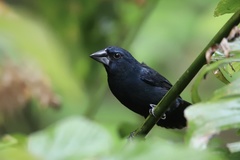
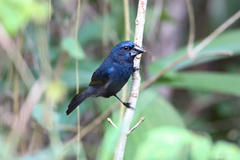
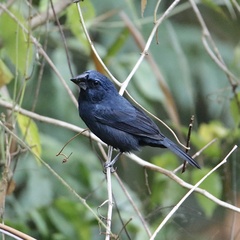
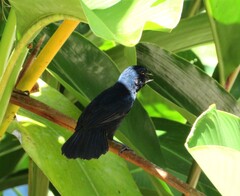
The blue-black grosbeak (Cyanoloxia cyanoides) is a species of songbird in the family Cardinalidae. The South American Classification Committee of the American Ornithological Society places this species in genus Cyanoloxia. In addition, in 2018 the committee split the eastern lowland population into a new species, the Amazonian grosbeak (Cyanoloxia rothschildii).

The blue-black grosbeak is found in the family Cardinalidae, within the order Passeriformes. Although it is still sometimes placed in the genus Cyanocompsa, it was found that this genus is paraphyletic and contains members of the genus Amaurospiza and Cyanoloxia.

There are three subspecies in this taxa: Cyanoloxia cyanoides cyanoides, Cyanoloxia cyanoides caerulescens, and Cyanoloxia cyanoides concreta. Although these three subspecies are very similar, there are slight differences between them. Males all have dark blue plumage, however, C.c. concreta has the darkest of the three and is also the largest. Next, in terms of size and coloration, is C.c. caerulescens, followed by C.c. cyanoides, which has the smallest size and brightest plumage.

Originally there was a fourth subspecies, C.c. rothschildii... Wikipedia →

Sounds

Song1:12

Ecuador · 2020

© Manuel Sánchez-Nivicela · XC1176066 · CC BY-NC-ND 4.0

Alarm call0:29

Mexico · 2021

© Alán Palacios · XC694398 · CC BY-NC-SA 4.0

Call0:50

Panama · 2021

© Kent Livezey · XC690205 · CC BY-NC-ND 4.0

Global Distribution

Parks Where Found

# Park Country Daily sighting probability
1 Cockscomb Basin Wildlife Sanctuary 🇧🇿 Belize
~30%
2 Bastimentos Island National Marine Park 🇵🇦 Panama
~20%
3 Tenorio Volcano National Park 🇨🇷 Costa Rica
~20%
4 Piedras Blancas National Park 🇨🇷 Costa Rica
~20%
5 San Lorenzo Protected Forest 🇵🇦 Panama
~20%
6 Corcovado National Park 🇨🇷 Costa Rica
~20%
7 Cusuco National Park 🇭🇳 Honduras
~20%
8 Cahuita National Park 🇨🇷 Costa Rica
~10%
9 Carara National Park 🇨🇷 Costa Rica
~10%
10 Chagres National Park 🇵🇦 Panama
~10%
11 Henri Pittier National Park 🇻🇪 Venezuela
~10%
12 Soberanía National Park 🇵🇦 Panama
~10%
13 Cerro Azul Meámbar National Park 🇭🇳 Honduras
~10%
14 Braulio Carrillo National Park 🇨🇷 Costa Rica
~10%
15 Utría National Natural Park 🇨🇴 Colombia
~10%
16 Gandoca-Manzanillo Wildlife Refuge 🇨🇷 Costa Rica
~10%
17 La Amistad International Park (Panama) 🇵🇦 Panama
~10%
18 Pico Bonito National Park 🇭🇳 Honduras
~10%
19 Rincón de la Vieja National Park 🇨🇷 Costa Rica
~10%
20 Tayrona National Natural Park 🇨🇴 Colombia
~10%
21 Montes Azules Biosphere Reserve 🇲🇽 Mexico
~10%
22 Arenal Volcano National Park 🇨🇷 Costa Rica
~10%
23 Marino Ballena National Park 🇨🇷 Costa Rica
~10%
24 Darién National Park 🇵🇦 Panama
<5%
25 Parque Natural Metropolitano 🇵🇦 Panama
<5%
26 Lago de Yojoa 🇭🇳 Honduras
<5%
27 Calakmul Biosphere Reserve 🇲🇽 Mexico
<5%
28 Machalilla National Park 🇪🇨 Ecuador
<5%
29 Tapantí-Macizo de la Muerte National Park 🇨🇷 Costa Rica
<5%
30 Manuel Antonio National Park 🇨🇷 Costa Rica
<5%
31 Tortuguero National Park 🇨🇷 Costa Rica
<5%
32 Farallones de Cali National Natural Park 🇨🇴 Colombia
<5%
33 Tikal National Park 🇬🇹 Guatemala
<5%
34 Palo Verde National Park 🇨🇷 Costa Rica
<5%
35 Cabo Blanco Absolute Nature Reserve 🇨🇷 Costa Rica
<5%
36 Chirripó National Park 🇨🇷 Costa Rica
<5%
37 Volcán Barú National Park 🇵🇦 Panama
<5%
38 Poás Volcano National Park 🇨🇷 Costa Rica
<5%
39 Monteverde Cloud Forest Reserve 🇨🇷 Costa Rica
<5%

Cities Where Found

# City Country Daily sighting probability
1 San Pedro Sula 🇭🇳 Honduras
<5%
2 San José 🇨🇷 Costa Rica
<5%
3 Caracas 🇻🇪 Venezuela
<5%
4 Panama City 🇵🇦 Panama
<5%

Before you go

What are the chances of seeing a Blue-black Grosbeak in Chagres National Park?

With luck

About 10% of wildlife watchers report a Blue-black Grosbeak sighting in Chagres National Park on a given day, based on 161 verified sightings from GBIF citizen-science data from 2019 to 2026. It is the 108th most-seen of the 372 birds we can rate there. Over three days the chance rises to about 40%, and over a week to about 60%, if each day is a fresh chance.

When is the best time to see a Blue-black Grosbeak in Chagres National Park?

July and October

In those months about 30% of wildlife watchers report a Blue-black Grosbeak in Chagres National Park on a given day, against about 10% in January–June, August and November, the lowest months. Those are among Chagres National Park's wettest months, with about 290 mm of rain a month against 30 mm in February.

What time of day is best to see a Blue-black Grosbeak?

Between 7 and 10 am

Across all the parks we cover, that three-hour window holds the most Blue-black Grosbeak sightings with a recorded time, and about 9 in 10 of them come between 6 am and 6 pm: it is a daytime animal.

Which relatives of the Blue-black Grosbeak live in Chagres National Park?

Same family: Cardinalidae

The closest relatives of the Blue-black Grosbeak that you can see in Chagres National Park (family Cardinalidae, Cardinals and Allies) are Red Tanager (about 60%), Carmiol's Tanager (about 40%) and Summer Tanager (about 30%), with each one's daily chance of a sighting.

Where does the Blue-black Grosbeak sighting chance come from?

GBIF citizen-science records

It is estimated from how often the Blue-black Grosbeak is recorded against all the birds logged in Chagres National Park (161 verified sightings from 2019 to 2026), calibrated against known sighting rates. Figures are rounded to the nearest 10% because citizen-science data supports honest approximations, not decimals, and months with records from fewer than five people show "—". How it works.

← Back to Chagres National Park