Striped Cuckoo

Striped Cuckoo

Tapera naevia

Silhouette: Nicolas Huet le Jeune and Jean-Gabriel Prêtre (vectorized by T. Michael Keesey) · PhyloPic

LCLeast ConcernNTVUENCR
Daily sighting probability ~10% · With luck
at Asuncion

In 3 days ~30% in a week ~60%

222 Verified sightings at Asuncion
3,008 In all 43 parks From 2019 to 2026
November Best month
☀️ Diurnal When it's spotted

About the Striped Cuckoo

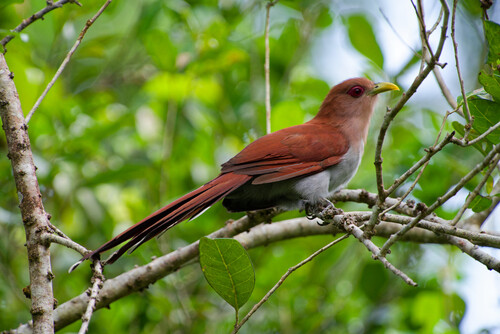
The striped cuckoo (Tapera naevia) is a near-passerine bird, the only member of the genus Tapera. This resident cuckoo is found from Mexico and Trinidad south to Bolivia and Argentina and Colombia. The striped cuckoo is found in open country with trees or shrubs, and the edges of mangrove forests. It is among the very few brood parasitic cuckoos of the Americas (only other are Dromococcyx), and typical hosts are spinetails, but often also wrens, and other species with domed nests. The female cuckoo lays one, sometimes two, white or bluish eggs in the host's large stick nest. The eggs hatch in 15 days, with a further 18 days until the cuckoo fledges. The young spinetails disappear.

This species is about 27 cm (11 in) long and weighs 40 g (1.4 oz). The adult is mainly grey-brown above, streaked with black and buff. It has a pale supercilium and a chestnut and black crest which is raised as part of its display. The underparts are off-white and the tail is long and graduated. Immature birds are spotted with buff and are more rufous on the back and wings.

The striped cuckoo eats large insects (primarily grasshoppers and caterpillars), often taken off the ground. This is a solitary and fairly shy species which tends to keep to the cover of bushes, although it will sing from more open perches. It has a whistled call usually of two or three notes, wu-weee or wu-wu-wee, and can be attracted by imitations of this. Wikipedia →

Sounds

Duet0:41

Paraguay · 2025

© Guillermo Menéndez (gmmv80) · XC1169499 · CC BY-NC-SA 4.0

Song0:19

Ecuador · 2025

© Manuel Sánchez-Nivicela · XC1157587 · CC BY-NC-ND 4.0

Call0:16

Brazil · 2026

© JAYRSON ARAUJO DE OLIVEIRA · XC1080152 · CC BY-NC-SA 4.0

Global Distribution

Parks Where Found

# Park Country Daily sighting probability
1 Iberá National Park 🇦🇷 Argentina
~30%
2 Parque Estadual Encontro das Águas 🇧🇷 Brazil
~30%
3 El Palmar National Park 🇦🇷 Argentina
~20%
4 Amacayacu National Natural Park 🇨🇴 Colombia
~20%
5 El Impenetrable National Park 🇦🇷 Argentina
~10%
6 Chapada Diamantina National Park 🇧🇷 Brazil
~10%
7 Caroni Swamp 🇹🇹 Trinidad and Tobago
~10%
8 El Triunfo 🇲🇽 Mexico
~10%
9 Carara National Park 🇨🇷 Costa Rica
~10%
10 Serra da Canastra National Park 🇧🇷 Brazil
~10%
11 Machalilla National Park 🇪🇨 Ecuador
~10%
12 Henri Pittier National Park 🇻🇪 Venezuela
<5%
13 Piedras Blancas National Park 🇨🇷 Costa Rica
<5%
14 Cañón del Sumidero National Park 🇲🇽 Mexico
<5%
15 Corcovado National Park 🇨🇷 Costa Rica
<5%
16 Ostional Wildlife Refuge 🇨🇷 Costa Rica
<5%
17 Cerro Azul Meámbar National Park 🇭🇳 Honduras
<5%
18 Iguazú National Park 🇦🇷 Argentina
<5%
19 Iguaçu National Park 🇧🇷 Brazil
<5%
20 Gandoca-Manzanillo Wildlife Refuge 🇨🇷 Costa Rica
<5%
21 Cabo Blanco Absolute Nature Reserve 🇨🇷 Costa Rica
<5%
22 Lago de Yojoa 🇭🇳 Honduras
<5%
23 La Amistad International Park (Panama) 🇵🇦 Panama
<5%
24 Serra dos Órgãos National Park 🇧🇷 Brazil
<5%
25 Darién National Park 🇵🇦 Panama
<5%
26 Farallones de Cali National Natural Park 🇨🇴 Colombia
<5%
27 Chagres National Park 🇵🇦 Panama
<5%
28 Rincón de la Vieja National Park 🇨🇷 Costa Rica
<5%
29 Bastimentos Island National Marine Park 🇵🇦 Panama
<5%
30 Chapada dos Guimarães National Park 🇧🇷 Brazil
<5%
31 Marino Ballena National Park 🇨🇷 Costa Rica
<5%
32 Arenal Volcano National Park 🇨🇷 Costa Rica
<5%
33 Tambopata National Reserve 🇵🇪 Peru
<5%
34 Tenorio Volcano National Park 🇨🇷 Costa Rica
<5%
35 Tortuguero National Park 🇨🇷 Costa Rica
<5%
36 Itatiaia National Park 🇧🇷 Brazil
<5%
37 Palo Verde National Park 🇨🇷 Costa Rica
<5%
38 Tikal National Park 🇬🇹 Guatemala
<5%
39 Braulio Carrillo National Park 🇨🇷 Costa Rica
<5%
40 Parque Natural Metropolitano 🇵🇦 Panama
<5%
41 Manu National Park 🇵🇪 Peru
<5%
42 Los Nevados National Natural Park 🇨🇴 Colombia
<5%
43 Soberanía National Park 🇵🇦 Panama
<5%

Cities Where Found

# City Country Daily sighting probability
1 Asuncion 🇵🇾 Paraguay
~10%
2 Santa Cruz de la Sierra 🇧🇴 Bolivia
~10%
3 Goiânia 🇧🇷 Brazil
<5%
4 Cali 🇨🇴 Colombia
<5%
5 Valencia 🇻🇪 Venezuela
<5%
6 Rio de Janeiro 🇧🇷 Brazil
<5%
7 Campinas 🇧🇷 Brazil
<5%
8 Niterói 🇧🇷 Brazil
<5%
9 Curitiba 🇧🇷 Brazil
<5%
10 Cordoba 🇦🇷 Argentina
<5%

Before you go

What are the chances of seeing a Striped Cuckoo in Asuncion?

With luck

About 10% of wildlife watchers report a Striped Cuckoo sighting in Asuncion on a given day, based on 222 verified sightings from GBIF citizen-science data. It is the 65th most-seen of the 224 birds we can rate there. Over three days the chance rises to about 30%, and over a week to about 60%, if each day is a fresh chance.

When is the best time to see a Striped Cuckoo in Asuncion?

November

In that month about 30% of wildlife watchers report a Striped Cuckoo in Asuncion on a given day, against under 5% in March and April, the lowest months. That is one of Asuncion's wettest months, with about 190 mm of rain against 40 mm in August.

What time of day is best to see a Striped Cuckoo?

Between 8 and 11 am

Across all the parks we cover, that three-hour window holds the most Striped Cuckoo sightings with a recorded time, and about 9 in 10 of them come between 6 am and 6 pm: it is a daytime animal.

Is Asuncion the best place to see a Striped Cuckoo?

Yes

Of the 16 cities where we can rate Striped Cuckoo sightings, Asuncion has the highest daily chance: about 10%. Next come Santa Cruz de la Sierra (Bolivia, about 10%) and Goiânia (Brazil, under 5%).

Which relatives of the Striped Cuckoo live in Asuncion?

Same family: Cuculidae

The closest relatives of the Striped Cuckoo that you can see in Asuncion (family Cuculidae, Cuckoos) are Guira Cuckoo (about 30%) and Smooth-billed Ani (about 30%), with each one's daily chance of a sighting.

Where does the Striped Cuckoo sighting chance come from?

GBIF citizen-science records

It is estimated from how often the Striped Cuckoo is recorded against all the birds logged in Asuncion (222 verified sightings), calibrated against known sighting rates. Figures are rounded to the nearest 10% because citizen-science data supports honest approximations, not decimals, and months with records from fewer than five people show "—". How it works.

← Back to Asuncion