Melodious Blackbird

Melodious Blackbird

Dives dives

Silhouette: Sheatherius · PhyloPic

LCLeast ConcernNTVUENCR
Daily sighting probability ~70% · Very likely
at Lago de Yojoa

In 3 days >90%

656 Verified sightings at Lago de Yojoa From 2019 to 2026
32,515 In all 44 parks
July Best month
☀️ Diurnal When it's spotted

About the Melodious Blackbird

The melodious blackbird (Dives dives) is a species of bird in the family Icteridae, the oropendolas, New World orioles, and New World blackbirds. It is found from Mexico to Costa Rica. The melodious blackbird was formally described in 1830 with the binomial Icterus dives. It now shares the genus Dives with the scrub blackbird (D. warczewiczi). The two form a superspecies and some early twentieth century authors treated them as conspecific.

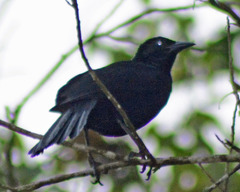
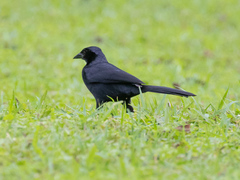
The melodious blackbird is monotypic. Male melodious blackbirds average 25.5 cm (10 in) long and weigh 98.3 to 102 g (3.5 to 3.6 oz). Females average 23 cm (9.1 in) long and weigh 83.4 to 95.9 g (2.9 to 3.4 oz). The species has a long tail and disproportionately large legs and feet. The sexes have the same plumage: Adults are entirely black with blue and purple iridescence. They have a dark brown iris, a black bill, and black legs and feet. Juveniles are a duller, non-glossy, brownish black.

The melodious blackbird is found from southern Tamaulipas in northeastern Mexico south on the Gulf of Mexico slope almost to the Isthmus of Tehuantepec and from there on both the... Wikipedia →

Sounds

Song0:10

Costa Rica · 2013

© Albert Lastukhin · XC1087967 · CC BY-NC-ND 4.0

Call1:18

Mexico · 2025

© Daniel Hinckley · XC1063610 · CC BY-NC-SA 4.0

Recording0:21

Mexico · 2020

© Alfredo Dorantes Euan · XC580763 · CC BY-NC-SA 4.0

Global Distribution

Parks Where Found

# Park Country Daily sighting probability
1 Masaya Volcano National Park 🇳🇮 Nicaragua
~80%
2 Lago de Yojoa 🇭🇳 Honduras
~70%
3 Tikal National Park 🇬🇹 Guatemala
~70%
4 Cerro Azul Meámbar National Park 🇭🇳 Honduras
~60%
5 Celaque National Park 🇭🇳 Honduras
~60%
6 Cusuco National Park 🇭🇳 Honduras
~60%
7 El Triunfo 🇲🇽 Mexico
~60%
8 Cockscomb Basin Wildlife Sanctuary 🇧🇿 Belize
~60%
9 Sian Ka'an Biosphere Reserve 🇲🇽 Mexico
~60%
10 Montes Azules Biosphere Reserve 🇲🇽 Mexico
~50%
11 La Tigra National Park 🇭🇳 Honduras
~50%
12 Arenal Volcano National Park 🇨🇷 Costa Rica
~50%
13 Pico Bonito National Park 🇭🇳 Honduras
~40%
14 Calakmul Biosphere Reserve 🇲🇽 Mexico
~40%
15 Marino Ballena National Park 🇨🇷 Costa Rica
~40%
16 Biotopo Cerro Cahuí 🇬🇹 Guatemala
~40%
17 Braulio Carrillo National Park 🇨🇷 Costa Rica
~40%
18 Chirripó National Park 🇨🇷 Costa Rica
~30%
19 Rincón de la Vieja National Park 🇨🇷 Costa Rica
~30%
20 Las Baulas Marine National Park 🇨🇷 Costa Rica
~30%
21 Cabo Blanco Absolute Nature Reserve 🇨🇷 Costa Rica
~30%
22 Ostional Wildlife Refuge 🇨🇷 Costa Rica
~30%
23 Tortuguero National Park 🇨🇷 Costa Rica
~30%
24 Poás Volcano National Park 🇨🇷 Costa Rica
~20%
25 Carara National Park 🇨🇷 Costa Rica
~20%
26 Manuel Antonio National Park 🇨🇷 Costa Rica
~20%
27 Cañón del Sumidero National Park 🇲🇽 Mexico
~20%
28 Tenorio Volcano National Park 🇨🇷 Costa Rica
~20%
29 Monteverde Cloud Forest Reserve 🇨🇷 Costa Rica
~20%
30 Cahuita National Park 🇨🇷 Costa Rica
~20%
31 Gandoca-Manzanillo Wildlife Refuge 🇨🇷 Costa Rica
~10%
32 Tapantí-Macizo de la Muerte National Park 🇨🇷 Costa Rica
~10%
33 Los Quetzales National Park 🇨🇷 Costa Rica
~10%
34 Santa Rosa National Park 🇨🇷 Costa Rica
~10%
35 Palo Verde National Park 🇨🇷 Costa Rica
~10%
36 Piedras Blancas National Park 🇨🇷 Costa Rica
~10%
37 Corcovado National Park 🇨🇷 Costa Rica
~10%
38 Ría Lagartos Biosphere Reserve 🇲🇽 Mexico
~10%
39 La Amistad International Park (Panama) 🇵🇦 Panama
~10%
40 Celestún Biosphere Reserve 🇲🇽 Mexico
~10%
41 Volcán Barú National Park 🇵🇦 Panama
~10%
42 Irazú Volcano National Park 🇨🇷 Costa Rica
<5%
43 Arrecifes de Cozumel National Park 🇲🇽 Mexico
<5%
44 Bastimentos Island National Marine Park 🇵🇦 Panama
<5%

Cities Where Found

# City Country Daily sighting probability
1 San Salvador 🇸🇻 El Salvador
~70%
2 Guatemala City 🇬🇹 Guatemala
~60%
3 Tegucigalpa 🇭🇳 Honduras
~60%
4 Managua 🇳🇮 Nicaragua
~60%
5 San Pedro Sula 🇭🇳 Honduras
~50%
6 San José 🇨🇷 Costa Rica
~50%
7 Mexico City 🇲🇽 México
<5%

Zoos & Centres Where Found

# Zoo / Centre Country
1 California Academy of Sciences 🇺🇸 United States In captivity
2 The Seas with Nemo & Friends 🇺🇸 United States In captivity

Before you go

What are the chances of seeing a Melodious Blackbird in Lago de Yojoa?

Very likely

About 70% of wildlife watchers report a Melodious Blackbird sighting in Lago de Yojoa on a given day, based on 656 verified sightings from GBIF citizen-science data from 2019 to 2026. It is the 4th most-seen of the 263 birds we can rate there. Over three days the chance rises to over 90%, if each day is a fresh chance.

When is the best time to see a Melodious Blackbird in Lago de Yojoa?

June and July

In those months about 80% of wildlife watchers report a Melodious Blackbird in Lago de Yojoa on a given day, against about 60% in April, August and December, the lowest months. Those are among Lago de Yojoa's wettest months, with about 260 mm of rain a month against 65 mm in April.

What time of day is best to see a Melodious Blackbird?

Between 6 and 9 am

Across all the parks we cover, that three-hour window holds the most Melodious Blackbird sightings with a recorded time, and about 9 in 10 of them come between 6 am and 6 pm: it is a daytime animal.

Is Lago de Yojoa the best place to see a Melodious Blackbird?

2nd of 44

Of the 44 parks where we can rate Melodious Blackbird sightings, Lago de Yojoa ranks 2nd at about 70%. The best odds are in Masaya Volcano National Park (Nicaragua, about 80%). All parks ranked.

Which relatives of the Melodious Blackbird live in Lago de Yojoa?

Same family: Icteridae

The closest relatives of the Melodious Blackbird that you can see in Lago de Yojoa (family Icteridae, New World Blackbirds and Orioles) are Montezuma Oropendola (about 80%), Great-tailed Grackle (about 70%) and Baltimore Oriole (about 30%), with each one's daily chance of a sighting.

Where does the Melodious Blackbird sighting chance come from?

GBIF citizen-science records

It is estimated from how often the Melodious Blackbird is recorded against all the birds logged in Lago de Yojoa (656 verified sightings from 2019 to 2026), calibrated against known sighting rates. Figures are rounded to the nearest 10% because citizen-science data supports honest approximations, not decimals, and months with records from fewer than five people show "—". How it works.

← Back to Lago de Yojoa