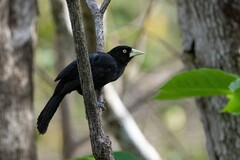
Yellow-billed Cacique

Yellow-billed Cacique

Amblycercus holosericeus

Silhouette: Sheatherius · PhyloPic

LCLeast ConcernNTVUENCR
Daily sighting probability <5% · Rare
at Los Nevados National Natural Park

In 3 days ~10% in a week ~20%

137 Verified sightings at Los Nevados National Natural Park From 2019 to 2026
3,759 In all 40 parks
October Best month
☀️ Diurnal When it's spotted

About the Yellow-billed Cacique

The yellow-billed cacique (Amblycercus holosericeus) is a species of bird in the family Icteridae. It is found in Mexico, every Central American country, Bolivia, Colombia, Ecuador, Peru, and Venezuela. The yellow-billed cacique was formally described in 1830 with the binomial Sturnus holosericieus. In 1851 Jean Cabanis erected the genus Amblycercus with it as the type species. For part of the twentieth century it was assigned to genus Cacicus but by the end of the century had been firmly placed back in Amblycercus. It is basal to the oropendolas and caciques but is not closely related to any of them.

The yellow-billed cacique is the only member of its genus and has these three subspecies: Amblycercus holosericeus holosericeus (Deppe, 1830) Amblycercus holosericeus flavirostris Chapman, 1915 Amblycercus holosericeus australis Chapman, 1919

Some authors have suggested that A. h. australis might warrant full species status. The Clements taxonomy draws some distinction within the species, calling A. h. australis the "yellow-billed cacique (Chapman's)" and grouping the other two subspecies as the "yellow-billed cacique (Prevost's)".

Yellow... Wikipedia →

Sounds

Call0:22

Ecuador · 2021

© Manuel Sánchez-Nivicela · XC1164092 · CC BY-NC-ND 4.0

Song0:10

Colombia · 2022

© Jorge L. Peña · XC701338 · CC BY-NC-SA 4.0

Duet0:11

Ecuador · 1996

© Paul Coopmans · XC264892 · CC BY-NC-SA 4.0

Global Distribution

Parks Where Found

# Park Country Daily sighting probability
1 Cockscomb Basin Wildlife Sanctuary 🇧🇿 Belize
~30%
2 Montes Azules Biosphere Reserve 🇲🇽 Mexico
~20%
3 Sian Ka'an Biosphere Reserve 🇲🇽 Mexico
~20%
4 Cusuco National Park 🇭🇳 Honduras
~10%
5 Cañón del Sumidero National Park 🇲🇽 Mexico
~10%
6 Poás Volcano National Park 🇨🇷 Costa Rica
~10%
7 Calakmul Biosphere Reserve 🇲🇽 Mexico
~10%
8 El Triunfo 🇲🇽 Mexico
~10%
9 Cerro Azul Meámbar National Park 🇭🇳 Honduras
~10%
10 Lago de Yojoa 🇭🇳 Honduras
~10%
11 Arenal Volcano National Park 🇨🇷 Costa Rica
~10%
12 Corcovado National Park 🇨🇷 Costa Rica
<5%
13 Piedras Blancas National Park 🇨🇷 Costa Rica
<5%
14 Podocarpus National Park 🇪🇨 Ecuador
<5%
15 Los Nevados National Natural Park 🇨🇴 Colombia
<5%
16 Biotopo Cerro Cahuí 🇬🇹 Guatemala
<5%
17 Tapantí-Macizo de la Muerte National Park 🇨🇷 Costa Rica
<5%
18 Soberanía National Park 🇵🇦 Panama
<5%
19 Machalilla National Park 🇪🇨 Ecuador
<5%
20 Chirripó National Park 🇨🇷 Costa Rica
<5%
21 Darién National Park 🇵🇦 Panama
<5%
22 Chagres National Park 🇵🇦 Panama
<5%
23 Cahuita National Park 🇨🇷 Costa Rica
<5%
24 Los Quetzales National Park 🇨🇷 Costa Rica
<5%
25 Pico Bonito National Park 🇭🇳 Honduras
<5%
26 Braulio Carrillo National Park 🇨🇷 Costa Rica
<5%
27 Chingaza National Natural Park 🇨🇴 Colombia
<5%
28 La Amistad International Park (Panama) 🇵🇦 Panama
<5%
29 Celestún Biosphere Reserve 🇲🇽 Mexico
<5%
30 Tikal National Park 🇬🇹 Guatemala
<5%
31 Cabo Blanco Absolute Nature Reserve 🇨🇷 Costa Rica
<5%
32 Tortuguero National Park 🇨🇷 Costa Rica
<5%
33 Parque Natural Metropolitano 🇵🇦 Panama
<5%
34 Volcán Barú National Park 🇵🇦 Panama
<5%
35 Palo Verde National Park 🇨🇷 Costa Rica
<5%
36 Gandoca-Manzanillo Wildlife Refuge 🇨🇷 Costa Rica
<5%
37 Bastimentos Island National Marine Park 🇵🇦 Panama
<5%
38 Carara National Park 🇨🇷 Costa Rica
<5%
39 Tenorio Volcano National Park 🇨🇷 Costa Rica
<5%
40 Monteverde Cloud Forest Reserve 🇨🇷 Costa Rica
<5%

Cities Where Found

# City Country Daily sighting probability
1 San Pedro Sula 🇭🇳 Honduras
<5%
2 Guatemala City 🇬🇹 Guatemala
<5%
3 Panama City 🇵🇦 Panama
<5%
4 San José 🇨🇷 Costa Rica
<5%
5 San Salvador 🇸🇻 El Salvador
<5%

Before you go

What are the chances of seeing a Yellow-billed Cacique in Los Nevados National Natural Park?

Rare

Under 5% of wildlife watchers report a Yellow-billed Cacique sighting in Los Nevados National Natural Park on a given day, based on 137 verified sightings from GBIF citizen-science data from 2019 to 2026. It is the 211th most-seen of the 424 birds we can rate there. Over three days the chance rises to about 10%, and over a week to about 20%, if each day is a fresh chance.

When is the best time to see a Yellow-billed Cacique in Los Nevados National Natural Park?

October

In that month about 10% of wildlife watchers report a Yellow-billed Cacique in Los Nevados National Natural Park on a given day, against under 5% in November to September, the lowest months.

What time of day is best to see a Yellow-billed Cacique?

Between 7 and 10 am

Across all the parks we cover, that three-hour window holds the most Yellow-billed Cacique sightings with a recorded time, and about 9 in 10 of them come between 6 am and 6 pm: it is a daytime animal.

Where does the Yellow-billed Cacique sighting chance come from?

GBIF citizen-science records

It is estimated from how often the Yellow-billed Cacique is recorded against all the birds logged in Los Nevados National Natural Park (137 verified sightings from 2019 to 2026), calibrated against known sighting rates. Figures are rounded to the nearest 10% because citizen-science data supports honest approximations, not decimals, and months with records from fewer than five people show "—". How it works.

← Back to Los Nevados National Natural Park