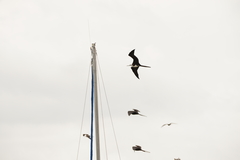
Magnificent Frigatebird

Magnificent Frigatebird

Fregata magnificens

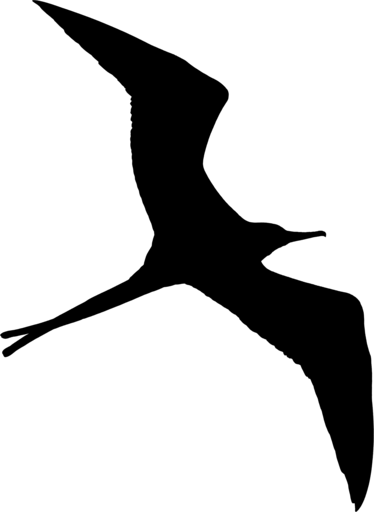
Silhouette: Emily Willoughby · PhyloPic

LCLeast ConcernNTVUENCR
Daily sighting probability ~50% · Likely
at Bahía de Loreto National Park

In 3 days ~90% in a week >90%

700 Verified sightings at Bahía de Loreto National Park From 2019 to 2026
47,899 In all 49 parks
December Best month
☀️ Diurnal When it's spotted

About the Magnificent Frigatebird

The magnificent frigatebird (Fregata magnificens), frigate petrel or man o' war is a seabird of the frigatebird family Fregatidae. With a length of 89–114 centimetres (2 ft 11 in – 3 ft 9 in) and wingspan of 2.17–2.44 m (7 ft 1 in – 8 ft 0 in), it is the largest species of frigatebird. It occurs over tropical and subtropical waters off America, between northern Mexico and Peru on the Pacific coast and between Florida and southern Brazil along the Atlantic coast. There are also populations on the Galápagos Islands in the Pacific and the Cape Verde islands in the Atlantic. It is one of the fastest birds in the world, flying at speeds of up to 153 kilometres (95 mi) per hour.

The magnificent frigatebird is a large, lightly built seabird with brownish-black plumage, long narrow wings and a deeply forked tail. The male has a striking red gular sac which he inflates to attract a mate. The female is slightly larger than the male and has a white breast and belly. Frigatebirds feed on fish taken in flight from the ocean's surface (often flying fish), and sometimes indulge in kleptoparasitism, harassing other birds to force them to regurgitate their food.

The magnificent frigatebird... Wikipedia →

Sounds

Call0:14

Brazil · 2024

© JAYRSON ARAUJO DE OLIVEIRA · XC927123 · CC BY-NC-SA 4.0

Begging call0:04

Brazil · 2022

© Ricardo José Mitidieri · XC698965 · CC BY-NC-SA 4.0

Bill clacking and vocal clicking0:27

Ecuador · 2011

© Richard C. Hoyer · XC99731 · CC BY-NC-ND 2.5

Global Distribution

Parks Where Found

# Park Country Daily sighting probability
1 Ría Lagartos Biosphere Reserve 🇲🇽 Mexico
~90%
2 Galápagos Islands 🇪🇨 Ecuador
~80%
3 Celestún Biosphere Reserve 🇲🇽 Mexico
~70%
4 Machalilla National Park 🇪🇨 Ecuador
~70%
5 Tijuca National Park 🇧🇷 Brazil
~60%
6 Coiba National Park 🇵🇦 Panama
~60%
7 Bastimentos Island National Marine Park 🇵🇦 Panama
~60%
8 Cabo Blanco Absolute Nature Reserve 🇨🇷 Costa Rica
~50%
9 Main Ridge Forest Reserve 🇹🇹 Trinidad and Tobago
~50%
10 Los Haitises National Park 🇩🇴 Dominican Republic
~50%
11 Bahía de Loreto National Park 🇲🇽 Mexico
~50%
12 Manuel Antonio National Park 🇨🇷 Costa Rica
~40%
13 Carara National Park 🇨🇷 Costa Rica
~40%
14 Arrecifes de Cozumel National Park 🇲🇽 Mexico
~40%
15 Tortuguero National Park 🇨🇷 Costa Rica
~40%
16 Marino Ballena National Park 🇨🇷 Costa Rica
~40%
17 San Lorenzo Protected Forest 🇵🇦 Panama
~40%
18 Jaragua National Park 🇩🇴 Dominican Republic
~40%
19 Utría National Natural Park 🇨🇴 Colombia
~40%
20 Ciénaga de Zapata 🇨🇺 Cuba
~30%
21 Las Baulas Marine National Park 🇨🇷 Costa Rica
~30%
22 Sian Ka'an Biosphere Reserve 🇲🇽 Mexico
~30%
23 Ostional Wildlife Refuge 🇨🇷 Costa Rica
~30%
24 Soberanía National Park 🇵🇦 Panama
~30%
25 Tayrona National Natural Park 🇨🇴 Colombia
~30%
26 Cahuita National Park 🇨🇷 Costa Rica
~30%
27 Cabo Pulmo National Park 🇲🇽 Mexico
~30%
28 Corcovado National Park 🇨🇷 Costa Rica
~20%
29 La Amistad International Park (Panama) 🇵🇦 Panama
~20%
30 Gandoca-Manzanillo Wildlife Refuge 🇨🇷 Costa Rica
~20%
31 Isla del Coco National Park 🇨🇷 Costa Rica
~20%
32 Parque Natural Metropolitano 🇵🇦 Panama
~20%
33 Santa Rosa National Park 🇨🇷 Costa Rica
~20%
34 Caroni Swamp 🇹🇹 Trinidad and Tobago
~10%
35 Henri Pittier National Park 🇻🇪 Venezuela
~10%
36 Everglades National Park 🇺🇸 United States
~10%
37 Piedras Blancas National Park 🇨🇷 Costa Rica
~10%
38 Palo Verde National Park 🇨🇷 Costa Rica
~10%
39 Merritt Island National Wildlife Refuge 🇺🇸 United States
~10%
40 Padre Island National Seashore 🇺🇸 United States
<5%
41 Masaya Volcano National Park 🇳🇮 Nicaragua
<5%
42 Cockscomb Basin Wildlife Sanctuary 🇧🇿 Belize
<5%
43 Big Cypress National Preserve 🇺🇸 United States
<5%
44 Serra dos Órgãos National Park 🇧🇷 Brazil
<5%
45 Chagres National Park 🇵🇦 Panama
<5%
46 El Vizcaíno Biosphere Reserve 🇲🇽 Mexico
<5%
47 Tenorio Volcano National Park 🇨🇷 Costa Rica
<5%
48 Arenal Volcano National Park 🇨🇷 Costa Rica
<5%
49 Monteverde Cloud Forest Reserve 🇨🇷 Costa Rica
<5%

Cities Where Found

# City Country Daily sighting probability
1 Rio de Janeiro 🇧🇷 Brazil
~70%
2 Niterói 🇧🇷 Brazil
~60%
3 Maracaibo 🇻🇪 Venezuela
~60%
4 Santos 🇧🇷 Brazil
~60%
5 Vitória 🇧🇷 Brazil
~40%
6 Panama City 🇵🇦 Panama
~40%
7 Havana 🇨🇺 Cuba
~30%
8 Guayaquil 🇪🇨 Ecuador
~20%
9 Salvador 🇧🇷 Brazil
~10%
10 Santo Domingo 🇩🇴 Dominican Republic
~10%

Zoos & Centres Where Found

# Zoo / Centre Country
1 Aquarium of Veracruz 🇲🇽 Mexico In captivity
2 Seaside Seabird Sanctuary 🇺🇸 United States In captivity

Before you go

What are the chances of seeing a Magnificent Frigatebird in Bahía de Loreto National Park?

Likely

About 50% of wildlife watchers report a Magnificent Frigatebird sighting in Bahía de Loreto National Park on a given day, based on 700 verified sightings from GBIF citizen-science data from 2019 to 2026. It is the 16th most-seen of the 169 birds we can rate there. Over three days the chance rises to about 90%, and over a week to over 90%, if each day is a fresh chance.

When is the best time to see a Magnificent Frigatebird in Bahía de Loreto National Park?

February–April, June–July, October and December

In those months about 50% of wildlife watchers report a Magnificent Frigatebird in Bahía de Loreto National Park on a given day, against about 30% in November, the lowest month.

What time of day is best to see a Magnificent Frigatebird?

Between 3 and 6 pm

Across all the parks we cover, that three-hour window holds the most Magnificent Frigatebird sightings with a recorded time, and about 9 in 10 of them come between 6 am and 6 pm: it is a daytime animal.

Which relatives of the Magnificent Frigatebird live in Bahía de Loreto National Park?

Same order: Suliformes

The closest relatives of the Magnificent Frigatebird that you can see in Bahía de Loreto National Park (order Suliformes, Gannets, Cormorants, and Allies) are Double-crested Cormorant (about 60%), Blue-footed Booby (about 40%) and Townsend's Cormorant (about 20%), with each one's daily chance of a sighting.

Where does the Magnificent Frigatebird sighting chance come from?

GBIF citizen-science records

It is estimated from how often the Magnificent Frigatebird is recorded against all the birds logged in Bahía de Loreto National Park (700 verified sightings from 2019 to 2026), calibrated against known sighting rates. Figures are rounded to the nearest 10% because citizen-science data supports honest approximations, not decimals, and months with records from fewer than five people show "—". How it works.

← Back to Bahía de Loreto National Park