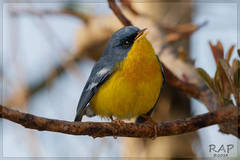
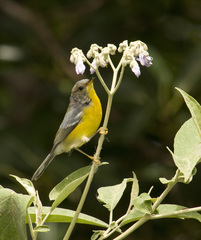
Tropical Parula

Tropical Parula

Setophaga pitiayumi

Silhouette: Dylan GE Gomes · PhyloPic

LCLeast ConcernNTVUENCR
Daily sighting probability ~10% · With luck
at Caracas

In 3 days ~40% in a week ~70%

1,343 Verified sightings at Caracas
20,022 In all 43 parks From 2019 to 2026
July Best month
☀️ Diurnal When it's spotted

About the Tropical Parula

The tropical parula (Setophaga pitiayumi) is a species of passerine bird in the family Parulidae, the New World warblers. It is found in the U. S. state of Texas, Mexico, and every Central American country. Its range continues in every mainland South American country (though in Chile only as a vagrant), on Trinidad, and as a vagrant on the Falkland Islands.

The tropical parula was formally described in 1817 as Sylvia pitiayumi. It was sequentially placed in genera Parula and Dendroica. Beginning in 2011 taxonomic systems merged both of those genera into its present genus Setophaga. In the twentieth century some authors proposed that the tropical parula and the northern parula (Setophaga americana) should be lumped as a single species. They do form a superspecies. The tropical parula has also borne the English names Sennett's warbler, olive-backed warbler, Pitiaymi warbler, and tropical parula warbler.

The tropical parula's further taxonomy is unsettled. The IOC, AviList, the Clements taxonomy, and the American Ornithological Society assign it these nine subspecies: However, since 2016 BirdLife International's Handbook of the Birds of the World has treated... Wikipedia →

Sounds

Song0:24

Uruguay · 2010

© Pedro Rinaldi · XC1186500 · CC BY-NC-SA 4.0

Call0:17

Argentina · 2026

© Marcos E. Sosa · XC1142984 · CC BY-NC-SA 4.0

Song0:16

Peru · 2026

© Étienne Leroy · XC1184753 · CC BY-NC-SA 4.0

Global Distribution

Parks Where Found

# Park Country Daily sighting probability
1 El Palmar National Park 🇦🇷 Argentina
~70%
2 Amboró National Park 🇧🇴 Bolivia
~50%
3 Iguazú National Park 🇦🇷 Argentina
~50%
4 Iguaçu National Park 🇧🇷 Brazil
~40%
5 Henri Pittier National Park 🇻🇪 Venezuela
~40%
6 Farallones de Cali National Natural Park 🇨🇴 Colombia
~30%
7 Cumbres de Monterrey National Park 🇲🇽 Mexico
~30%
8 El Impenetrable National Park 🇦🇷 Argentina
~30%
9 Brownsberg Nature Park 🇸🇷 Suriname
~30%
10 Iberá National Park 🇦🇷 Argentina
~30%
11 Arenal Volcano National Park 🇨🇷 Costa Rica
~20%
12 Machalilla National Park 🇪🇨 Ecuador
~20%
13 Emas National Park 🇧🇷 Brazil
~20%
14 Tijuca National Park 🇧🇷 Brazil
~20%
15 Chirripó National Park 🇨🇷 Costa Rica
~20%
16 Tenorio Volcano National Park 🇨🇷 Costa Rica
~20%
17 Tapantí-Macizo de la Muerte National Park 🇨🇷 Costa Rica
~20%
18 Serra dos Órgãos National Park 🇧🇷 Brazil
~10%
19 Podocarpus National Park 🇪🇨 Ecuador
~10%
20 Serra da Canastra National Park 🇧🇷 Brazil
~10%
21 Poás Volcano National Park 🇨🇷 Costa Rica
~10%
22 La Amistad International Park (Panama) 🇵🇦 Panama
~10%
23 Chapada Diamantina National Park 🇧🇷 Brazil
~10%
24 Lago de Yojoa 🇭🇳 Honduras
~10%
25 Coiba National Park 🇵🇦 Panama
~10%
26 Volcán Barú National Park 🇵🇦 Panama
~10%
27 Los Nevados National Natural Park 🇨🇴 Colombia
~10%
28 Cerro Azul Meámbar National Park 🇭🇳 Honduras
~10%
29 Braulio Carrillo National Park 🇨🇷 Costa Rica
~10%
30 Parque Estadual Encontro das Águas 🇧🇷 Brazil
~10%
31 Carara National Park 🇨🇷 Costa Rica
<5%
32 Cusuco National Park 🇭🇳 Honduras
<5%
33 Chapada dos Guimarães National Park 🇧🇷 Brazil
<5%
34 Monteverde Cloud Forest Reserve 🇨🇷 Costa Rica
<5%
35 Tayrona National Natural Park 🇨🇴 Colombia
<5%
36 Darién National Park 🇵🇦 Panama
<5%
37 Rincón de la Vieja National Park 🇨🇷 Costa Rica
<5%
38 Itatiaia National Park 🇧🇷 Brazil
<5%
39 Tikal National Park 🇬🇹 Guatemala
<5%
40 Los Quetzales National Park 🇨🇷 Costa Rica
<5%
41 Pico Bonito National Park 🇭🇳 Honduras
<5%
42 Chingaza National Natural Park 🇨🇴 Colombia
<5%
43 Marino Ballena National Park 🇨🇷 Costa Rica
<5%

Cities Where Found

# City Country Daily sighting probability
1 Porto Alegre 🇧🇷 Brazil
~40%
2 Curitiba 🇧🇷 Brazil
~30%
3 Buenos Aires 🇦🇷 Argentina
~30%
4 Montevideo 🇺🇾 Uruguay
~20%
5 Cali 🇨🇴 Colombia
~20%
6 Santos 🇧🇷 Brazil
~20%
7 Rio de Janeiro 🇧🇷 Brazil
~20%
8 Niterói 🇧🇷 Brazil
~20%
9 Caracas 🇻🇪 Venezuela
~10%
10 Cordoba 🇦🇷 Argentina
~10%

Before you go

What are the chances of seeing a Tropical Parula in Caracas?

With luck

About 10% of wildlife watchers report a Tropical Parula sighting in Caracas on a given day, based on 1,343 verified sightings from GBIF citizen-science data. It is the 54th most-seen of the 295 birds we can rate there. Over three days the chance rises to about 40%, and over a week to about 70%, if each day is a fresh chance.

When is the best time to see a Tropical Parula in Caracas?

April, June–July and November–December

In those months about 20% of wildlife watchers report a Tropical Parula in Caracas on a given day, against about 10% in January–March, May and August–October, the lowest months.

What time of day is best to see a Tropical Parula?

Between 9 am and noon

Across all the parks we cover, that three-hour window holds the most Tropical Parula sightings with a recorded time, and about 9 in 10 of them come between 6 am and 6 pm: it is a daytime animal.

Is Caracas the best place to see a Tropical Parula?

9th of 24

Of the 24 cities where we can rate Tropical Parula sightings, Caracas ranks 9th at about 10%. The best odds are in Porto Alegre (Brazil, about 40%), Curitiba (Brazil, about 30%) and Buenos Aires (Argentina, about 30%).

Which relatives of the Tropical Parula live in Caracas?

Same genus: Setophaga

The closest relatives of the Tropical Parula that you can see in Caracas (genus Setophaga, Setophaga Warblers) are American Redstart (about 20%) and Northern Yellow Warbler (about 20%), with each one's daily chance of a sighting.

Where does the Tropical Parula sighting chance come from?

GBIF citizen-science records

It is estimated from how often the Tropical Parula is recorded against all the birds logged in Caracas (1,343 verified sightings), calibrated against known sighting rates. Figures are rounded to the nearest 10% because citizen-science data supports honest approximations, not decimals, and months with records from fewer than five people show "—". How it works.

← Back to Caracas