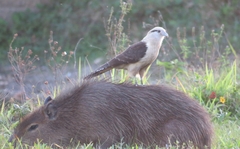
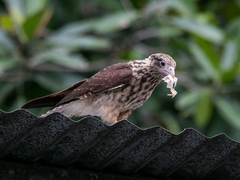
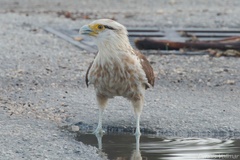
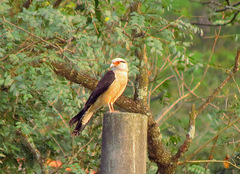
Yellow-Headed Caracara

Yellow-Headed Caracara

Milvago chimachima

LCLeast ConcernNTVUENCR
Daily sighting probability ~50% · Likely
at Caracas

In 3 days ~90% in a week >90%

6,681 Verified sightings at Caracas
21,657 In all 38 parks From 2019 to 2026
December Best month
☀️ Diurnal When it's spotted

About the Yellow-Headed Caracara

The yellow-headed caracara (Daptrius chimachima) is a new-world bird of prey in the family Falconidae, of the Falconiformes order (true falcons, caracaras and their kin). It can be found in North America and South America, from Nicaragua to Uruguay.

The yellow-headed caracara was formally described in 1816 by French ornithologist Louis Vieillot with the binomial name Polyborus chimachima. Vieillot based his account on the "Chimachima" from Paraguay that had been described by the Spanish naturalist Félix de Azara in 1802. The specific epithet is from a local Argentinian onomatopoeia word "Chimachima" for a caracara. The yellow-headed caracara was formerly placed with the chimango caracara in the genus Milvago. Molecular genetic studies found that Milvago was polyphyletic with the chimango caracara sister to the genus Phalcoboenus and the yellow-headed caracara sister to species in the genus Daptrius. As the genetic divergence was relatively shallow, the polyphyly was resolved by expanding the genus Daptrius to include the two other genera.

Two subspecies are recognised:

Wikipedia →

Sounds

Call0:08

Brazil · 2026

© JAYRSON ARAUJO DE OLIVEIRA · XC1166862 · CC BY-NC-SA 4.0

Song0:25

Brazil · 2022

© João Vitor Oliveira de Souza · XC744716 · CC BY-NC-SA 4.0

Alarm call0:39

Colombia · 2020

© Urias Edgardo Gonzalez Carreño · XC743890 · CC BY-NC-SA 4.0

Global Distribution

Parks Where Found

# Park Country Daily sighting probability
1 Coiba National Park 🇵🇦 Panama
~70%
2 Soberanía National Park 🇵🇦 Panama
~50%
3 Emas National Park 🇧🇷 Brazil
~50%
4 Carara National Park 🇨🇷 Costa Rica
~50%
5 Tayrona National Natural Park 🇨🇴 Colombia
~40%
6 San Lorenzo Protected Forest 🇵🇦 Panama
~40%
7 Marino Ballena National Park 🇨🇷 Costa Rica
~40%
8 Piedras Blancas National Park 🇨🇷 Costa Rica
~40%
9 Manuel Antonio National Park 🇨🇷 Costa Rica
~40%
10 Corcovado National Park 🇨🇷 Costa Rica
~40%
11 Main Ridge Forest Reserve 🇹🇹 Trinidad and Tobago
~40%
12 Iberá National Park 🇦🇷 Argentina
~40%
13 Amacayacu National Natural Park 🇨🇴 Colombia
~40%
14 Parque Natural Metropolitano 🇵🇦 Panama
~30%
15 Las Baulas Marine National Park 🇨🇷 Costa Rica
~30%
16 El Palmar National Park 🇦🇷 Argentina
~30%
17 Anavilhanas National Park 🇧🇷 Brazil
~30%
18 Caroni Swamp 🇹🇹 Trinidad and Tobago
~20%
19 Henri Pittier National Park 🇻🇪 Venezuela
~20%
20 Serra da Canastra National Park 🇧🇷 Brazil
~20%
21 Bastimentos Island National Marine Park 🇵🇦 Panama
~20%
22 Farallones de Cali National Natural Park 🇨🇴 Colombia
~20%
23 Ostional Wildlife Refuge 🇨🇷 Costa Rica
~20%
24 Itatiaia National Park 🇧🇷 Brazil
~20%
25 Iguazú National Park 🇦🇷 Argentina
~20%
26 Iguaçu National Park 🇧🇷 Brazil
~20%
27 La Amistad International Park (Panama) 🇵🇦 Panama
~20%
28 Chirripó National Park 🇨🇷 Costa Rica
~20%
29 Chagres National Park 🇵🇦 Panama
~20%
30 Serra dos Órgãos National Park 🇧🇷 Brazil
~20%
31 Tijuca National Park 🇧🇷 Brazil
~20%
32 Cuyabeno Wildlife Reserve 🇪🇨 Ecuador
~10%
33 Yasuní National Park 🇪🇨 Ecuador
~10%
34 Cahuita National Park 🇨🇷 Costa Rica
~10%
35 Arenal Volcano National Park 🇨🇷 Costa Rica
~10%
36 Gandoca-Manzanillo Wildlife Refuge 🇨🇷 Costa Rica
~10%
37 Los Nevados National Natural Park 🇨🇴 Colombia
~10%
38 Tapantí-Macizo de la Muerte National Park 🇨🇷 Costa Rica
~10%

Cities Where Found

# City Country Daily sighting probability
1 Cali 🇨🇴 Colombia
~80%
2 Barranquilla 🇨🇴 Colombia
~60%
3 Caracas 🇻🇪 Venezuela
~50%
4 Vitória 🇧🇷 Brazil
~40%
5 São Luís 🇧🇷 Brazil
~40%
6 Panama City 🇵🇦 Panama
~40%
7 Medellín 🇨🇴 Colombia
~30%
8 Valencia 🇻🇪 Venezuela
~30%
9 Belém 🇧🇷 Brazil
~30%
10 Rio de Janeiro 🇧🇷 Brazil
~20%

Zoos & Centres Where Found

# Zoo / Centre Country
1 Parque Municipal Summit 🇵🇦 Panama In captivity
2 Ukumarí Biopark 🇨🇴 Colombia In captivity
3 Gramado Zoo 🇧🇷 Brazil In captivity
4 Zoológico Municipal de Cascavel 🇧🇷 Brazil In captivity
5 Municipal Zoological Park Quinzinho de Barros 🇧🇷 Brazil In captivity
6 Complejo Turistico de Quistococha 🇵🇪 Peru In captivity
7 Aviario Nacional de Colombia 🇨🇴 Colombia In captivity
8 Zoológico Municipal de Guarulhos 🇧🇷 Brazil In captivity
9 Gauntlet Birds of Prey 🇬🇧 United Kingdom In captivity
10 Parque dos Falcões 🇧🇷 Brazil In captivity
11 Suffolk Owl Sanctuary 🇬🇧 United Kingdom In captivity
12 Zoológico do Município de São Bernardo do Campo 🇧🇷 Brazil In captivity
13 Eureka Orchideeën en Vogelbush 🇳🇱 Netherlands In captivity

Before you go

What are the chances of seeing a Yellow-Headed Caracara in Caracas?

Likely

About 50% of wildlife watchers report a Yellow-Headed Caracara sighting in Caracas on a given day, based on 6,681 verified sightings from GBIF citizen-science data. It is the 12th most-seen of the 298 birds we can rate there. Over three days the chance rises to about 90%, and over a week to over 90%, if each day is a fresh chance.

When is the best time to see a Yellow-Headed Caracara in Caracas?

May and October–January

In those months about 60% of wildlife watchers report a Yellow-Headed Caracara in Caracas on a given day, against about 50% in February–April and June–September, the lowest months.

What time of day is best to see a Yellow-Headed Caracara?

Between 3 and 6 pm

Across all the parks we cover, that three-hour window holds the most Yellow-Headed Caracara sightings with a recorded time, and about 9 in 10 of them come between 6 am and 6 pm: it is a daytime animal.

Is Caracas the best place to see a Yellow-Headed Caracara?

3rd of 30

Of the 30 cities where we can rate Yellow-Headed Caracara sightings, Caracas ranks 3rd at about 50%. The best odds are in Cali (Colombia, about 80%) and Barranquilla (Colombia, about 60%).

Which relatives of the Yellow-Headed Caracara live in Caracas?

Same family: Falconidae

The closest relatives of the Yellow-Headed Caracara that you can see in Caracas (family Falconidae, Falcons and Caracaras) are Crested Caracara (about 10%) and Aplomado Falcon (about 10%), with each one's daily chance of a sighting.

Where does the Yellow-Headed Caracara sighting chance come from?

GBIF citizen-science records

It is estimated from how often the Yellow-Headed Caracara is recorded against all the birds logged in Caracas (6,681 verified sightings), calibrated against known sighting rates. Figures are rounded to the nearest 10% because citizen-science data supports honest approximations, not decimals, and months with records from fewer than five people show "—". How it works.

← Back to Caracas