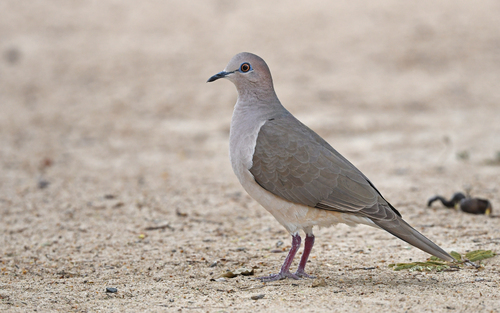
Blue Ground-Dove

Blue Ground-Dove

Claravis pretiosa

Silhouette: Sheatherius · PhyloPic

LCLeast ConcernNTVUENCR
Daily sighting probability <5% · Rare
at Cochabamba

In 3 days ~10%

6 Verified sightings at Cochabamba
3,188 In all 40 parks From 2019 to 2026
September Best month
☀️ Diurnal When it's spotted

About the Blue Ground-Dove

The blue ground dove (Claravis pretiosa) is a small New World tropical dove. It is a resident breeder from southeastern Mexico to northwestern Peru and northern Argentina, and on Trinidad in the Caribbean. The blue ground dove is relatively common in open woodland, forest edges, clearings and roadsides, especially in more humid areas. It is found from sea level to about 1200 m altitude. It builds a flimsy dish nest of twigs 1–11 m high in a tree and lays two white eggs.

Blue ground doves are small pigeons, 20 cm long with a weight of 65–72 g. Adult males have blue-grey upperparts and paler grey underparts, becoming grey-white on the face. The flight feathers and outer tail feathers are blackish, and the wings are boldly spotted black (these spots often forming distinct bands). The iris is red or yellow, the bare eyering is green, and the legs are flesh-pink. The female has a grey-brown head neck and breast, becoming pale blue-grey on the underwings and belly. The back is ruddy brown, contrasting with the chestnut rump and tail. The spots in the wings are chestnut-brown. Young birds resemble the female, but have ruddy scaling on the back... Wikipedia →

Sounds

Call0:14

Argentina · 2026

© Marcos E. Sosa · XC1084175 · CC BY-NC-SA 4.0

Song0:24

Brazil · 2025

© Joost van Bruggen · XC1050442 · CC BY-NC-ND 4.0

Call0:07

Brazil · 2025

© JAYRSON ARAUJO DE OLIVEIRA · XC974433 · CC BY-NC-SA 4.0

Global Distribution

Parks Where Found

# Park Country Daily sighting probability
1 Calakmul Biosphere Reserve 🇲🇽 Mexico
~20%
2 Piedras Blancas National Park 🇨🇷 Costa Rica
~20%
3 Montes Azules Biosphere Reserve 🇲🇽 Mexico
~10%
4 Cockscomb Basin Wildlife Sanctuary 🇧🇿 Belize
~10%
5 Pico Bonito National Park 🇭🇳 Honduras
~10%
6 Chapada dos Guimarães National Park 🇧🇷 Brazil
~10%
7 Machalilla National Park 🇪🇨 Ecuador
~10%
8 Manuel Antonio National Park 🇨🇷 Costa Rica
~10%
9 Corcovado National Park 🇨🇷 Costa Rica
~10%
10 Utría National Natural Park 🇨🇴 Colombia
~10%
11 Bastimentos Island National Marine Park 🇵🇦 Panama
~10%
12 Tikal National Park 🇬🇹 Guatemala
~10%
13 Chapada Diamantina National Park 🇧🇷 Brazil
<5%
14 Parque Estadual Encontro das Águas 🇧🇷 Brazil
<5%
15 Cerro Azul Meámbar National Park 🇭🇳 Honduras
<5%
16 La Amistad International Park (Panama) 🇵🇦 Panama
<5%
17 Amboró National Park 🇧🇴 Bolivia
<5%
18 Carara National Park 🇨🇷 Costa Rica
<5%
19 Sierra de la Macarena National Park 🇨🇴 Colombia
<5%
20 Santa Rosa National Park 🇨🇷 Costa Rica
<5%
21 Iguazú National Park 🇦🇷 Argentina
<5%
22 Henri Pittier National Park 🇻🇪 Venezuela
<5%
23 Cuyabeno Wildlife Reserve 🇪🇨 Ecuador
<5%
24 Chagres National Park 🇵🇦 Panama
<5%
25 Iguaçu National Park 🇧🇷 Brazil
<5%
26 Gandoca-Manzanillo Wildlife Refuge 🇨🇷 Costa Rica
<5%
27 Volcán Barú National Park 🇵🇦 Panama
<5%
28 Darién National Park 🇵🇦 Panama
<5%
29 Soberanía National Park 🇵🇦 Panama
<5%
30 Palo Verde National Park 🇨🇷 Costa Rica
<5%
31 Tayrona National Natural Park 🇨🇴 Colombia
<5%
32 Marino Ballena National Park 🇨🇷 Costa Rica
<5%
33 Cahuita National Park 🇨🇷 Costa Rica
<5%
34 Tambopata National Reserve 🇵🇪 Peru
<5%
35 Tortuguero National Park 🇨🇷 Costa Rica
<5%
36 Tijuca National Park 🇧🇷 Brazil
<5%
37 Braulio Carrillo National Park 🇨🇷 Costa Rica
<5%
38 Parque Natural Metropolitano 🇵🇦 Panama
<5%
39 Manu National Park 🇵🇪 Peru
<5%
40 Arenal Volcano National Park 🇨🇷 Costa Rica
<5%

Cities Where Found

# City Country Daily sighting probability
1 Guayaquil 🇪🇨 Ecuador
<5%
2 Cochabamba 🇧🇴 Bolivia
<5%
3 Caracas 🇻🇪 Venezuela
<5%
4 Panama City 🇵🇦 Panama
<5%
5 Rio de Janeiro 🇧🇷 Brazil
<5%

Zoos & Centres Where Found

# Zoo / Centre Country
1 Pairi Daiza 🇧🇪 Belgium In captivity
2 National Zoological Park 🇺🇸 United States In captivity
3 Natura Artis Magistra 🇳🇱 Netherlands In captivity
4 Antwerp Zoo 🇧🇪 Belgium In captivity
5 Zoo Miami 🇺🇸 United States In captivity
6 Burgers' Ocean 🇳🇱 Netherlands In captivity
7 Royal Burgers' Zoo 🇳🇱 Netherlands In captivity
8 Singapore Zoo 🇸🇬 Singapore In captivity
9 Wilhelma 🇩🇪 Germany In captivity
10 Bird Paradise 🇸🇬 Singapore In captivity
11 Rainforest Wild Asia 🇸🇬 Singapore In captivity
12 Vogelpark Avifauna 🇳🇱 Netherlands In captivity
13 Santillana Zoo 🇪🇸 Spain In captivity
14 Zoo Lagos 🇵🇹 Portugal In captivity
15 Agroflori Parque de las Aves 🇧🇴 Bolivia In captivity
16 Aquatopia 🇧🇪 Belgium In captivity

Before you go

What are the chances of seeing a Blue Ground-Dove in Cochabamba?

Rare

Under 5% of wildlife watchers report a Blue Ground-Dove sighting in Cochabamba on a given day, based on 6 verified sightings from GBIF citizen-science data. It is the 108th most-seen of the 112 birds we can rate there. Over three days the chance rises to about 10%, if each day is a fresh chance.

When is the best time to see a Blue Ground-Dove in Cochabamba?

September

In that month about 10% of wildlife watchers report a Blue Ground-Dove in Cochabamba on a given day, against under 5% in October to August, the lowest months. That is one of Cochabamba's driest months, with about 10 mm of rain against 100 mm in January.

What time of day is best to see a Blue Ground-Dove?

Between 7 and 10 am

Across all the parks we cover, that three-hour window holds the most Blue Ground-Dove sightings with a recorded time, and nearly all of them come between 6 am and 6 pm: it is a daytime animal.

Is Cochabamba the best place to see a Blue Ground-Dove?

Among the best

Of the 5 cities where we can rate Blue Ground-Dove sightings, Cochabamba ranks 2nd at under 5%, level with the leaders once rounded. The best odds are in Guayaquil (Ecuador, under 5%).

Which relatives of the Blue Ground-Dove live in Cochabamba?

Same family: Columbidae

The closest relatives of the Blue Ground-Dove that you can see in Cochabamba (family Columbidae, Pigeons and Doves) are Eared Dove (about 90%), Rock Pigeon (about 50%) and Picuí Ground-Dove (about 40%), with each one's daily chance of a sighting.

Where does the Blue Ground-Dove sighting chance come from?

GBIF citizen-science records

It is estimated from how often the Blue Ground-Dove is recorded against all the birds logged in Cochabamba (6 verified sightings), calibrated against known sighting rates. Figures are rounded to the nearest 10% because citizen-science data supports honest approximations, not decimals, and months with records from fewer than five people show "—". How it works.

← Back to Cochabamba