Yellow-bellied Flycatcher

Yellow-bellied Flycatcher

Empidonax flaviventris

Silhouette: Emily Willoughby · PhyloPic

LCLeast ConcernNTVUENCR
Daily sighting probability ~20% · Possible
at El Triunfo

In 3 days ~60% in a week ~90%

45 Verified sightings at El Triunfo From 2019 to 2026
10,587 In all 49 parks
February Best month
☀️ Diurnal When it's spotted

About the Yellow-bellied Flycatcher

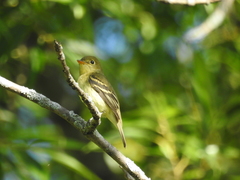
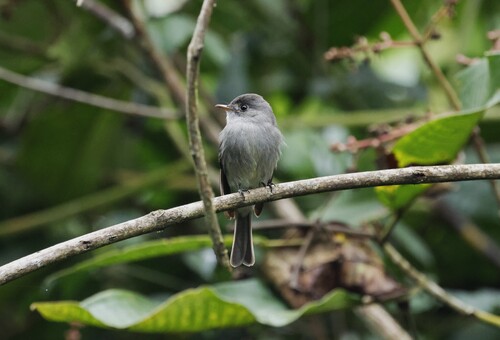
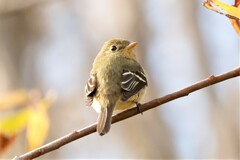
The yellow-bellied flycatcher (Empidonax flaviventris) is a small insect-eating bird of the tyrant flycatcher family. Adults have greenish upperparts and yellowish underparts (especially on the throat), with a dusky wash on the chest. They have a white or yellow eye ring that lacks the teardrop projection of the western flycatcher, white or yellowish wing bars that contrast strongly against the black wings, a broad, flat bill, and a relatively short tail when compared to other members of the genus. The upper mandible of the bill is dark, while the lower mandible is orange-pink. DNA testing in 2014 confirmed a field mark, involving the extent of buffy edging on the secondaries, to reliably distinguish this species from the western flycatcher.

Measurements: Length: 5.1–5.9 in (13–15 cm) Weight: 0.3–0.6 oz (8.5–17.0 g) Wingspan: 7.1–7.9 in (18–20 cm) Yellow-bellied flycatchers wait on a perch low or in the middle of a tree and fly out to catch insects in flight, sometimes hovering over foliage. They sometimes eat berries or seeds.

The yellow-bellied flycatcher's song can be transcribed as a rough, descending "tse-berk", which can be similar to the more common least... Wikipedia →

Sounds

Call0:20

Guatemala · 2024

© Peter Boesman · XC880100 · CC BY-NC-ND 4.0

Song0:58

El Salvador · 2018

© Mario Trejo · XC404658 · CC BY-NC-SA 4.0

Dawn song1:26

United States · 2012

© Andrew Spencer · XC110098 · CC BY-NC-SA 3.0

Global Distribution

Parks Where Found

# Park Country Daily sighting probability
1 Gros Morne National Park 🇨🇦 Canada
~50%
2 Cockscomb Basin Wildlife Sanctuary 🇧🇿 Belize
~40%
3 Cerro Azul Meámbar National Park 🇭🇳 Honduras
~30%
4 Pico Bonito National Park 🇭🇳 Honduras
~30%
5 Tikal National Park 🇬🇹 Guatemala
~20%
6 El Triunfo 🇲🇽 Mexico
~20%
7 Biotopo Cerro Cahuí 🇬🇹 Guatemala
~20%
8 Cusuco National Park 🇭🇳 Honduras
~20%
9 Calakmul Biosphere Reserve 🇲🇽 Mexico
~20%
10 Lago de Yojoa 🇭🇳 Honduras
~20%
11 Montes Azules Biosphere Reserve 🇲🇽 Mexico
~20%
12 Santa Rosa National Park 🇨🇷 Costa Rica
~10%
13 Rincón de la Vieja National Park 🇨🇷 Costa Rica
~10%
14 Corcovado National Park 🇨🇷 Costa Rica
~10%
15 Piedras Blancas National Park 🇨🇷 Costa Rica
~10%
16 Carara National Park 🇨🇷 Costa Rica
~10%
17 Tenorio Volcano National Park 🇨🇷 Costa Rica
~10%
18 Arenal Volcano National Park 🇨🇷 Costa Rica
~10%
19 Celaque National Park 🇭🇳 Honduras
~10%
20 Chirripó National Park 🇨🇷 Costa Rica
~10%
21 Manuel Antonio National Park 🇨🇷 Costa Rica
~10%
22 Cabo Blanco Absolute Nature Reserve 🇨🇷 Costa Rica
~10%
23 Cañón del Sumidero National Park 🇲🇽 Mexico
~10%
24 Tapantí-Macizo de la Muerte National Park 🇨🇷 Costa Rica
~10%
25 Isle Royale National Park 🇺🇸 United States
~10%
26 Cape Breton Highlands National Park 🇨🇦 Canada
~10%
27 La Amistad International Park (Panama) 🇵🇦 Panama
~10%
28 Point Pelee National Park 🇨🇦 Canada
<5%
29 Cahuita National Park 🇨🇷 Costa Rica
<5%
30 Marino Ballena National Park 🇨🇷 Costa Rica
<5%
31 La Tigra National Park 🇭🇳 Honduras
<5%
32 Braulio Carrillo National Park 🇨🇷 Costa Rica
<5%
33 Jasper National Park 🇨🇦 Canada
<5%
34 Palo Verde National Park 🇨🇷 Costa Rica
<5%
35 Cumbres de Monterrey National Park 🇲🇽 Mexico
<5%
36 Riding Mountain National Park 🇨🇦 Canada
<5%
37 Gandoca-Manzanillo Wildlife Refuge 🇨🇷 Costa Rica
<5%
38 Monteverde Cloud Forest Reserve 🇨🇷 Costa Rica
<5%
39 Volcán Barú National Park 🇵🇦 Panama
<5%
40 Ostional Wildlife Refuge 🇨🇷 Costa Rica
<5%
41 Tortuguero National Park 🇨🇷 Costa Rica
<5%
42 Irazú Volcano National Park 🇨🇷 Costa Rica
<5%
43 Poás Volcano National Park 🇨🇷 Costa Rica
<5%
44 Los Quetzales National Park 🇨🇷 Costa Rica
<5%
45 Acadia National Park 🇺🇸 United States
<5%
46 Las Baulas Marine National Park 🇨🇷 Costa Rica
<5%
47 Arrecifes de Cozumel National Park 🇲🇽 Mexico
<5%
48 Celestún Biosphere Reserve 🇲🇽 Mexico
<5%
49 Masaya Volcano National Park 🇳🇮 Nicaragua
<5%

Cities Where Found

# City Country Daily sighting probability
1 San José 🇨🇷 Costa Rica
<5%
2 Guatemala City 🇬🇹 Guatemala
<5%
3 Tegucigalpa 🇭🇳 Honduras
<5%
4 Chicago 🇺🇸 United States
<5%
5 San Antonio 🇺🇸 United States
<5%
6 San Salvador 🇸🇻 El Salvador
<5%
7 Toronto 🇨🇦 Canada
<5%
8 Austin 🇺🇸 United States
<5%
9 Houston 🇺🇸 United States
<5%
10 Montreal 🇨🇦 Canada
<5%

Before you go

What are the chances of seeing a Yellow-bellied Flycatcher in El Triunfo?

Possible

About 20% of wildlife watchers report a Yellow-bellied Flycatcher sighting in El Triunfo on a given day, based on 45 verified sightings from GBIF citizen-science data from 2019 to 2026. It is the 69th most-seen of the 221 birds we can rate there. Over three days the chance rises to about 60%, and over a week to about 90%, if each day is a fresh chance.

When is the best time to see a Yellow-bellied Flycatcher in El Triunfo?

February and April

In those months about 50% of wildlife watchers report a Yellow-bellied Flycatcher in El Triunfo on a given day, against about 10% in March, May and July–January, the lowest months. Those are among El Triunfo's driest months, with about 40 mm of rain a month against 420 mm in June. June has too few records to rate.

What time of day is best to see a Yellow-bellied Flycatcher?

Between 8 and 11 am

Across all the parks we cover, that three-hour window holds the most Yellow-bellied Flycatcher sightings with a recorded time, and about 9 in 10 of them come between 6 am and 6 pm: it is a daytime animal.

Which relatives of the Yellow-bellied Flycatcher live in El Triunfo?

Same genus: Empidonax

The closest relatives of the Yellow-bellied Flycatcher that you can see in El Triunfo (genus Empidonax, Empidonax Flycatchers) are Yellowish Flycatcher (about 20%), Least Flycatcher (about 20%) and Hammond's Flycatcher (about 10%), with each one's daily chance of a sighting.

Where does the Yellow-bellied Flycatcher sighting chance come from?

GBIF citizen-science records

It is estimated from how often the Yellow-bellied Flycatcher is recorded against all the birds logged in El Triunfo (45 verified sightings from 2019 to 2026), calibrated against known sighting rates. Figures are rounded to the nearest 10% because citizen-science data supports honest approximations, not decimals, and months with records from fewer than five people show "—". How it works.

← Back to El Triunfo