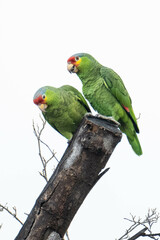
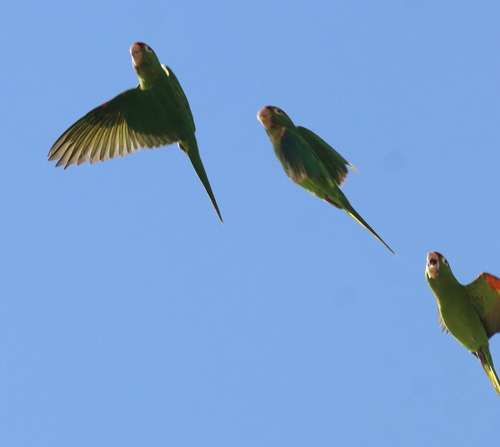
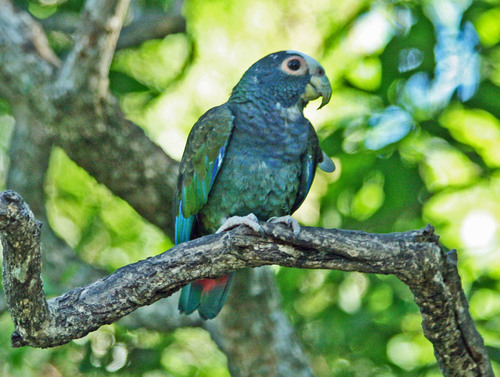
Red-lored Parrot

Red-lored Parrot

Amazona autumnalis

Silhouette: Ferran Sayol · PhyloPic

LCLeast ConcernNTVUENCR
Daily sighting probability ~20% · Possible
at Manuel Antonio National Park

In 3 days ~40% in a week ~70%

361 Verified sightings at Manuel Antonio National Park From 2019 to 2026
35,871 In all 42 parks
December Best month
☀️ Diurnal When it's spotted

About the Red-lored Parrot

The red-lored amazon or red-lored parrot (Amazona autumnalis) is a species of amazon parrot, native to tropical regions of the Americas, from eastern Mexico south to Ecuador where it occurs in humid evergreen to semi-deciduous forests up to 1,100 m altitude. It is absent from the Pacific side of Central America north of Costa Rica. Not originally known from El Salvador, a pair - perhaps escaped from captivity - nested successfully in 1995 and 1996 in the outskirts of San Salvador and the species might expand its range permanently into that country in the future. This species has also established feral populations in several California cities.

The red-lored amazon was formally described in 1758 by the Swedish naturalist Carl Linnaeus in the tenth edition of his Systema Naturae. He placed it with all the other parrots in the genus Psittacus and coined the binomial name Psittacus autumnalis. Linnaeus based his description on the "lesser green parrot" that had been described and illustrated in 1751 by the English naturalist George Edwards in the fourth volume of his A Natural History of Uncommon Birds. Edwards mistakenly believed his specimen had come from the West Indies... Wikipedia →

Sounds

Call1:08

Ecuador · 2021

© Manuel Sánchez-Nivicela · XC1157381 · CC BY-NC-ND 4.0

Flight call0:45

Costa Rica · 2018

© Simon Elliott · XC597424 · CC BY-NC-ND 4.0

Song0:22

Panama · 2020

© Kent Livezey · XC580511 · CC BY-NC-SA 4.0

Global Distribution

Parks Where Found

# Park Country Daily sighting probability
1 Bastimentos Island National Marine Park 🇵🇦 Panama
~70%
2 Tikal National Park 🇬🇹 Guatemala
~70%
3 Soberanía National Park 🇵🇦 Panama
~60%
4 Gandoca-Manzanillo Wildlife Refuge 🇨🇷 Costa Rica
~50%
5 Marino Ballena National Park 🇨🇷 Costa Rica
~50%
6 Piedras Blancas National Park 🇨🇷 Costa Rica
~50%
7 Montes Azules Biosphere Reserve 🇲🇽 Mexico
~40%
8 Tortuguero National Park 🇨🇷 Costa Rica
~40%
9 Arenal Volcano National Park 🇨🇷 Costa Rica
~40%
10 Cockscomb Basin Wildlife Sanctuary 🇧🇿 Belize
~40%
11 Corcovado National Park 🇨🇷 Costa Rica
~30%
12 San Lorenzo Protected Forest 🇵🇦 Panama
~30%
13 Tenorio Volcano National Park 🇨🇷 Costa Rica
~30%
14 Rincón de la Vieja National Park 🇨🇷 Costa Rica
~30%
15 La Amistad International Park (Panama) 🇵🇦 Panama
~30%
16 Coiba National Park 🇵🇦 Panama
~30%
17 Darién National Park 🇵🇦 Panama
~20%
18 Cahuita National Park 🇨🇷 Costa Rica
~20%
19 Parque Natural Metropolitano 🇵🇦 Panama
~20%
20 Cabo Blanco Absolute Nature Reserve 🇨🇷 Costa Rica
~20%
21 Braulio Carrillo National Park 🇨🇷 Costa Rica
~20%
22 Lago de Yojoa 🇭🇳 Honduras
~20%
23 Utría National Natural Park 🇨🇴 Colombia
~20%
24 Carara National Park 🇨🇷 Costa Rica
~20%
25 Manuel Antonio National Park 🇨🇷 Costa Rica
~20%
26 Cerro Azul Meámbar National Park 🇭🇳 Honduras
~10%
27 Pico Bonito National Park 🇭🇳 Honduras
~10%
28 Chagres National Park 🇵🇦 Panama
~10%
29 Tapantí-Macizo de la Muerte National Park 🇨🇷 Costa Rica
~10%
30 Calakmul Biosphere Reserve 🇲🇽 Mexico
~10%
31 Anavilhanas National Park 🇧🇷 Brazil
<5%
32 Biotopo Cerro Cahuí 🇬🇹 Guatemala
<5%
33 Santa Rosa National Park 🇨🇷 Costa Rica
<5%
34 Cañón del Sumidero National Park 🇲🇽 Mexico
<5%
35 Ostional Wildlife Refuge 🇨🇷 Costa Rica
<5%
36 Cusuco National Park 🇭🇳 Honduras
<5%
37 Palo Verde National Park 🇨🇷 Costa Rica
<5%
38 Las Baulas Marine National Park 🇨🇷 Costa Rica
<5%
39 Monteverde Cloud Forest Reserve 🇨🇷 Costa Rica
<5%
40 Poás Volcano National Park 🇨🇷 Costa Rica
<5%
41 Cumbres de Monterrey National Park 🇲🇽 Mexico
<5%
42 Farallones de Cali National Natural Park 🇨🇴 Colombia
<5%

Cities Where Found

# City Country Daily sighting probability
1 León 🇲🇽 México
~10%
2 Panama City 🇵🇦 Panama
~10%
3 Monterrey 🇲🇽 México
~10%
4 Cali 🇨🇴 Colombia
<5%
5 Guadalajara 🇲🇽 México
<5%
6 Medellín 🇨🇴 Colombia
<5%
7 Guayaquil 🇪🇨 Ecuador
<5%
8 San José 🇨🇷 Costa Rica
<5%
9 Mexico City 🇲🇽 México
<5%
10 Los Angeles 🇺🇸 United States
<5%

Zoos & Centres Where Found

# Zoo / Centre Country
1 Skansen 🇸🇪 Sweden In captivity
2 Zoobotánico Jerez 🇪🇸 Spain In captivity
3 Bioparque Estrella 🇲🇽 Mexico In captivity
4 Bronx Zoo 🇺🇸 United States In captivity
5 Yumka' 🇲🇽 Mexico In captivity
6 Ecological Center of Sonora 🇲🇽 Mexico In captivity
7 Zoofari 🇲🇽 Mexico In captivity
8 Parque Municipal Summit 🇵🇦 Panama In captivity
9 Parco Natura Viva 🇮🇹 Italy In captivity
10 Xcaret 🇲🇽 Mexico In captivity
11 Guadalajara Zoo 🇲🇽 Mexico In captivity
12 Zoológico de San Juan de Aragón 🇲🇽 Mexico In captivity
13 Ukumarí Biopark 🇨🇴 Colombia In captivity
14 Branson's Promised Land Zoo 🇺🇸 United States In captivity
15 San Francisco Zoo 🇺🇸 United States In captivity
16 Lisbon Zoo 🇵🇹 Portugal In captivity
17 Zoológico Benito Juárez 🇲🇽 Mexico In captivity
18 Vallazoo 🇲🇽 Mexico In captivity
19 Zoológico la pastroa 🇲🇽 Mexico In captivity
20 Schönbrunn Zoo 🇦🇹 Austria In captivity
21 Zoológico del Altiplano 🇲🇽 Mexico In captivity
22 Zoológico Los Coyotes 🇲🇽 Mexico In captivity
23 Gladys Porter Zoo 🇺🇸 United States In captivity
24 La Paz Waterfall Gardens 🇨🇷 Costa Rica In captivity
25 Aviario Nacional de Colombia 🇨🇴 Colombia In captivity
26 Loro Parque 🇪🇸 Spain In captivity
27 Mundo Granjero y Zoológico 🇲🇽 Mexico In captivity
28 Parque del pueblo 🇲🇽 Mexico In captivity
29 Safari Masai Mara 🇲🇽 Mexico In captivity
30 UMA "El Palapo" 🇲🇽 Mexico In captivity
31 Parque de la Conservación 🇨🇴 Colombia In captivity
32 Delfinario Sonora 🇲🇽 Mexico In captivity
33 Palmitos Park 🇪🇸 Spain In captivity
34 Parque Zoológico Miguel Ángel de Quevedo 🇲🇽 Mexico In captivity
35 Salisbury Zoo 🇺🇸 United States In captivity
36 Wamerú zoo 🇲🇽 Mexico In captivity
37 Xenpal 🇲🇽 Mexico In captivity
38 Zoológico Tamatán 🇲🇽 Mexico In captivity
39 Parque Zoológico El Pinar 🇻🇪 Venezuela In captivity
40 Rancho Mágico 🇲🇽 Mexico In captivity
41 Sarasota Jungle Gardens 🇺🇸 United States In captivity
42 Macaw mountain bird park 🇭🇳 Honduras In captivity
43 Croco Cun Zoo 🇲🇽 Mexico In captivity
44 El Nispero Zoo 🇵🇦 Panama In captivity
45 parque recreativo mirador 🇲🇽 Mexico In captivity
46 Zoológico de Culiacán 🇲🇽 Mexico In captivity
47 Zoologico Sahuatoba 🇲🇽 Mexico In captivity
48 ARCAS Petén Education Centre 🇬🇹 Guatemala In captivity
49 Parque museo La Venta 🇲🇽 Mexico In captivity
50 Unidad de Manejo Ambiental 🇲🇽 Mexico In captivity

Before you go

What are the chances of seeing a Red-lored Parrot in Manuel Antonio National Park?

Possible

About 20% of wildlife watchers report a Red-lored Parrot sighting in Manuel Antonio National Park on a given day, based on 361 verified sightings from GBIF citizen-science data from 2019 to 2026. It is the 51st most-seen of the 325 birds we can rate there. Over three days the chance rises to about 40%, and over a week to about 70%, if each day is a fresh chance.

When is the best time to see a Red-lored Parrot in Manuel Antonio National Park?

February–March, September and December

In those months about 20% of wildlife watchers report a Red-lored Parrot in Manuel Antonio National Park on a given day, against about 10% in January, April–August and October–November, the lowest months. Those are among Manuel Antonio National Park's driest months, with about 230 mm of rain a month against 950 mm in October.

What time of day is best to see a Red-lored Parrot?

Between 6 and 9 am

Across all the parks we cover, that three-hour window holds the most Red-lored Parrot sightings with a recorded time, and about 7 in 10 of them come between 6 am and 6 pm: it is a daytime animal.

Where does the Red-lored Parrot sighting chance come from?

GBIF citizen-science records

It is estimated from how often the Red-lored Parrot is recorded against all the birds logged in Manuel Antonio National Park (361 verified sightings from 2019 to 2026), calibrated against known sighting rates. Figures are rounded to the nearest 10% because citizen-science data supports honest approximations, not decimals, and months with records from fewer than five people show "—". How it works.

← Back to Manuel Antonio National Park