




Completed

House Sparrow
Passer domesticus
- KingdomAnimalia (Animals)
- PhylumChordata (Chordates)
- ClassAves (Birds)
- OrderPasseriformes (Perching Birds)
- FamilyPasseridae (Old World Sparrows)
- GenusPasser (True Sparrows)
- SpeciesPasser domesticus (House Sparrow)
In 3 days ~60% in a week ~90%
126 Verified sightings at Royal Bardia National Park From 2019 to 2026
25,680 In all 56 parks
July Best month
☀️ Diurnal When it's spotted
About the House Sparrow
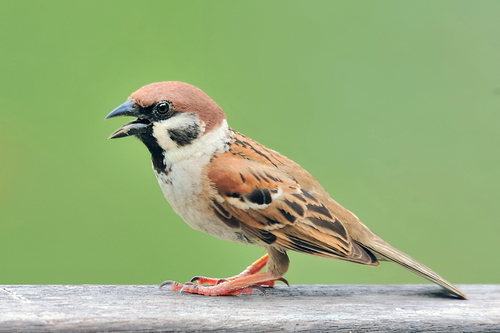
The house sparrow (Passer domesticus) is a bird of the sparrow family Passeridae, found in most parts of the world. It is a small bird that has a typical length of 16 cm (6.3 in) and a mass of 24–39.5 g (0.85–1.39 oz). Females and young birds are coloured pale brown and grey, and males have brighter black, white, and brown markings. One of 28 species in the genus Passer, the house sparrow is native to most of Europe, the Mediterranean Basin, and a large part of Asia. Its intentional or accidental introductions to many regions, including parts of Australasia, Africa, and the Americas, make it the most widely distributed wild bird.
The house sparrow is strongly associated with human habitation, and can live in urban or rural settings. Though found in widely varied habitats and climates, it typically avoids extensive woodlands, grasslands, polar regions, and hot, dry deserts far away from human development. For sustenance, the house sparrow routinely feeds at home and public bird feeding stations, but naturally feeds on the seeds of grains, flowering plants and weeds. However, it is an opportunistic, omnivorous eater, and commonly catches invertebrates such as insects and their larvae, caterpillars, and many other natural foods.
Because of its numbers, ubiquity, and association with human settlements, the house sparrow is culturally prominent. It is extensively, and usually unsuccessfully, persecuted as an agricultural pest. It has also often been kept as a pet, as well as being a food item and a symbol of lust, sexual potency, commonness, and vulgarity. Though it is widespread and abundant, its numbers have declined in some areas. The bird's conservation status is listed as least concern on the IUCN Red List.
Recent sightings of House Sparrow in Royal Bardia National Park
LIVEiNaturalistGlobal Distribution
Parks Where Found
Closest Relatives at Royal Bardia National Park







Before you go
What are the chances of seeing a House Sparrow in Royal Bardia National Park?
Possible
About 30% of wildlife watchers report a House Sparrow sighting in Royal Bardia National Park on a given day, based on 126 verified sightings from GBIF citizen-science data from 2019 to 2026. It is the 61st most-seen of the 237 birds we can rate there. Over three days the chance rises to about 60%, and over a week to about 90%, if each day is a fresh chance.
When is the best time to see a House Sparrow in Royal Bardia National Park?
July
In that month about 40% of wildlife watchers report a House Sparrow in Royal Bardia National Park on a given day, against about 10% in June and September, the lowest months. That is one of Royal Bardia National Park's wettest months, with about 590 mm of rain against almost none in November. August has too few records to rate.
What time of day is best to see a House Sparrow?
Between 10 am and 1 pm
Across all the parks we cover, that three-hour window holds the most House Sparrow sightings with a recorded time, and about 9 in 10 of them come between 6 am and 6 pm: it is a daytime animal.
Is Royal Bardia National Park the best place to see a House Sparrow?
23rd of 56
Of the 56 parks where we can rate House Sparrow sightings, Royal Bardia National Park ranks 23rd at about 30%. The best odds are in Doñana National Park (Spain, about 70%), Monfragüe National Park (Spain, about 70%) and Sierra Nevada National Park (Spain, about 60%). All parks ranked.
Where does the House Sparrow sighting chance come from?
GBIF citizen-science records
It is estimated from how often the House Sparrow is recorded against all the birds logged in Royal Bardia National Park (126 verified sightings from 2019 to 2026), calibrated against known sighting rates. Figures are rounded to the nearest 10% because citizen-science data supports honest approximations, not decimals, and months with records from fewer than five people show "—". How it works.
