Ruddy Quail-Dove

Ruddy Quail-Dove

Geotrygon montana

Silhouette: Sheatherius · PhyloPic

LCLeast ConcernNTVUENCR
Daily sighting probability <5% · Rare
at Santo Domingo

In 3 days <5% in a week ~10%

9 Verified sightings at Santo Domingo
4,091 In all 46 parks From 2019 to 2026
June Best month
☀️ Diurnal When it's spotted

About the Ruddy Quail-Dove

The ruddy quail-dove (Geotrygon montana) is a species of bird in the dove and pigeon family Columbidae. It breeds throughout the West Indies, Central America, and tropical South America. It has appeared as a vagrant in Florida and southern Texas. It lays two buff-colored eggs on a flimsy platform built on a shrub. Some nests are built on the ground.

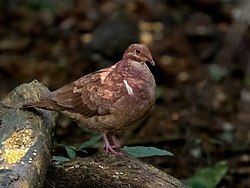
The ruddy quail-dove is approximately 19–28 cm in length. The bird is distinguished by having a rust-colored back, facial mask and similarly colored wings. The breast, rump and undereye stripe are lighter brown. This bird is found in woodland and scrub forest. It also has adapted to coffee plantations. It is somewhat sensitive to forest fragmentation. These birds forage on the ground, mainly eating seeds. It will also take small invertebrates in its diet.

In the first half of the 18th century the ruddy quail-dove was described and illustrated by several naturalists including John Ray in 1713, Hans Sloane in 1725 and George Edwards in 1743. When in 1758 the Swedish naturalist Carl Linnaeus updated his Systema Naturae for the tenth edition, he placed the ruddy quail-dove with all the... Wikipedia →

Sounds

Song0:35

Brazil · 2023

© JAYRSON ARAUJO DE OLIVEIRA · XC838408 · CC BY-NC-SA 4.0

Call0:26

Costa Rica · 2020

© Steve Hampton · XC542276 · CC BY-NC-SA 4.0

Recording0:45

Colombia · 2002

© Sergio Córdoba-Córdoba (Colección de Sonidos Ambientales - Instituto Humboldt) · XC533018 · CC BY-NC-SA 4.0

Global Distribution

Parks Where Found

# Park Country Daily sighting probability
1 Blue and John Crow Mountains National Park 🇯🇲 Jamaica
~30%
2 Los Haitises National Park 🇩🇴 Dominican Republic
~20%
3 Brownsberg Nature Park 🇸🇷 Suriname
~20%
4 Corcovado National Park 🇨🇷 Costa Rica
~10%
5 Carara National Park 🇨🇷 Costa Rica
~10%
6 Ciénaga de Zapata 🇨🇺 Cuba
~10%
7 Calakmul Biosphere Reserve 🇲🇽 Mexico
~10%
8 Piedras Blancas National Park 🇨🇷 Costa Rica
~10%
9 Cockscomb Basin Wildlife Sanctuary 🇧🇿 Belize
~10%
10 Tikal National Park 🇬🇹 Guatemala
~10%
11 Tambopata National Reserve 🇵🇪 Peru
~10%
12 Henri Pittier National Park 🇻🇪 Venezuela
~10%
13 Iguaçu National Park 🇧🇷 Brazil
~10%
14 Iguazú National Park 🇦🇷 Argentina
<5%
15 Manu National Park 🇵🇪 Peru
<5%
16 Amboró National Park 🇧🇴 Bolivia
<5%
17 Darién National Park 🇵🇦 Panama
<5%
18 Yasuní National Park 🇪🇨 Ecuador
<5%
19 Pico Bonito National Park 🇭🇳 Honduras
<5%
20 Cerro Azul Meámbar National Park 🇭🇳 Honduras
<5%
21 Itatiaia National Park 🇧🇷 Brazil
<5%
22 Serra dos Órgãos National Park 🇧🇷 Brazil
<5%
23 Soberanía National Park 🇵🇦 Panama
<5%
24 Montes Azules Biosphere Reserve 🇲🇽 Mexico
<5%
25 Sierra de la Macarena National Park 🇨🇴 Colombia
<5%
26 Biotopo Cerro Cahuí 🇬🇹 Guatemala
<5%
27 Manuel Antonio National Park 🇨🇷 Costa Rica
<5%
28 Amacayacu National Natural Park 🇨🇴 Colombia
<5%
29 Cuyabeno Wildlife Reserve 🇪🇨 Ecuador
<5%
30 Cañón del Sumidero National Park 🇲🇽 Mexico
<5%
31 Rincón de la Vieja National Park 🇨🇷 Costa Rica
<5%
32 La Amistad International Park (Panama) 🇵🇦 Panama
<5%
33 Podocarpus National Park 🇪🇨 Ecuador
<5%
34 Chagres National Park 🇵🇦 Panama
<5%
35 Cabo Blanco Absolute Nature Reserve 🇨🇷 Costa Rica
<5%
36 Farallones de Cali National Natural Park 🇨🇴 Colombia
<5%
37 Bastimentos Island National Marine Park 🇵🇦 Panama
<5%
38 Marino Ballena National Park 🇨🇷 Costa Rica
<5%
39 Sian Ka'an Biosphere Reserve 🇲🇽 Mexico
<5%
40 Tapantí-Macizo de la Muerte National Park 🇨🇷 Costa Rica
<5%
41 Monteverde Cloud Forest Reserve 🇨🇷 Costa Rica
<5%
42 Tijuca National Park 🇧🇷 Brazil
<5%
43 Tenorio Volcano National Park 🇨🇷 Costa Rica
<5%
44 Arenal Volcano National Park 🇨🇷 Costa Rica
<5%
45 Volcán Barú National Park 🇵🇦 Panama
<5%
46 Braulio Carrillo National Park 🇨🇷 Costa Rica
<5%

Cities Where Found

# City Country Daily sighting probability
1 Manaus 🇧🇷 Brazil
<5%
2 Santo Domingo 🇩🇴 Dominican Republic
<5%
3 São Paulo 🇧🇷 Brazil
<5%
4 Santos 🇧🇷 Brazil
<5%
5 Cali 🇨🇴 Colombia
<5%
6 Havana 🇨🇺 Cuba
<5%
7 Panama City 🇵🇦 Panama
<5%

Zoos & Centres Where Found

# Zoo / Centre Country
1 National Zoological Park 🇺🇸 United States In captivity
2 Walsrode World Bird Park 🇩🇪 Germany In captivity
3 Bird Paradise 🇸🇬 Singapore In captivity
4 Rainforest Wild Asia 🇸🇬 Singapore In captivity
5 Aviario Nacional de Colombia 🇨🇴 Colombia In captivity
6 Ralph Perkins II Wildlife Center and Woods Garden 🇺🇸 United States In captivity

Before you go

What are the chances of seeing a Ruddy Quail-Dove in Santo Domingo?

Rare

Under 5% of wildlife watchers report a Ruddy Quail-Dove sighting in Santo Domingo on a given day, based on 9 verified sightings from GBIF citizen-science data. It is the 89th most-seen of the 110 birds we can rate there. Over three days the chance rises to under 5%, and over a week to about 10%, if each day is a fresh chance.

When is the best time to see a Ruddy Quail-Dove in Santo Domingo?

Any time of year

In every month with enough records, under 5% of wildlife watchers report a Ruddy Quail-Dove in Santo Domingo on a given day, so our monthly data shows no clear season.

What time of day is best to see a Ruddy Quail-Dove?

Between 6 and 9 am

Across all the parks we cover, that three-hour window holds the most Ruddy Quail-Dove sightings with a recorded time, and about 8 in 10 of them come between 6 am and 6 pm: it is a daytime animal.

Is Santo Domingo the best place to see a Ruddy Quail-Dove?

Among the best

Of the 7 cities where we can rate Ruddy Quail-Dove sightings, Santo Domingo ranks 2nd at under 5%, level with the leaders once rounded. The best odds are in Manaus (Brazil, under 5%).

Which relatives of the Ruddy Quail-Dove live in Santo Domingo?

Same family: Columbidae

The closest relatives of the Ruddy Quail-Dove that you can see in Santo Domingo (family Columbidae, Pigeons and Doves) are Mourning Dove (about 80%), Rock Pigeon (about 70%) and White-winged Dove (about 60%), with each one's daily chance of a sighting.

Where does the Ruddy Quail-Dove sighting chance come from?

GBIF citizen-science records

It is estimated from how often the Ruddy Quail-Dove is recorded against all the birds logged in Santo Domingo (9 verified sightings), calibrated against known sighting rates. Figures are rounded to the nearest 10% because citizen-science data supports honest approximations, not decimals, and months with records from fewer than five people show "—". How it works.

← Back to Santo Domingo