Mourning Warbler

Mourning Warbler

Geothlypis philadelphia

Silhouette: Andy Wilson · PhyloPic

LCLeast ConcernNTVUENCR
Daily sighting probability <5% · Rare
at Darién National Park

In 3 days ~10%

9 Verified sightings at Darién National Park From 2019 to 2026
3,605 In all 39 parks
October Best month
☀️ Diurnal When it's spotted

About the Mourning Warbler

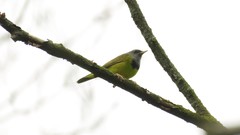
The mourning warbler (Geothlypis philadelphia) is a small songbird of the New World warbler family. Mourning warblers are neotropical migrants native to eastern and central North America and wintering in Central and South America. They tend to be found in dense second growth forests. They are very similar to the MacGillivray's warbler in appearance, especially in females and immature birds, but their breeding range does not overlap into the west.

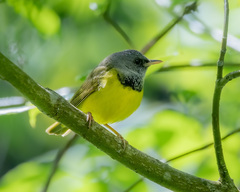
The "mourning" in this bird's name refers to the male's hood, thought to resemble a mourning veil. Mourning warblers are small songbird with yellow underparts, olive-green upperparts, a thin pointed bill and pink legs. Adult males have a gray hood, black lores and a black patch on the throat and breast. In the fall, this pattern becomes less bright and harder to distinguish from similar species; however they never have a broken eye ring. Females and immatures are gray-brown on the head with an incomplete eye-ring. They have a yellow-gray throat with a brown or olive tint to their breast. Both sexes can range from 10 to 15 cm (3.9–5.9 in) in length and 11–13 g (0.4–0.5 oz) in weight. Their wingspan is 18 cm (7.1 in). Other... Wikipedia →

Sounds

Call0:48

Ecuador · 2020

© Manuel Sánchez-Nivicela · XC1022027 · CC BY-NC-ND 4.0

Song1:07

United States · 2024

© Valerie Heemstra · XC917495 · CC BY-NC-SA 4.0

Alarm call0:42

Portugal · 2023

© Peter Stronach · XC832247 · CC BY-NC-SA 4.0

Global Distribution

Parks Where Found

# Park Country Daily sighting probability
1 Gros Morne National Park 🇨🇦 Canada
~30%
2 Riding Mountain National Park 🇨🇦 Canada
~20%
3 Cape Breton Highlands National Park 🇨🇦 Canada
~10%
4 Farallones de Cali National Natural Park 🇨🇴 Colombia
~10%
5 Isle Royale National Park 🇺🇸 United States
~10%
6 La Amistad International Park (Panama) 🇵🇦 Panama
~10%
7 Voyageurs National Park 🇺🇸 United States
<5%
8 Elk Island National Park 🇨🇦 Canada
<5%
9 San Lorenzo Protected Forest 🇵🇦 Panama
<5%
10 Piedras Blancas National Park 🇨🇷 Costa Rica
<5%
11 Bastimentos Island National Marine Park 🇵🇦 Panama
<5%
12 Tenorio Volcano National Park 🇨🇷 Costa Rica
<5%
13 Volcán Barú National Park 🇵🇦 Panama
<5%
14 Point Pelee National Park 🇨🇦 Canada
<5%
15 Chirripó National Park 🇨🇷 Costa Rica
<5%
16 Tapantí-Macizo de la Muerte National Park 🇨🇷 Costa Rica
<5%
17 Gandoca-Manzanillo Wildlife Refuge 🇨🇷 Costa Rica
<5%
18 Corcovado National Park 🇨🇷 Costa Rica
<5%
19 Manuel Antonio National Park 🇨🇷 Costa Rica
<5%
20 Darién National Park 🇵🇦 Panama
<5%
21 Soberanía National Park 🇵🇦 Panama
<5%
22 Arenal Volcano National Park 🇨🇷 Costa Rica
<5%
23 Rincón de la Vieja National Park 🇨🇷 Costa Rica
<5%
24 Henri Pittier National Park 🇻🇪 Venezuela
<5%
25 Marino Ballena National Park 🇨🇷 Costa Rica
<5%
26 Tortuguero National Park 🇨🇷 Costa Rica
<5%
27 Poás Volcano National Park 🇨🇷 Costa Rica
<5%
28 Braulio Carrillo National Park 🇨🇷 Costa Rica
<5%
29 Parque Natural Metropolitano 🇵🇦 Panama
<5%
30 Chagres National Park 🇵🇦 Panama
<5%
31 Cahuita National Park 🇨🇷 Costa Rica
<5%
32 Los Nevados National Natural Park 🇨🇴 Colombia
<5%
33 Celestún Biosphere Reserve 🇲🇽 Mexico
<5%
34 Palo Verde National Park 🇨🇷 Costa Rica
<5%
35 Monteverde Cloud Forest Reserve 🇨🇷 Costa Rica
<5%
36 Carara National Park 🇨🇷 Costa Rica
<5%
37 Big Bend National Park 🇺🇸 United States
<5%
38 Yasuní National Park 🇪🇨 Ecuador
<5%
39 Acadia National Park 🇺🇸 United States
<5%

Cities Where Found

# City Country Daily sighting probability
1 Medellín 🇨🇴 Colombia
~10%
2 San Antonio 🇺🇸 United States
<5%
3 Bogota 🇨🇴 Colombia
<5%
4 Chicago 🇺🇸 United States
<5%
5 San José 🇨🇷 Costa Rica
<5%
6 Austin 🇺🇸 United States
<5%
7 Houston 🇺🇸 United States
<5%
8 Toronto 🇨🇦 Canada
<5%
9 Minneapolis [Saint Paul] 🇺🇸 United States
<5%
10 Panama City 🇵🇦 Panama
<5%

Before you go

What are the chances of seeing a Mourning Warbler in Darién National Park?

Rare

Under 5% of wildlife watchers report a Mourning Warbler sighting in Darién National Park on a given day, based on 9 verified sightings from GBIF citizen-science data from 2019 to 2026. It is the 329th most-seen of the 397 birds we can rate there. Over three days the chance rises to about 10%, if each day is a fresh chance.

When is the best time to see a Mourning Warbler in Darién National Park?

October

In that month about 10% of wildlife watchers report a Mourning Warbler in Darién National Park on a given day, against under 5% in November to September, the lowest months.

What time of day is best to see a Mourning Warbler?

Between 7 and 10 am

Across all the parks we cover, that three-hour window holds the most Mourning Warbler sightings with a recorded time, and nearly all of them come between 6 am and 6 pm: it is a daytime animal.

Which relatives of the Mourning Warbler live in Darién National Park?

Same family: Parulidae

The closest relatives of the Mourning Warbler that you can see in Darién National Park (family Parulidae, New World Warblers) are Buff-rumped Warbler (about 30%), Bay-breasted Warbler (about 20%) and Prothonotary Warbler (about 10%), with each one's daily chance of a sighting.

Where does the Mourning Warbler sighting chance come from?

GBIF citizen-science records

It is estimated from how often the Mourning Warbler is recorded against all the birds logged in Darién National Park (9 verified sightings from 2019 to 2026), calibrated against known sighting rates. Figures are rounded to the nearest 10% because citizen-science data supports honest approximations, not decimals, and months with records from fewer than five people show "—". How it works.

← Back to Darién National Park