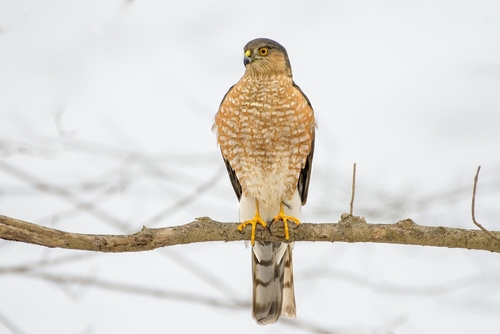
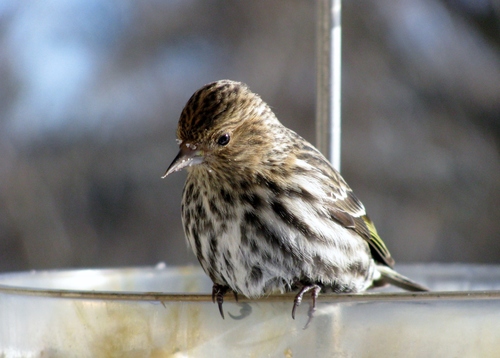
Red-tailed Hawk

Red-tailed Hawk

Buteo jamaicensis

Silhouette: Lauren Anderson · PhyloPic

LCLeast ConcernNTVUENCR
Daily sighting probability <5% · Rare
at Jasper National Park

In 3 days ~10% in a week ~20%

52 Verified sightings at Jasper National Park From 2019 to 2026
30,706 In all 68 parks
August Best month
☀️ Diurnal When it's spotted

About the Red-tailed Hawk

The red-tailed hawk (Buteo jamaicensis) is a bird of prey and one of the most common hawks in North America. In the United States, it is one of three species colloquially known as the "chickenhawk". The red-tailed hawk breeds throughout most of the continent, from western Alaska and northern Canada to as far south as Panama and the West Indies. The red-tailed hawk occupies a wide range of habitats and altitudes, including deserts, grasslands, coniferous and deciduous forests, agricultural fields, and urban areas. It is absent in areas of unbroken forest and in the high arctic. It is legally protected in Canada, Mexico, and the United States by the Migratory Bird Treaty.

The red-tailed hawk is one of the largest members of the genus Buteo in North America, typically weighing from 690 to 1,600 g (1.5 to 3.5 lb) and measuring 45–65 cm (18–26 in) in length, with a wingspan from 110–145 cm (43–57 in). Females are about 25% heavier than males. It has a stocky body with broad wings and can be distinguished from other North American hawks by the eponymous tail, which is uniformly brick-red above and light buff-orange below. The species feeds on a wide range of small animals, such as rodents, birds, and reptiles. Pairs stay together for life, taking a new mate only when the original mate dies. The pair constructs a stick nest in a high tree, in which a clutch of one to three eggs is laid.

The 14 recognized subspecies vary in appearance and range. The subspecies Harlan's hawk (B. j. harlani) is sometimes considered a separate species (B. harlani). Because they are so common and easily trained as capable hunters, most hawks captured for falconry in the United States are red-tailed hawks. The feathers and other parts of the red-tailed hawk are considered sacred to many American indigenous people. Wikipedia →

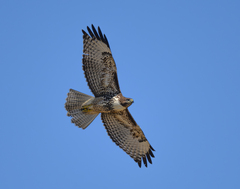
Sounds

Song0:04

United States · 2025

© Rory Nefdt · XC1035993 · CC BY-NC-SA 4.0

Call0:42

United States · 2023

© Richard E. Webster · XC973862 · CC BY-NC-SA 4.0

Begging call1:28

United States · 2021

© William Whitehead · XC664881 · CC BY-NC-ND 4.0

Global Distribution

Parks Where Found

# Park Country Daily sighting probability
1 Irazú Volcano National Park 🇨🇷 Costa Rica
~50%
2 Yellowstone National Park 🇺🇸 United States
~40%
3 Saguaro National Park 🇺🇸 United States
~40%
4 Blue and John Crow Mountains National Park 🇯🇲 Jamaica
~40%
5 Cabo Pulmo National Park 🇲🇽 Mexico
~30%
6 Los Quetzales National Park 🇨🇷 Costa Rica
~30%
7 Grand Teton National Park 🇺🇸 United States
~30%
8 Joshua Tree National Park 🇺🇸 United States
~30%
9 Los Haitises National Park 🇩🇴 Dominican Republic
~30%
10 Volcán Barú National Park 🇵🇦 Panama
~30%
11 Rocky Mountain National Park 🇺🇸 United States
~30%
12 Zion National Park 🇺🇸 United States
~30%
13 Sequoia and Kings Canyon National Parks 🇺🇸 United States
~20%
14 Badlands National Park 🇺🇸 United States
~20%
15 Death Valley National Park 🇺🇸 United States
~20%
16 Big Bend National Park 🇺🇸 United States
~20%
17 Grand Canyon National Park 🇺🇸 United States
~20%
18 Yosemite National Park 🇺🇸 United States
~20%
19 Channel Islands National Park 🇺🇸 United States
~20%
20 Guadalupe Mountains National Park 🇺🇸 United States
~20%
21 Redwood National Park 🇺🇸 United States
~20%
22 Wrangell-St. Elias National Park 🇺🇸 United States
~20%
23 Elk Island National Park 🇨🇦 Canada
~20%
24 Point Pelee National Park 🇨🇦 Canada
~20%
25 Shenandoah National Park 🇺🇸 United States
~20%
26 Riding Mountain National Park 🇨🇦 Canada
~10%
27 Tapantí-Macizo de la Muerte National Park 🇨🇷 Costa Rica
~10%
28 Cumbres de Monterrey National Park 🇲🇽 Mexico
~10%
29 El Vizcaíno Biosphere Reserve 🇲🇽 Mexico
~10%
30 Cape Breton Highlands National Park 🇨🇦 Canada
~10%
31 Celaque National Park 🇭🇳 Honduras
~10%
32 Glacier National Park 🇺🇸 United States
~10%
33 Reserva de la Biosfera Mariposa Monarca 🇲🇽 Mexico
~10%
34 La Amistad International Park (Panama) 🇵🇦 Panama
~10%
35 La Tigra National Park 🇭🇳 Honduras
~10%
36 Congaree National Park 🇺🇸 United States
~10%
37 Chirripó National Park 🇨🇷 Costa Rica
~10%
38 Wood Buffalo National Park 🇨🇦 Canada
~10%
39 Jaragua National Park 🇩🇴 Dominican Republic
~10%
40 Great Smoky Mountains National Park 🇺🇸 United States
~10%
41 Banff National Park 🇨🇦 Canada
~10%
42 El Triunfo 🇲🇽 Mexico
~10%
43 Olympic National Park 🇺🇸 United States
~10%
44 Bahía de Loreto National Park 🇲🇽 Mexico
~10%
45 Kluane National Park 🇨🇦 Canada
<5%
46 Isle Royale National Park 🇺🇸 United States
<5%
47 Poás Volcano National Park 🇨🇷 Costa Rica
<5%
48 Everglades National Park 🇺🇸 United States
<5%
49 Pacific Rim National Park Reserve 🇨🇦 Canada
<5%
50 Jasper National Park 🇨🇦 Canada
<5%
51 Braulio Carrillo National Park 🇨🇷 Costa Rica
<5%
52 Cañón del Sumidero National Park 🇲🇽 Mexico
<5%
53 Merritt Island National Wildlife Refuge 🇺🇸 United States
<5%
54 Great Bear Rainforest 🇨🇦 Canada
<5%
55 Arenal Volcano National Park 🇨🇷 Costa Rica
<5%
56 Big Cypress National Preserve 🇺🇸 United States
<5%
57 Monteverde Cloud Forest Reserve 🇨🇷 Costa Rica
<5%
58 Acadia National Park 🇺🇸 United States
<5%
59 Padre Island National Seashore 🇺🇸 United States
<5%
60 Ciénaga de Zapata 🇨🇺 Cuba
<5%
61 Cusuco National Park 🇭🇳 Honduras
<5%
62 Lago de Yojoa 🇭🇳 Honduras
<5%
63 Santa Rosa National Park 🇨🇷 Costa Rica
<5%
64 Cerro Azul Meámbar National Park 🇭🇳 Honduras
<5%
65 Denali National Park 🇺🇸 United States
<5%
66 Bastimentos Island National Marine Park 🇵🇦 Panama
<5%
67 Carara National Park 🇨🇷 Costa Rica
<5%
68 Tenorio Volcano National Park 🇨🇷 Costa Rica
<5%

Cities Where Found

# City Country Daily sighting probability
1 Denver 🇺🇸 United States
~40%
2 Los Angeles 🇺🇸 United States
~40%
3 New York City 🇺🇸 United States
~30%
4 Boston 🇺🇸 United States
~30%
5 San Francisco 🇺🇸 United States
~30%
6 Toronto 🇨🇦 Canada
~30%
7 San Diego 🇺🇸 United States
~30%
8 Philadelphia 🇺🇸 United States
~30%
9 Portland 🇺🇸 United States
~20%
10 Tijuana 🇲🇽 México
~20%

Zoos & Centres Where Found

# Zoo / Centre Country
1 Greensboro Science Center 🇺🇸 United States In captivity
2 Abilene Zoological Gardens 🇺🇸 United States In captivity
3 Ecomuseum Zoo 🇨🇦 Canada In captivity
4 Bioparque Estrella 🇲🇽 Mexico In captivity
5 Zoo sauvage Saint-Félicien 🇨🇦 Canada In captivity
6 San Diego Zoo Safari Park 🇺🇸 United States In captivity
7 African Lion Safari 🇨🇦 Canada In captivity
8 Living Desert Zoo and Gardens 🇺🇸 United States In captivity
9 World Bird Sanctuary 🇺🇸 United States In captivity
10 Squam Lakes Natural Science Center 🇺🇸 United States In captivity
11 Brookfield Zoo 🇺🇸 United States In captivity
12 Ecological Center of Sonora 🇲🇽 Mexico In captivity
13 Safari Madrid 🇪🇸 Spain In captivity
14 Milwaukee County Zoo 🇺🇸 United States In captivity
15 Parque y Zoológico Nacional Arquitecto Manuel Valverde Podestá 🇩🇴 Dominican Republic In captivity
16 Shubenacadie Wildlife Park 🇨🇦 Canada In captivity
17 Oakland Zoo 🇺🇸 United States In captivity
18 Wildlife World Zoo 🇺🇸 United States In captivity
19 Central Florida Zoo and Botanical Gardens 🇺🇸 United States In captivity
20 Birmingham Zoo 🇺🇸 United States In captivity
21 Dakota Zoo 🇺🇸 United States In captivity
22 Fonghuanggu Bird and Ecology Park 🇹🇼 Taiwan In captivity
23 West Virginia State Wildlife Center 🇺🇸 United States In captivity
24 Brevard Zoo 🇺🇸 United States In captivity
25 ZooMontana 🇺🇸 United States In captivity
26 Birds of prey 🇨🇦 Canada In captivity
27 Fort Worth Zoo 🇺🇸 United States In captivity
28 Zoológico Benito Juárez 🇲🇽 Mexico In captivity
29 Arizona-Sonora Desert Museum 🇺🇸 United States In captivity
30 Fort Wayne Children's Zoo 🇺🇸 United States In captivity
31 Edmonton Valley Zoo 🇨🇦 Canada In captivity
32 Wildwood Zoo 🇺🇸 United States In captivity
33 Chapultepec Zoo 🇲🇽 Mexico In captivity
34 British Columbia Wildlife Park 🇨🇦 Canada In captivity
35 Zoo Atlanta 🇺🇸 United States In captivity
36 Forestry Farm Park and Zoo 🇨🇦 Canada In captivity
37 Hogle Zoo 🇺🇸 United States In captivity
38 Connecticut's Beardsley Zoo 🇺🇸 United States In captivity
39 Rosamond Gifford Zoo 🇺🇸 United States In captivity
40 Naples Zoo 🇺🇸 United States In captivity
41 Leśny Park Niespodzianek 🇵🇱 Poland In captivity
42 Western North Carolina Nature Center 🇺🇸 United States In captivity
43 Zoológico Los Coyotes 🇲🇽 Mexico In captivity
44 California Living Museum 🇺🇸 United States In captivity
45 Lehigh Valley Zoo 🇺🇸 United States In captivity
46 Bluebird Gap Farm 🇺🇸 United States In captivity
47 The Abilene Zoo 🇺🇸 United States In captivity
48 Topeka Zoo 🇺🇸 United States In captivity
49 Racine Zoo 🇺🇸 United States In captivity
50 Bramble Park Zoo 🇺🇸 United States In captivity

Before you go

What are the chances of seeing a Red-tailed Hawk in Jasper National Park?

Rare

Under 5% of wildlife watchers report a Red-tailed Hawk sighting in Jasper National Park on a given day, based on 52 verified sightings from GBIF citizen-science data from 2019 to 2026. It is the 97th most-seen of the 156 birds we can rate there. Over three days the chance rises to about 10%, and over a week to about 20%, if each day is a fresh chance.

When is the best time to see a Red-tailed Hawk in Jasper National Park?

August

In that month about 10% of wildlife watchers report a Red-tailed Hawk in Jasper National Park on a given day, against under 5% in September to July, the lowest months.

What time of day is best to see a Red-tailed Hawk?

Between 9 am and noon

Across all the parks we cover, that three-hour window holds the most Red-tailed Hawk sightings with a recorded time, and about 9 in 10 of them come between 6 am and 6 pm: it is a daytime animal.

Where does the Red-tailed Hawk sighting chance come from?

GBIF citizen-science records

It is estimated from how often the Red-tailed Hawk is recorded against all the birds logged in Jasper National Park (52 verified sightings from 2019 to 2026), calibrated against known sighting rates. Figures are rounded to the nearest 10% because citizen-science data supports honest approximations, not decimals, and months with records from fewer than five people show "—". How it works.

← Back to Jasper National Park