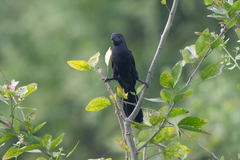
Groove-billed Ani

Groove-billed Ani

Crotophaga sulcirostris

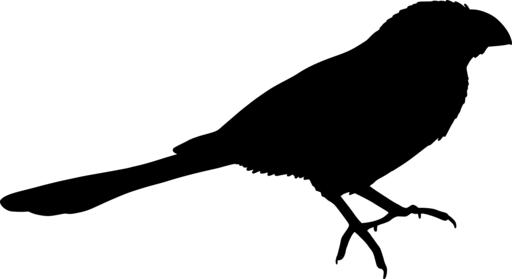
Silhouette: Andy Wilson · PhyloPic

LCLeast ConcernNTVUENCR
Daily sighting probability ~20% · Possible
at Ostional Wildlife Refuge

In 3 days ~50% in a week ~80%

155 Verified sightings at Ostional Wildlife Refuge From 2019 to 2026
16,981 In all 46 parks
June Best month
☀️ Diurnal When it's spotted

About the Groove-billed Ani

The groove-billed ani (Crotophaga sulcirostris) is a tropical bird in the cuckoo family with a long tail and a large, curved beak. It is a resident species throughout most of its range, from southern Texas, central Mexico and The Bahamas, through Central America, to northern Colombia and Venezuela, and coastal Ecuador and Peru. It only retreats from the northern limits of its range in Texas and northern Mexico during winter.

The groove-billed ani was formally described by the English naturalist William Swainson from a specimen collected in Temascaltepec, Mexico. It still bears its original binomial name of Crotophaga sulcirostris. The specific epithet combines the Latin sulcus meaning "furrow" with -rostris meaning "-billed". The species is monotypic: no subspecies are recognised.

The groove-billed ani is about 34 cm (13 in) long, and weighs 70–90 g (2.5–3.2 oz). Wingspan ranges 41–46 cm (16–18 in). It is completely black, with a very long tail almost as long as its body. It has a huge bill with lengthwise grooves running the length of the upper mandible. It is very similar to the smooth-billed ani, some specimens of which have bills as small as the... Wikipedia →

Sounds

Song0:27

Mexico · 2024

© Étienne Leroy · XC956278 · CC BY-NC-SA 4.0

Call0:21

Costa Rica · 2023

© Johan Chaves · XC828081 · CC BY-NC-SA 4.0

Uncertain0:09

Ecuador · 2022

© Cristopher Rodríguez-Moreira · XC767471 · CC BY-NC-SA 4.0

Global Distribution

Parks Where Found

# Park Country Daily sighting probability
1 Palo Verde National Park 🇨🇷 Costa Rica
~70%
2 Lago de Yojoa 🇭🇳 Honduras
~40%
3 Cusuco National Park 🇭🇳 Honduras
~40%
4 Cerro Azul Meámbar National Park 🇭🇳 Honduras
~30%
5 Celestún Biosphere Reserve 🇲🇽 Mexico
~30%
6 Masaya Volcano National Park 🇳🇮 Nicaragua
~30%
7 Carara National Park 🇨🇷 Costa Rica
~30%
8 Celaque National Park 🇭🇳 Honduras
~30%
9 Tortuguero National Park 🇨🇷 Costa Rica
~30%
10 Las Baulas Marine National Park 🇨🇷 Costa Rica
~30%
11 Manuel Antonio National Park 🇨🇷 Costa Rica
~30%
12 Montes Azules Biosphere Reserve 🇲🇽 Mexico
~30%
13 Rincón de la Vieja National Park 🇨🇷 Costa Rica
~30%
14 Gandoca-Manzanillo Wildlife Refuge 🇨🇷 Costa Rica
~20%
15 Pico Bonito National Park 🇭🇳 Honduras
~20%
16 Machalilla National Park 🇪🇨 Ecuador
~20%
17 Ostional Wildlife Refuge 🇨🇷 Costa Rica
~20%
18 Ría Lagartos Biosphere Reserve 🇲🇽 Mexico
~20%
19 Tenorio Volcano National Park 🇨🇷 Costa Rica
~20%
20 Bastimentos Island National Marine Park 🇵🇦 Panama
~20%
21 Cabo Blanco Absolute Nature Reserve 🇨🇷 Costa Rica
~20%
22 El Triunfo 🇲🇽 Mexico
~20%
23 Braulio Carrillo National Park 🇨🇷 Costa Rica
~20%
24 La Amistad International Park (Panama) 🇵🇦 Panama
~20%
25 Cañón del Sumidero National Park 🇲🇽 Mexico
~20%
26 Santa Rosa National Park 🇨🇷 Costa Rica
~20%
27 Cahuita National Park 🇨🇷 Costa Rica
~10%
28 Calakmul Biosphere Reserve 🇲🇽 Mexico
~10%
29 Sian Ka'an Biosphere Reserve 🇲🇽 Mexico
~10%
30 Arrecifes de Cozumel National Park 🇲🇽 Mexico
~10%
31 Biotopo Cerro Cahuí 🇬🇹 Guatemala
~10%
32 Arenal Volcano National Park 🇨🇷 Costa Rica
~10%
33 La Tigra National Park 🇭🇳 Honduras
~10%
34 Cockscomb Basin Wildlife Sanctuary 🇧🇿 Belize
~10%
35 Monteverde Cloud Forest Reserve 🇨🇷 Costa Rica
<5%
36 Tayrona National Natural Park 🇨🇴 Colombia
<5%
37 Henri Pittier National Park 🇻🇪 Venezuela
<5%
38 Tapantí-Macizo de la Muerte National Park 🇨🇷 Costa Rica
<5%
39 Piedras Blancas National Park 🇨🇷 Costa Rica
<5%
40 Podocarpus National Park 🇪🇨 Ecuador
<5%
41 Poás Volcano National Park 🇨🇷 Costa Rica
<5%
42 Cumbres de Monterrey National Park 🇲🇽 Mexico
<5%
43 Marino Ballena National Park 🇨🇷 Costa Rica
<5%
44 Tikal National Park 🇬🇹 Guatemala
<5%
45 Corcovado National Park 🇨🇷 Costa Rica
<5%
46 Los Quetzales National Park 🇨🇷 Costa Rica
<5%

Cities Where Found

# City Country Daily sighting probability
1 Guayaquil 🇪🇨 Ecuador
~40%
2 San Pedro Sula 🇭🇳 Honduras
~40%
3 León 🇲🇽 México
~40%
4 Tegucigalpa 🇭🇳 Honduras
~20%
5 Barranquilla 🇨🇴 Colombia
~10%
6 Managua 🇳🇮 Nicaragua
~10%
7 Guadalajara 🇲🇽 México
~10%
8 Puebla 🇲🇽 México
~10%
9 San Salvador 🇸🇻 El Salvador
~10%
10 Lima 🇵🇪 Peru
~10%

Before you go

What are the chances of seeing a Groove-billed Ani in Ostional Wildlife Refuge?

Possible

About 20% of wildlife watchers report a Groove-billed Ani sighting in Ostional Wildlife Refuge on a given day, based on 155 verified sightings from GBIF citizen-science data from 2019 to 2026. It is the 47th most-seen of the 182 birds we can rate there. Over three days the chance rises to about 50%, and over a week to about 80%, if each day is a fresh chance.

When is the best time to see a Groove-billed Ani in Ostional Wildlife Refuge?

May–June and September–November

In those months about 30% of wildlife watchers report a Groove-billed Ani in Ostional Wildlife Refuge on a given day, against about 10% in January and April, the lowest months. Those are among Ostional Wildlife Refuge's wettest months, with about 430 mm of rain a month against 15 mm in February.

What time of day is best to see a Groove-billed Ani?

Between 8 and 11 am

Across all the parks we cover, that three-hour window holds the most Groove-billed Ani sightings with a recorded time, and about 9 in 10 of them come between 6 am and 6 pm: it is a daytime animal.

Is Ostional Wildlife Refuge the best place to see a Groove-billed Ani?

17th of 46

Of the 46 parks where we can rate Groove-billed Ani sightings, Ostional Wildlife Refuge ranks 17th at about 20%. The best odds are in Palo Verde National Park (Costa Rica, about 70%), Lago de Yojoa (Honduras, about 40%) and Cusuco National Park (Honduras, about 40%). All parks ranked.

Where does the Groove-billed Ani sighting chance come from?

GBIF citizen-science records

It is estimated from how often the Groove-billed Ani is recorded against all the birds logged in Ostional Wildlife Refuge (155 verified sightings from 2019 to 2026), calibrated against known sighting rates. Figures are rounded to the nearest 10% because citizen-science data supports honest approximations, not decimals, and months with records from fewer than five people show "—". How it works.

← Back to Ostional Wildlife Refuge