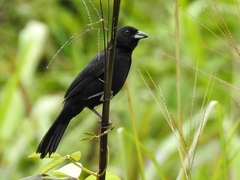
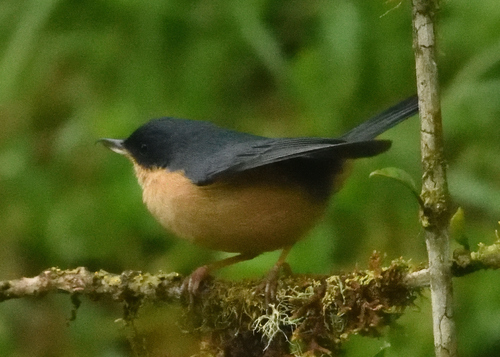
White-lined Tanager

White-lined Tanager

Tachyphonus rufus

Silhouette: Sheatherius · PhyloPic

LCLeast ConcernNTVUENCR
Daily sighting probability <5% · Rare
at Amboró National Park

In 3 days <5% in a week ~10%

7 Verified sightings at Amboró National Park From 2019 to 2026
6,713 In all 38 parks
September Best month
☀️ Diurnal When it's spotted

About the White-lined Tanager

The white-lined tanager (Tachyphonus rufus) is a medium-sized passerine bird in the tanager family Thraupidae. It is a resident breeder from Costa Rica south to northern Argentina and on the islands of Trinidad and Tobago.

The white-lined tanager was described by the French polymath Georges-Louis Leclerc, Comte de Buffon in 1779 in his Histoire Naturelle des Oiseaux from specimens collected in Cayenne, French Guiana. The female bird was also illustrated in a hand-coloured plate engraved by François-Nicolas Martinet in the Planches Enluminées D'Histoire Naturelle which was produced under the supervision of Edme-Louis Daubenton to accompany Buffon's text. Neither the plate caption nor Buffon's description included a scientific name but in 1783 the Dutch naturalist Pieter Boddaert coined the binomial name Tangara rufa in his catalogue of the Planches Enluminées. The white-lined tanager is now placed in the genus Tachyphonus and was introduced by the French ornithologist Louis Pierre Vieillot in 1816 with the white-lined tanager as the type species. The name combines the Ancient Greek words takhus "fast" and phōneō "to speak". The specific rufus is Latin for "red", "ruddy... Wikipedia →

Sounds

Song0:37

Ecuador · 2009

© Manuel Sánchez-Nivicela · XC1154918 · CC BY-NC-ND 4.0

Call0:36

Brazil · 2026

© JAYRSON ARAUJO DE OLIVEIRA · XC1136822 · CC BY-NC-SA 4.0

Dawn song0:24

Ecuador · 2001

© Olaf Jahn · XC262640 · CC BY-NC-SA 4.0

Global Distribution

Parks Where Found

# Park Country Daily sighting probability
1 Farallones de Cali National Natural Park 🇨🇴 Colombia
~70%
2 Main Ridge Forest Reserve 🇹🇹 Trinidad and Tobago
~50%
3 Chapada dos Guimarães National Park 🇧🇷 Brazil
~50%
4 Henri Pittier National Park 🇻🇪 Venezuela
~30%
5 Chapada Diamantina National Park 🇧🇷 Brazil
~20%
6 Iberá National Park 🇦🇷 Argentina
~10%
7 El Impenetrable National Park 🇦🇷 Argentina
~10%
8 Serra da Canastra National Park 🇧🇷 Brazil
~10%
9 La Amistad International Park (Panama) 🇵🇦 Panama
~10%
10 San Lorenzo Protected Forest 🇵🇦 Panama
~10%
11 Emas National Park 🇧🇷 Brazil
~10%
12 Bastimentos Island National Marine Park 🇵🇦 Panama
~10%
13 Gandoca-Manzanillo Wildlife Refuge 🇨🇷 Costa Rica
~10%
14 Cahuita National Park 🇨🇷 Costa Rica
<5%
15 Tapantí-Macizo de la Muerte National Park 🇨🇷 Costa Rica
<5%
16 Piedras Blancas National Park 🇨🇷 Costa Rica
<5%
17 Chagres National Park 🇵🇦 Panama
<5%
18 Corcovado National Park 🇨🇷 Costa Rica
<5%
19 Podocarpus National Park 🇪🇨 Ecuador
<5%
20 Machalilla National Park 🇪🇨 Ecuador
<5%
21 Chirripó National Park 🇨🇷 Costa Rica
<5%
22 Amboró National Park 🇧🇴 Bolivia
<5%
23 Sierra de la Macarena National Park 🇨🇴 Colombia
<5%
24 Caroni Swamp 🇹🇹 Trinidad and Tobago
<5%
25 Volcán Barú National Park 🇵🇦 Panama
<5%
26 Braulio Carrillo National Park 🇨🇷 Costa Rica
<5%
27 Manu National Park 🇵🇪 Peru
<5%
28 Chingaza National Natural Park 🇨🇴 Colombia
<5%
29 Arenal Volcano National Park 🇨🇷 Costa Rica
<5%
30 Itatiaia National Park 🇧🇷 Brazil
<5%
31 Tortuguero National Park 🇨🇷 Costa Rica
<5%
32 Soberanía National Park 🇵🇦 Panama
<5%
33 Tayrona National Natural Park 🇨🇴 Colombia
<5%
34 Yasuní National Park 🇪🇨 Ecuador
<5%
35 Manuel Antonio National Park 🇨🇷 Costa Rica
<5%
36 Parque Natural Metropolitano 🇵🇦 Panama
<5%
37 Tenorio Volcano National Park 🇨🇷 Costa Rica
<5%
38 Carara National Park 🇨🇷 Costa Rica
<5%

Cities Where Found

# City Country Daily sighting probability
1 Valencia 🇻🇪 Venezuela
~20%
2 Caracas 🇻🇪 Venezuela
~10%
3 Cali 🇨🇴 Colombia
~10%
4 Natal 🇧🇷 Brazil
~10%
5 Brasilia 🇧🇷 Brazil
<5%
6 Buenos Aires 🇦🇷 Argentina
<5%
7 Belém 🇧🇷 Brazil
<5%
8 Maceió 🇧🇷 Brazil
<5%
9 Medellín 🇨🇴 Colombia
<5%
10 Bogota 🇨🇴 Colombia
<5%

Zoos & Centres Where Found

# Zoo / Centre Country
1 Bioparque Wakatá 🇨🇴 Colombia In captivity
2 Universeum 🇸🇪 Sweden In captivity

Before you go

What are the chances of seeing a White-lined Tanager in Amboró National Park?

Rare

Under 5% of wildlife watchers report a White-lined Tanager sighting in Amboró National Park on a given day, based on 7 verified sightings from GBIF citizen-science data from 2019 to 2026. It is the 221st most-seen of the 273 birds we can rate there. Over three days the chance rises to under 5%, and over a week to about 10%, if each day is a fresh chance.

When is the best time to see a White-lined Tanager in Amboró National Park?

September

In that month about 10% of wildlife watchers report a White-lined Tanager in Amboró National Park on a given day, against under 5% in July–August and October–May, the lowest months. That is one of Amboró National Park's driest months, with about 90 mm of rain against 340 mm in January. June has too few records to rate.

What time of day is best to see a White-lined Tanager?

Between 8 and 11 am

Across all the parks we cover, that three-hour window holds the most White-lined Tanager sightings with a recorded time, and about 9 in 10 of them come between 6 am and 6 pm: it is a daytime animal.

Which relatives of the White-lined Tanager live in Amboró National Park?

Same family: Thraupidae

The closest relatives of the White-lined Tanager that you can see in Amboró National Park (family Thraupidae, Tanagers and Allies) are Black-goggled Tanager (about 40%), Sayaca Tanager (about 40%) and Palm Tanager (about 30%), with each one's daily chance of a sighting.

Where does the White-lined Tanager sighting chance come from?

GBIF citizen-science records

It is estimated from how often the White-lined Tanager is recorded against all the birds logged in Amboró National Park (7 verified sightings from 2019 to 2026), calibrated against known sighting rates. Figures are rounded to the nearest 10% because citizen-science data supports honest approximations, not decimals, and months with records from fewer than five people show "—". How it works.

← Back to Amboró National Park