Ferruginous Pygmy-Owl

Ferruginous Pygmy-Owl

Glaucidium brasilianum

Silhouette: Edwin Price · PhyloPic

LCLeast ConcernNTVUENCR
Daily sighting probability <5% · Rare
at Brasilia

In 3 days ~10% in a week ~20%

30 Verified sightings at Brasilia
8,329 In all 49 parks From 2019 to 2026
July Best month
☀️ Diurnal When it's spotted

About the Ferruginous Pygmy-Owl

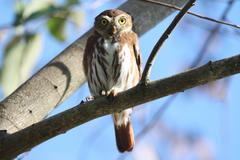
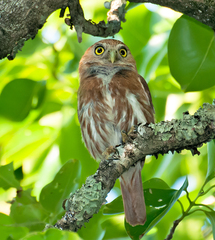
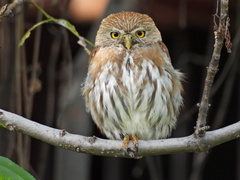
The ferruginous pygmy owl (Glaucidium brasilianum) is a species of small owl found in the southwestern United States, extending south through Mexico, Central America, and into South America, including countries like Brazil, Bolivia, Paraguay and Argentina.

It is the most widely distributed species of pygmy owl in Central and South America and is believed to be one of the most common owls in these regions, where it lives in a variety of semi-open wooded habitats. The ferruginous pygmy owl was formally described in 1788 by the German naturalist Johann Friedrich Gmelin in his revised and expanded edition of Carl Linnaeus's Systema Naturae. The species was originally assigned the binomial name Strix brasiliana, grouping it with other owls under the genus Strix. Although Gmelin did not directly cite it, his original description ultimately derived from the "Caburé", a small owl documented in 1648 by German naturalist Georg Marcgrave in his work Historia Naturalis Brasiliae. The ferruginous pygmy owl is currently classified alongside 28 other small owls in the genus Glaucidium, introduced in 1826 by German zoologist Friedrich Boie. The genus name derives from the Ancient Greek... Wikipedia →

Sounds

Song1:07

Brazil · 2026

© JAYRSON ARAUJO DE OLIVEIRA · XC1163761 · CC BY-NC-SA 4.0

Recording0:15

Argentina · 2026

© Sabrina Andrea Rendon Anaya · XC1136369 · CC BY-NC-SA 4.0

Subsong0:27

Brazil · 2026

© Eduardo Vieira 1301 · XC1075083 · CC BY-NC-SA 4.0

Global Distribution

Parks Where Found

# Park Country Daily sighting probability
1 Cerro Azul Meámbar National Park 🇭🇳 Honduras
~40%
2 Celaque National Park 🇭🇳 Honduras
~30%
3 Sian Ka'an Biosphere Reserve 🇲🇽 Mexico
~30%
4 Lago de Yojoa 🇭🇳 Honduras
~20%
5 Cañón del Sumidero National Park 🇲🇽 Mexico
~20%
6 Pico Bonito National Park 🇭🇳 Honduras
~20%
7 Cusuco National Park 🇭🇳 Honduras
~20%
8 Palo Verde National Park 🇨🇷 Costa Rica
~20%
9 Chapada Diamantina National Park 🇧🇷 Brazil
~20%
10 Masaya Volcano National Park 🇳🇮 Nicaragua
~20%
11 Calakmul Biosphere Reserve 🇲🇽 Mexico
~20%
12 Yasuní National Park 🇪🇨 Ecuador
~20%
13 El Impenetrable National Park 🇦🇷 Argentina
~20%
14 Amboró National Park 🇧🇴 Bolivia
~20%
15 Ostional Wildlife Refuge 🇨🇷 Costa Rica
~20%
16 Serra da Canastra National Park 🇧🇷 Brazil
~10%
17 El Triunfo 🇲🇽 Mexico
~10%
18 Parque Estadual Encontro das Águas 🇧🇷 Brazil
~10%
19 Carara National Park 🇨🇷 Costa Rica
~10%
20 Cumbres de Monterrey National Park 🇲🇽 Mexico
~10%
21 Santa Rosa National Park 🇨🇷 Costa Rica
~10%
22 La Tigra National Park 🇭🇳 Honduras
~10%
23 Sierra de la Macarena National Park 🇨🇴 Colombia
~10%
24 Anavilhanas National Park 🇧🇷 Brazil
~10%
25 Cuyabeno Wildlife Reserve 🇪🇨 Ecuador
~10%
26 Henri Pittier National Park 🇻🇪 Venezuela
~10%
27 Manu National Park 🇵🇪 Peru
~10%
28 Las Baulas Marine National Park 🇨🇷 Costa Rica
~10%
29 Manuel Antonio National Park 🇨🇷 Costa Rica
~10%
30 Chapada dos Guimarães National Park 🇧🇷 Brazil
~10%
31 Iguazú National Park 🇦🇷 Argentina
~10%
32 Celestún Biosphere Reserve 🇲🇽 Mexico
~10%
33 Amacayacu National Natural Park 🇨🇴 Colombia
~10%
34 Iguaçu National Park 🇧🇷 Brazil
~10%
35 Cabo Blanco Absolute Nature Reserve 🇨🇷 Costa Rica
~10%
36 Serra dos Órgãos National Park 🇧🇷 Brazil
~10%
37 Tambopata National Reserve 🇵🇪 Peru
<5%
38 Biotopo Cerro Cahuí 🇬🇹 Guatemala
<5%
39 Ría Lagartos Biosphere Reserve 🇲🇽 Mexico
<5%
40 Tayrona National Natural Park 🇨🇴 Colombia
<5%
41 Emas National Park 🇧🇷 Brazil
<5%
42 Caroni Swamp 🇹🇹 Trinidad and Tobago
<5%
43 Tikal National Park 🇬🇹 Guatemala
<5%
44 Itatiaia National Park 🇧🇷 Brazil
<5%
45 Rincón de la Vieja National Park 🇨🇷 Costa Rica
<5%
46 Monteverde Cloud Forest Reserve 🇨🇷 Costa Rica
<5%
47 Marino Ballena National Park 🇨🇷 Costa Rica
<5%
48 Tenorio Volcano National Park 🇨🇷 Costa Rica
<5%
49 Tapantí-Macizo de la Muerte National Park 🇨🇷 Costa Rica
<5%

Cities Where Found

# City Country Daily sighting probability
1 Tegucigalpa 🇭🇳 Honduras
~30%
2 San Salvador 🇸🇻 El Salvador
~20%
3 San Pedro Sula 🇭🇳 Honduras
~20%
4 Fortaleza 🇧🇷 Brazil
~10%
5 Monterrey 🇲🇽 México
~10%
6 San José 🇨🇷 Costa Rica
~10%
7 Guatemala City 🇬🇹 Guatemala
~10%
8 Maceió 🇧🇷 Brazil
~10%
9 Campo Grande 🇧🇷 Brazil
~10%
10 Managua 🇳🇮 Nicaragua
~10%

Zoos & Centres Where Found

# Zoo / Centre Country
1 Parque Zoobotânico Getúlio Vargas 🇧🇷 Brazil In captivity
2 Amaru 🇪🇨 Ecuador In captivity
3 Complejo Turistico de Quistococha 🇵🇪 Peru In captivity
4 Aviario Nacional de Colombia 🇨🇴 Colombia In captivity
5 Mangal das Garças 🇧🇷 Brazil In captivity
6 Monkey Park 🇪🇸 Spain In captivity
7 Parque dos Falcões 🇧🇷 Brazil In captivity

Before you go

What are the chances of seeing a Ferruginous Pygmy-Owl in Brasilia?

Rare

Under 5% of wildlife watchers report a Ferruginous Pygmy-Owl sighting in Brasilia on a given day, based on 30 verified sightings from GBIF citizen-science data. It is the 88th most-seen of the 141 birds we can rate there. Over three days the chance rises to about 10%, and over a week to about 20%, if each day is a fresh chance.

When is the best time to see a Ferruginous Pygmy-Owl in Brasilia?

July

In that month about 10% of wildlife watchers report a Ferruginous Pygmy-Owl in Brasilia on a given day, against under 5% in August to June, the lowest months. That is one of Brasilia's driest months, with almost no rain against 220 mm in December.

What time of day is best to see a Ferruginous Pygmy-Owl?

Between 7 and 10 am

Across all the parks we cover, that three-hour window holds the most Ferruginous Pygmy-Owl sightings with a recorded time, and about 8 in 10 of them come between 6 am and 6 pm: it is a daytime animal.

Is Brasilia the best place to see a Ferruginous Pygmy-Owl?

16th of 25

Of the 25 cities where we can rate Ferruginous Pygmy-Owl sightings, Brasilia ranks 16th at under 5%. The best odds are in Tegucigalpa (Honduras, about 30%), San Salvador (El Salvador, about 20%) and San Pedro Sula (Honduras, about 20%).

Where does the Ferruginous Pygmy-Owl sighting chance come from?

GBIF citizen-science records

It is estimated from how often the Ferruginous Pygmy-Owl is recorded against all the birds logged in Brasilia (30 verified sightings), calibrated against known sighting rates. Figures are rounded to the nearest 10% because citizen-science data supports honest approximations, not decimals, and months with records from fewer than five people show "—". How it works.

← Back to Brasilia