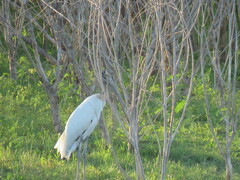
Wood Stork

Wood Stork

Mycteria americana

Silhouette: Mathieu Basille · PhyloPic

LCLeast ConcernNTVUENCR
Daily sighting probability ~10% · With luck
at Goiânia

In 3 days ~20% in a week ~40%

34 Verified sightings at Goiânia
19,534 In all 53 parks From 2019 to 2026
May Best month
☀️ Diurnal When it's spotted

About the Wood Stork

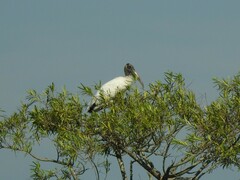
The wood stork (Mycteria americana) is a large wading bird in the family Ciconiidae (storks). Originally described in 1758 by Carl Linnaeus, this stork is native to the subtropics and tropics of the Americas, where it persists in habitats with fluctuating water levels. It is the only stork species that breeds in North America. The head and neck are bare of feathers, and dark grey in colour. The plumage is mostly white, with the exception of the tail and some of the wing feathers, which are black with a greenish-purplish sheen.

Globally, the wood stork is considered to be of least concern by the International Union for Conservation of Nature. In the United States, the wood stork was previously classified as endangered due to loss of suitable feeding habitat in the Florida Everglades, its historical population stronghold in the country. The species has been subsequently downlisted to threatened after northward range expansion and increased population size.

The wood stork was first formally given its binomial name Mycteria americana by Linnaeus in 1758. Linnaeus originally named two separate species, M. americana and Tantalus loculator, based on different and... Wikipedia →

Sounds

Begging call0:40

United States · 2025

© Sue Riffe · XC1043547 · CC BY-NC-SA 4.0

Billed snapping0:14

United States · 2013

© Paul Marvin · XC161837 · CC BY-NC-SA 3.0

Alarm call1:08

United States · 2013

© Russ Wigh · XC139206 · CC BY-NC-SA 3.0

Global Distribution

Parks Where Found

# Park Country Daily sighting probability
1 Palo Verde National Park 🇨🇷 Costa Rica
~70%
2 Parque Estadual Encontro das Águas 🇧🇷 Brazil
~60%
3 Big Cypress National Preserve 🇺🇸 United States
~50%
4 Ría Lagartos Biosphere Reserve 🇲🇽 Mexico
~50%
5 Celestún Biosphere Reserve 🇲🇽 Mexico
~40%
6 Merritt Island National Wildlife Refuge 🇺🇸 United States
~30%
7 Carara National Park 🇨🇷 Costa Rica
~30%
8 Iberá National Park 🇦🇷 Argentina
~30%
9 Everglades National Park 🇺🇸 United States
~30%
10 Ciénaga de Zapata 🇨🇺 Cuba
~20%
11 El Impenetrable National Park 🇦🇷 Argentina
~10%
12 Ostional Wildlife Refuge 🇨🇷 Costa Rica
~10%
13 Montes Azules Biosphere Reserve 🇲🇽 Mexico
~10%
14 Manu National Park 🇵🇪 Peru
~10%
15 Manuel Antonio National Park 🇨🇷 Costa Rica
~10%
16 Las Baulas Marine National Park 🇨🇷 Costa Rica
~10%
17 Tambopata National Reserve 🇵🇪 Peru
~10%
18 Marino Ballena National Park 🇨🇷 Costa Rica
~10%
19 Santa Rosa National Park 🇨🇷 Costa Rica
<5%
20 Lago de Yojoa 🇭🇳 Honduras
<5%
21 Cahuita National Park 🇨🇷 Costa Rica
<5%
22 Sian Ka'an Biosphere Reserve 🇲🇽 Mexico
<5%
23 Soberanía National Park 🇵🇦 Panama
<5%
24 Piedras Blancas National Park 🇨🇷 Costa Rica
<5%
25 Parque Natural Metropolitano 🇵🇦 Panama
<5%
26 Cockscomb Basin Wildlife Sanctuary 🇧🇿 Belize
<5%
27 Gandoca-Manzanillo Wildlife Refuge 🇨🇷 Costa Rica
<5%
28 El Palmar National Park 🇦🇷 Argentina
<5%
29 La Amistad International Park (Panama) 🇵🇦 Panama
<5%
30 Cerro Azul Meámbar National Park 🇭🇳 Honduras
<5%
31 Cañón del Sumidero National Park 🇲🇽 Mexico
<5%
32 Tenorio Volcano National Park 🇨🇷 Costa Rica
<5%
33 Cusuco National Park 🇭🇳 Honduras
<5%
34 Pico Bonito National Park 🇭🇳 Honduras
<5%
35 Bastimentos Island National Marine Park 🇵🇦 Panama
<5%
36 Congaree National Park 🇺🇸 United States
<5%
37 Calakmul Biosphere Reserve 🇲🇽 Mexico
<5%
38 Chapada Diamantina National Park 🇧🇷 Brazil
<5%
39 Tortuguero National Park 🇨🇷 Costa Rica
<5%
40 Tikal National Park 🇬🇹 Guatemala
<5%
41 Darién National Park 🇵🇦 Panama
<5%
42 Cuyabeno Wildlife Reserve 🇪🇨 Ecuador
<5%
43 Chapada dos Guimarães National Park 🇧🇷 Brazil
<5%
44 Amacayacu National Natural Park 🇨🇴 Colombia
<5%
45 Cabo Blanco Absolute Nature Reserve 🇨🇷 Costa Rica
<5%
46 Chagres National Park 🇵🇦 Panama
<5%
47 Corcovado National Park 🇨🇷 Costa Rica
<5%
48 Braulio Carrillo National Park 🇨🇷 Costa Rica
<5%
49 Iguaçu National Park 🇧🇷 Brazil
<5%
50 Arenal Volcano National Park 🇨🇷 Costa Rica
<5%
51 Iguazú National Park 🇦🇷 Argentina
<5%
52 Tapantí-Macizo de la Muerte National Park 🇨🇷 Costa Rica
<5%
53 Monteverde Cloud Forest Reserve 🇨🇷 Costa Rica
<5%

Cities Where Found

# City Country Daily sighting probability
1 Panama City 🇵🇦 Panama
~20%
2 Miami 🇺🇸 United States
~20%
3 Orlando 🇺🇸 United States
~10%
4 Santa Cruz de la Sierra 🇧🇴 Bolivia
~10%
5 San Pedro Sula 🇭🇳 Honduras
~10%
6 Denver 🇺🇸 United States
~10%
7 Goiânia 🇧🇷 Brazil
~10%
8 Barranquilla 🇨🇴 Colombia
<5%
9 Belém 🇧🇷 Brazil
<5%
10 Brasilia 🇧🇷 Brazil
<5%

Zoos & Centres Where Found

# Zoo / Centre Country
1 SeaWorld Orlando 🇺🇸 United States In captivity
2 Parque das Aves 🇧🇷 Brazil In captivity
3 Zoológico de Brasília 🇧🇷 Brazil In captivity
4 Sedgwick County Zoo 🇺🇸 United States In captivity
5 Jacksonville Zoo and Gardens 🇺🇸 United States In captivity
6 São Paulo Zoo 🇧🇷 Brazil In captivity
7 ZooTampa 🇺🇸 United States In captivity
8 Gatorland 🇺🇸 United States In captivity
9 Houston Zoo 🇺🇸 United States In captivity
10 Aviario Nacional de Colombia 🇨🇴 Colombia In captivity
11 Discovery Cove 🇺🇸 United States In captivity
12 Mangal das Garças 🇧🇷 Brazil In captivity
13 Parque Zoobotânico do Museu Paraense Emílio Goeldi 🇧🇷 Brazil In captivity
14 Museu Paraense Emílio Goeldi 🇧🇷 Brazil In captivity
15 Santa Fe College Teaching Zoo 🇺🇸 United States In captivity
16 El Nispero Zoo 🇵🇦 Panama In captivity
17 St. Augustine Alligator Farm Zoological Park 🇺🇸 United States In captivity
18 Jacques Huber Aquarium 🇧🇷 Brazil In captivity
19 Seaside Seabird Sanctuary 🇺🇸 United States In captivity
20 Zoológico Miguél Álvarez del Toro 🇲🇽 Mexico In captivity

Before you go

What are the chances of seeing a Wood Stork in Goiânia?

With luck

About 10% of wildlife watchers report a Wood Stork sighting in Goiânia on a given day, based on 34 verified sightings from GBIF citizen-science data. It is the 104th most-seen of the 174 birds we can rate there. Over three days the chance rises to about 20%, and over a week to about 40%, if each day is a fresh chance.

When is the best time to see a Wood Stork in Goiânia?

March–May, July, September–October and December–January

In those months about 10% of wildlife watchers report a Wood Stork in Goiânia on a given day, against under 5% in February, June, August and November, the lowest months.

What time of day is best to see a Wood Stork?

Between 9 am and noon

Across all the parks we cover, that three-hour window holds the most Wood Stork sightings with a recorded time, and about 9 in 10 of them come between 6 am and 6 pm: it is a daytime animal.

Is Goiânia the best place to see a Wood Stork?

7th of 24

Of the 24 cities where we can rate Wood Stork sightings, Goiânia ranks 7th at about 10%. The best odds are in Panama City (Panama, about 20%), Miami (United States, about 20%) and Orlando (United States, about 10%).

Where does the Wood Stork sighting chance come from?

GBIF citizen-science records

It is estimated from how often the Wood Stork is recorded against all the birds logged in Goiânia (34 verified sightings), calibrated against known sighting rates. Figures are rounded to the nearest 10% because citizen-science data supports honest approximations, not decimals, and months with records from fewer than five people show "—". How it works.

← Back to Goiânia