Bay-breasted Warbler

Bay-breasted Warbler

Setophaga castanea

Silhouette: Dylan GE Gomes · PhyloPic

LCLeast ConcernNTVUENCR
Daily sighting probability <5% · Rare
at Tayrona National Natural Park

In 3 days ~10% in a week ~20%

41 Verified sightings at Tayrona National Natural Park From 2019 to 2026
16,049 In all 49 parks
November Best month
☀️ Diurnal When it's spotted

About the Bay-breasted Warbler

The bay-breasted warbler (Setophaga castanea) is a small species of songbird in the New World warbler family, Parulidae. It is one of 35 species in the diverse genus Setophaga. Like all songbirds, or passerines, the species is classified in the order Passeriformes.

The bay-breasted warbler was formally described and illustrated in 1810 by the American ornithologist Alexander Wilson based on specimens collected in Pennsylvania. Wilson coined the binomial name Sylvia castanea. The specific epithet is Latin meaning "chestnut-coloured". The bay-breasted warbler is now one of over 30 species placed in the genus Setophaga that was introduced by the English naturalist William Swainson in 1827. The species is monotypic, with no subspecies accepted. The genus name Setophaga combines the Ancient Greek σης/sēs, σητος/sētos meaning "moth" with -φαγος/-phagos meaning "-eating".

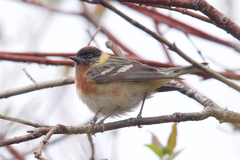
Adult males in breeding plumage are primarily greyish above, with two white wing bars, dark streaks on the back, and a creamy neck patch. The face is black, and the crown, throat, and sides are a dark chestnut colour. Breeding females are similar in overall pattern to the males, but are paler... Wikipedia →

Sounds

Song0:51

United States · 2025

© Bobby Wilcox · XC1036962 · CC BY-NC-SA 4.0

Nocturnal flight call0:06

Canada · 2023

© David Tattersley · XC808425 · CC BY-NC-SA 4.0

Flight call1:09

United States · 2017

© Matt Wistrand · XC368895 · CC BY-NC-SA 4.0

Global Distribution

Parks Where Found

# Park Country Daily sighting probability
1 Chagres National Park 🇵🇦 Panama
~40%
2 Soberanía National Park 🇵🇦 Panama
~30%
3 Point Pelee National Park 🇨🇦 Canada
~30%
4 Darién National Park 🇵🇦 Panama
~20%
5 Parque Natural Metropolitano 🇵🇦 Panama
~20%
6 Utría National Natural Park 🇨🇴 Colombia
~20%
7 Bastimentos Island National Marine Park 🇵🇦 Panama
~20%
8 San Lorenzo Protected Forest 🇵🇦 Panama
~10%
9 Gandoca-Manzanillo Wildlife Refuge 🇨🇷 Costa Rica
~10%
10 Riding Mountain National Park 🇨🇦 Canada
~10%
11 Gros Morne National Park 🇨🇦 Canada
~10%
12 Tortuguero National Park 🇨🇷 Costa Rica
~10%
13 La Amistad International Park (Panama) 🇵🇦 Panama
~10%
14 Cahuita National Park 🇨🇷 Costa Rica
~10%
15 Cape Breton Highlands National Park 🇨🇦 Canada
~10%
16 Pico Bonito National Park 🇭🇳 Honduras
~10%
17 Great Smoky Mountains National Park 🇺🇸 United States
<5%
18 Isle Royale National Park 🇺🇸 United States
<5%
19 Tikal National Park 🇬🇹 Guatemala
<5%
20 Braulio Carrillo National Park 🇨🇷 Costa Rica
<5%
21 Celestún Biosphere Reserve 🇲🇽 Mexico
<5%
22 Tayrona National Natural Park 🇨🇴 Colombia
<5%
23 Arrecifes de Cozumel National Park 🇲🇽 Mexico
<5%
24 Cockscomb Basin Wildlife Sanctuary 🇧🇿 Belize
<5%
25 Tenorio Volcano National Park 🇨🇷 Costa Rica
<5%
26 Voyageurs National Park 🇺🇸 United States
<5%
27 Arenal Volcano National Park 🇨🇷 Costa Rica
<5%
28 Farallones de Cali National Natural Park 🇨🇴 Colombia
<5%
29 Sierra de la Macarena National Park 🇨🇴 Colombia
<5%
30 Sian Ka'an Biosphere Reserve 🇲🇽 Mexico
<5%
31 Shenandoah National Park 🇺🇸 United States
<5%
32 Cusuco National Park 🇭🇳 Honduras
<5%
33 Henri Pittier National Park 🇻🇪 Venezuela
<5%
34 Congaree National Park 🇺🇸 United States
<5%
35 Acadia National Park 🇺🇸 United States
<5%
36 Calakmul Biosphere Reserve 🇲🇽 Mexico
<5%
37 Rincón de la Vieja National Park 🇨🇷 Costa Rica
<5%
38 Marino Ballena National Park 🇨🇷 Costa Rica
<5%
39 Piedras Blancas National Park 🇨🇷 Costa Rica
<5%
40 Caroni Swamp 🇹🇹 Trinidad and Tobago
<5%
41 Poás Volcano National Park 🇨🇷 Costa Rica
<5%
42 Tapantí-Macizo de la Muerte National Park 🇨🇷 Costa Rica
<5%
43 Manuel Antonio National Park 🇨🇷 Costa Rica
<5%
44 Carara National Park 🇨🇷 Costa Rica
<5%
45 Volcán Barú National Park 🇵🇦 Panama
<5%
46 Merritt Island National Wildlife Refuge 🇺🇸 United States
<5%
47 Everglades National Park 🇺🇸 United States
<5%
48 Monteverde Cloud Forest Reserve 🇨🇷 Costa Rica
<5%
49 Los Nevados National Natural Park 🇨🇴 Colombia
<5%

Cities Where Found

# City Country Daily sighting probability
1 Medellín 🇨🇴 Colombia
~10%
2 Chicago 🇺🇸 United States
~10%
3 Panama City 🇵🇦 Panama
~10%
4 Detroit 🇺🇸 United States
~10%
5 Montreal 🇨🇦 Canada
~10%
6 Toronto 🇨🇦 Canada
<5%
7 New York City 🇺🇸 United States
<5%
8 Boston 🇺🇸 United States
<5%
9 Houston 🇺🇸 United States
<5%
10 Philadelphia 🇺🇸 United States
<5%

Before you go

What are the chances of seeing a Bay-breasted Warbler in Tayrona National Natural Park?

Rare

Under 5% of wildlife watchers report a Bay-breasted Warbler sighting in Tayrona National Natural Park on a given day, based on 41 verified sightings from GBIF citizen-science data from 2019 to 2026. It is the 156th most-seen of the 285 birds we can rate there. Over three days the chance rises to about 10%, and over a week to about 20%, if each day is a fresh chance.

When is the best time to see a Bay-breasted Warbler in Tayrona National Natural Park?

April and November

In those months about 10% of wildlife watchers report a Bay-breasted Warbler in Tayrona National Natural Park on a given day, against under 5% in May–October and December–March, the lowest months.

What time of day is best to see a Bay-breasted Warbler?

Between 9 am and noon

Across all the parks we cover, that three-hour window holds the most Bay-breasted Warbler sightings with a recorded time, and about 9 in 10 of them come between 6 am and 6 pm: it is a daytime animal.

Where does the Bay-breasted Warbler sighting chance come from?

GBIF citizen-science records

It is estimated from how often the Bay-breasted Warbler is recorded against all the birds logged in Tayrona National Natural Park (41 verified sightings from 2019 to 2026), calibrated against known sighting rates. Figures are rounded to the nearest 10% because citizen-science data supports honest approximations, not decimals, and months with records from fewer than five people show "—". How it works.

← Back to Tayrona National Natural Park