Great Crested Flycatcher

Great Crested Flycatcher

Myiarchus crinitus

Silhouette: Jason Dilworth · PhyloPic

LCLeast ConcernNTVUENCR
Daily sighting probability ~10% · With luck
at Voyageurs National Park

In 3 days ~20% in a week ~40%

21 Verified sightings at Voyageurs National Park From 2019 to 2026
24,216 In all 57 parks
June Best month
☀️ Diurnal When it's spotted

About the Great Crested Flycatcher

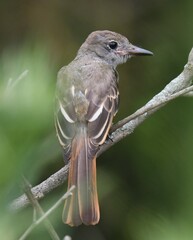
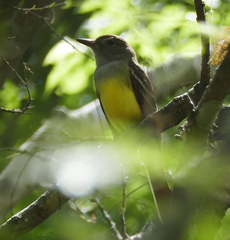
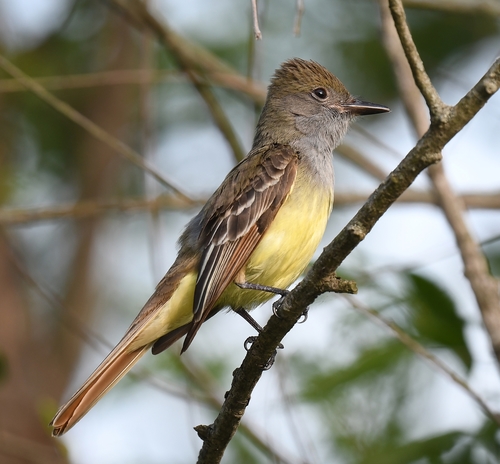
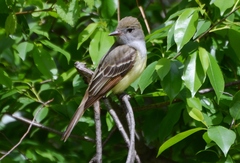
The great crested flycatcher (Myiarchus crinitus) is a large insect-eating bird of the tyrant flycatcher family. It is the most widespread member of the genus Myiarchus in North America, and is found over most of the eastern and mid-western portions of the continent. It dwells mostly in the treetops and rarely is found on the ground.

The great crested flycatcher was formally described in 1758 by the Swedish naturalist Carl Linnaeus in the tenth edition of his Systema Naturae. He placed it with the thrushes in the genus Turdus and coined the binomial name Turdus crinitus. The specific epithet crinitus is Latin and means "long-haired" (from crinis meaning "hair") Linnaeus based his account on the "crested fly-catcher" that had been described and illustrated by the English naturalist Mark Catesby in his book The Natural History of Carolina, Florida and the Bahama Islands. Linnaeus specified the type locality as "America" but this was restricted to South Carolina by Outram Bangs in 1898. It is now one of 22 species placed in the genus Myiarchus that was introduced by the German ornithologist Jean Cabanis in 1844. The species is monotypic: no subspecies are recognised.

�... Wikipedia →

Sounds

Call0:41

United States · 2025

© Bobby Wilcox · XC1036375 · CC BY-NC-SA 4.0

Recording0:05

United States · 2024

© Oscar Gordo · XC924423 · CC BY-NC-SA 4.0

Song0:17

Canada · 2024

© Denis Provencher · XC916957 · CC BY-NC-SA 4.0

Global Distribution

Parks Where Found

# Park Country Daily sighting probability
1 Big Cypress National Preserve 🇺🇸 United States
~40%
2 Point Pelee National Park 🇨🇦 Canada
~40%
3 Everglades National Park 🇺🇸 United States
~40%
4 Calakmul Biosphere Reserve 🇲🇽 Mexico
~40%
5 Santa Rosa National Park 🇨🇷 Costa Rica
~40%
6 Tikal National Park 🇬🇹 Guatemala
~30%
7 Biotopo Cerro Cahuí 🇬🇹 Guatemala
~30%
8 Congaree National Park 🇺🇸 United States
~20%
9 Cabo Blanco Absolute Nature Reserve 🇨🇷 Costa Rica
~20%
10 Ostional Wildlife Refuge 🇨🇷 Costa Rica
~20%
11 Manuel Antonio National Park 🇨🇷 Costa Rica
~20%
12 Corcovado National Park 🇨🇷 Costa Rica
~20%
13 Lago de Yojoa 🇭🇳 Honduras
~20%
14 Soberanía National Park 🇵🇦 Panama
~10%
15 Palo Verde National Park 🇨🇷 Costa Rica
~10%
16 Carara National Park 🇨🇷 Costa Rica
~10%
17 Shenandoah National Park 🇺🇸 United States
~10%
18 Cahuita National Park 🇨🇷 Costa Rica
~10%
19 Piedras Blancas National Park 🇨🇷 Costa Rica
~10%
20 Cañón del Sumidero National Park 🇲🇽 Mexico
~10%
21 Pico Bonito National Park 🇭🇳 Honduras
~10%
22 El Triunfo 🇲🇽 Mexico
~10%
23 Bastimentos Island National Marine Park 🇵🇦 Panama
~10%
24 Tortuguero National Park 🇨🇷 Costa Rica
~10%
25 Marino Ballena National Park 🇨🇷 Costa Rica
~10%
26 Cockscomb Basin Wildlife Sanctuary 🇧🇿 Belize
~10%
27 Tayrona National Natural Park 🇨🇴 Colombia
~10%
28 Utría National Natural Park 🇨🇴 Colombia
~10%
29 Gandoca-Manzanillo Wildlife Refuge 🇨🇷 Costa Rica
~10%
30 Darién National Park 🇵🇦 Panama
~10%
31 Coiba National Park 🇵🇦 Panama
~10%
32 Great Smoky Mountains National Park 🇺🇸 United States
~10%
33 San Lorenzo Protected Forest 🇵🇦 Panama
~10%
34 Montes Azules Biosphere Reserve 🇲🇽 Mexico
~10%
35 Cerro Azul Meámbar National Park 🇭🇳 Honduras
~10%
36 Voyageurs National Park 🇺🇸 United States
~10%
37 Rincón de la Vieja National Park 🇨🇷 Costa Rica
~10%
38 Las Baulas Marine National Park 🇨🇷 Costa Rica
~10%
39 Elk Island National Park 🇨🇦 Canada
~10%
40 Parque Natural Metropolitano 🇵🇦 Panama
~10%
41 La Amistad International Park (Panama) 🇵🇦 Panama
<5%
42 Chagres National Park 🇵🇦 Panama
<5%
43 Merritt Island National Wildlife Refuge 🇺🇸 United States
<5%
44 Riding Mountain National Park 🇨🇦 Canada
<5%
45 Acadia National Park 🇺🇸 United States
<5%
46 Braulio Carrillo National Park 🇨🇷 Costa Rica
<5%
47 Arenal Volcano National Park 🇨🇷 Costa Rica
<5%
48 Badlands National Park 🇺🇸 United States
<5%
49 Arrecifes de Cozumel National Park 🇲🇽 Mexico
<5%
50 Tenorio Volcano National Park 🇨🇷 Costa Rica
<5%
51 Ría Lagartos Biosphere Reserve 🇲🇽 Mexico
<5%
52 Masaya Volcano National Park 🇳🇮 Nicaragua
<5%
53 Sian Ka'an Biosphere Reserve 🇲🇽 Mexico
<5%
54 Cumbres de Monterrey National Park 🇲🇽 Mexico
<5%
55 Monteverde Cloud Forest Reserve 🇨🇷 Costa Rica
<5%
56 Volcán Barú National Park 🇵🇦 Panama
<5%
57 Tapantí-Macizo de la Muerte National Park 🇨🇷 Costa Rica
<5%

Cities Where Found

# City Country Daily sighting probability
1 Orlando 🇺🇸 United States
~20%
2 Baltimore 🇺🇸 United States
~20%
3 Washington 🇺🇸 United States
~20%
4 Austin 🇺🇸 United States
~20%
5 Dallas 🇺🇸 United States
~10%
6 Minneapolis [Saint Paul] 🇺🇸 United States
~10%
7 San Antonio 🇺🇸 United States
~10%
8 Montreal 🇨🇦 Canada
~10%
9 Houston 🇺🇸 United States
~10%
10 Philadelphia 🇺🇸 United States
~10%

Before you go

What are the chances of seeing a Great Crested Flycatcher in Voyageurs National Park?

With luck

About 10% of wildlife watchers report a Great Crested Flycatcher sighting in Voyageurs National Park on a given day, based on 21 verified sightings from GBIF citizen-science data from 2019 to 2026. It is the 69th most-seen of the 116 birds we can rate there. Over three days the chance rises to about 20%, and over a week to about 40%, if each day is a fresh chance.

When is the best time to see a Great Crested Flycatcher in Voyageurs National Park?

May to July

In those months about 10% of wildlife watchers report a Great Crested Flycatcher in Voyageurs National Park on a given day, against under 5% in February–April and August–November, the lowest months. December and January have too few records to rate.

What time of day is best to see a Great Crested Flycatcher?

Between 7 and 10 am

Across all the parks we cover, that three-hour window holds the most Great Crested Flycatcher sightings with a recorded time, and about 9 in 10 of them come between 6 am and 6 pm: it is a daytime animal.

Which relatives of the Great Crested Flycatcher live in Voyageurs National Park?

Same family: Tyrannidae

The closest relatives of the Great Crested Flycatcher that you can see in Voyageurs National Park (family Tyrannidae, Tyrant Flycatchers) are Eastern Phoebe (about 20%), Least Flycatcher (about 20%) and Eastern Wood-Pewee (about 10%), with each one's daily chance of a sighting.

Where does the Great Crested Flycatcher sighting chance come from?

GBIF citizen-science records

It is estimated from how often the Great Crested Flycatcher is recorded against all the birds logged in Voyageurs National Park (21 verified sightings from 2019 to 2026), calibrated against known sighting rates. Figures are rounded to the nearest 10% because citizen-science data supports honest approximations, not decimals, and months with records from fewer than five people show "—". How it works.
← Back to Voyageurs National Park