White-winged Dove

White-winged Dove

Zenaida asiatica

Silhouette: Danielle Alba · PhyloPic

LCLeast ConcernNTVUENCR
Daily sighting probability <5% · Rare
at Channel Islands National Park

In 3 days <5%

36 Verified sightings at Channel Islands National Park From 2019 to 2026
32,472 In all 59 parks
September Best month
☀️ Diurnal When it's spotted

About the White-winged Dove

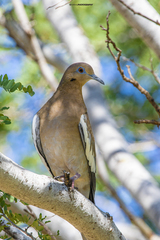
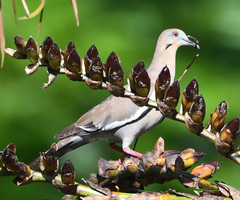
The white-winged dove (Zenaida asiatica) is a dove whose native range extends from the Southwestern United States through Mexico, Central America, and the Caribbean. They are large for doves, and can be distinguished from similar doves by the distinctive white edge on their wings. They have a blue eyering and red eyes. The plumage is brownish-gray to gray. Juveniles are duller in color and have brown eyes. The call is likened to the English phrase "who cooks for you". There are three subspecies. It was first described by George Edwards in 1743, and given its binomial name by Linnaeus in 1756. It was moved into the genus Zenaida in 1838.

They inhabit a variety of environments, including desert, scrub, and urban. Their diet consists mostly of grains, but will also include pollen and nectar, especially from the saguaro cactus, which is a vital source of water.

Human expansion has greatly affected the white-winged dove. Before human presence, their range closely mirrored that of their favorite food, the saguaro. The advent of agriculture in North America greatly expanded its range by providing a reliable food source. This has also led some modern populations to be migratory. Historically, they nested in enormous colonies, but most have been lost to human activities and climate change, and most nesting now occurs in isolation. It is hunted for sport, and is the second most shot game bird in the United States. Its population collapsed in the 1960s and 1970s, likely due to the loss of major nesting colonies. The population rebounded, however, and despite continued habitat loss and hunting, it has proved adaptable to human environments. The International Union for Conservation of Nature considers it to be a species of least-concern. Wikipedia →

Sounds

Wing sound0:12

United States · 2017

© Pat Goltz · XC1157432 · CC BY-NC-SA 4.0

Song0:09

Costa Rica · 2017

© Albert Lastukhin · XC1094638 · CC BY-NC-ND 4.0

Dawn song0:07

United States · 2025

© David Tattersley · XC1000260 · CC BY-NC-SA 4.0

Global Distribution

Parks Where Found

# Park Country Daily sighting probability
1 Masaya Volcano National Park 🇳🇮 Nicaragua
~90%
2 Cabo Pulmo National Park 🇲🇽 Mexico
~80%
3 Big Bend National Park 🇺🇸 United States
~70%
4 Las Baulas Marine National Park 🇨🇷 Costa Rica
~70%
5 Bahía de Loreto National Park 🇲🇽 Mexico
~70%
6 Arrecifes de Cozumel National Park 🇲🇽 Mexico
~50%
7 Saguaro National Park 🇺🇸 United States
~50%
8 Celestún Biosphere Reserve 🇲🇽 Mexico
~50%
9 Palo Verde National Park 🇨🇷 Costa Rica
~40%
10 Cerro Azul Meámbar National Park 🇭🇳 Honduras
~40%
11 Guadalupe Mountains National Park 🇺🇸 United States
~40%
12 Ostional Wildlife Refuge 🇨🇷 Costa Rica
~40%
13 Lago de Yojoa 🇭🇳 Honduras
~40%
14 Rincón de la Vieja National Park 🇨🇷 Costa Rica
~40%
15 Cusuco National Park 🇭🇳 Honduras
~40%
16 Carara National Park 🇨🇷 Costa Rica
~40%
17 Cabo Blanco Absolute Nature Reserve 🇨🇷 Costa Rica
~40%
18 Cumbres de Monterrey National Park 🇲🇽 Mexico
~30%
19 Santa Rosa National Park 🇨🇷 Costa Rica
~30%
20 Pico Bonito National Park 🇭🇳 Honduras
~30%
21 Celaque National Park 🇭🇳 Honduras
~30%
22 Calakmul Biosphere Reserve 🇲🇽 Mexico
~30%
23 Sian Ka'an Biosphere Reserve 🇲🇽 Mexico
~30%
24 Cañón del Sumidero National Park 🇲🇽 Mexico
~30%
25 Ría Lagartos Biosphere Reserve 🇲🇽 Mexico
~30%
26 Los Haitises National Park 🇩🇴 Dominican Republic
~20%
27 El Vizcaíno Biosphere Reserve 🇲🇽 Mexico
~20%
28 La Tigra National Park 🇭🇳 Honduras
~20%
29 Biotopo Cerro Cahuí 🇬🇹 Guatemala
~20%
30 El Triunfo 🇲🇽 Mexico
~20%
31 Blue and John Crow Mountains National Park 🇯🇲 Jamaica
~20%
32 Tenorio Volcano National Park 🇨🇷 Costa Rica
~20%
33 Manuel Antonio National Park 🇨🇷 Costa Rica
~10%
34 Jaragua National Park 🇩🇴 Dominican Republic
~10%
35 Ciénaga de Zapata 🇨🇺 Cuba
~10%
36 Arenal Volcano National Park 🇨🇷 Costa Rica
~10%
37 Braulio Carrillo National Park 🇨🇷 Costa Rica
~10%
38 Death Valley National Park 🇺🇸 United States
~10%
39 Joshua Tree National Park 🇺🇸 United States
~10%
40 Marino Ballena National Park 🇨🇷 Costa Rica
~10%
41 Poás Volcano National Park 🇨🇷 Costa Rica
~10%
42 Everglades National Park 🇺🇸 United States
<5%
43 Montes Azules Biosphere Reserve 🇲🇽 Mexico
<5%
44 Tapantí-Macizo de la Muerte National Park 🇨🇷 Costa Rica
<5%
45 Monteverde Cloud Forest Reserve 🇨🇷 Costa Rica
<5%
46 Zion National Park 🇺🇸 United States
<5%
47 Piedras Blancas National Park 🇨🇷 Costa Rica
<5%
48 Padre Island National Seashore 🇺🇸 United States
<5%
49 La Amistad International Park (Panama) 🇵🇦 Panama
<5%
50 Irazú Volcano National Park 🇨🇷 Costa Rica
<5%
51 Tikal National Park 🇬🇹 Guatemala
<5%
52 Big Cypress National Preserve 🇺🇸 United States
<5%
53 Cockscomb Basin Wildlife Sanctuary 🇧🇿 Belize
<5%
54 Channel Islands National Park 🇺🇸 United States
<5%
55 Grand Canyon National Park 🇺🇸 United States
<5%
56 Corcovado National Park 🇨🇷 Costa Rica
<5%
57 Merritt Island National Wildlife Refuge 🇺🇸 United States
<5%
58 Bastimentos Island National Marine Park 🇵🇦 Panama
<5%
59 Tortuguero National Park 🇨🇷 Costa Rica
<5%

Cities Where Found

# City Country Daily sighting probability
1 Torreón 🇲🇽 México
~90%
2 Managua 🇳🇮 Nicaragua
~90%
3 Monterrey 🇲🇽 México
~90%
4 Tegucigalpa 🇭🇳 Honduras
~90%
5 San Salvador 🇸🇻 El Salvador
~90%
6 León 🇲🇽 México
~90%
7 San Pedro Sula 🇭🇳 Honduras
~80%
8 Ciudad Juárez 🇲🇽 México
~80%
9 San Antonio 🇺🇸 United States
~80%
10 San José 🇨🇷 Costa Rica
~80%

Zoos & Centres Where Found

# Zoo / Centre Country
1 North Carolina Zoo 🇺🇸 United States In captivity
2 Abilene Zoological Gardens 🇺🇸 United States In captivity
3 Omaha’s Henry Doorly Zoo and Aquarium 🇺🇸 United States In captivity
4 Phoenix Zoo 🇺🇸 United States In captivity
5 Xcaret 🇲🇽 Mexico In captivity
6 Arizona-Sonora Desert Museum 🇺🇸 United States In captivity
7 Parc animalier de Casteil 🇫🇷 France In captivity
8 Riverbanks Zoo 🇺🇸 United States In captivity
9 The Abilene Zoo 🇺🇸 United States In captivity
10 Alameda Park Zoo 🇺🇸 United States In captivity

Before you go

What are the chances of seeing a White-winged Dove in Channel Islands National Park?

Rare

Under 5% of wildlife watchers report a White-winged Dove sighting in Channel Islands National Park on a given day, based on 36 verified sightings from GBIF citizen-science data from 2019 to 2026. It is the 205th most-seen of the 276 birds we can rate there. Over three days the chance rises to under 5%, if each day is a fresh chance.

When is the best time to see a White-winged Dove in Channel Islands National Park?

September

In that month about 10% of wildlife watchers report a White-winged Dove in Channel Islands National Park on a given day, against under 5% in October to August, the lowest months. That is one of Channel Islands National Park's driest months, with almost no rain against 60 mm in January.

What time of day is best to see a White-winged Dove?

Between 8 and 11 am

Across all the parks we cover, that three-hour window holds the most White-winged Dove sightings with a recorded time, and about 9 in 10 of them come between 6 am and 6 pm: it is a daytime animal.

Where does the White-winged Dove sighting chance come from?

GBIF citizen-science records

It is estimated from how often the White-winged Dove is recorded against all the birds logged in Channel Islands National Park (36 verified sightings from 2019 to 2026), calibrated against known sighting rates. Figures are rounded to the nearest 10% because citizen-science data supports honest approximations, not decimals, and months with records from fewer than five people show "—". How it works.

← Back to Channel Islands National Park