White-Bellied Sea-Eagle

White-Bellied Sea-Eagle

Haliaeetus leucogaster

Silhouette: Ron Holmes/U. S. Fish and Wildlife Service (source photo), T. Michael Keesey (vectorization) · PhyloPic

LCLeast ConcernNTVUENCR
Daily sighting probability <5% · Rare
at Mumbai

In 3 days <5%

18 Verified sightings at Mumbai
7,466 In all 39 parks From 2019 to 2026
August Best month
☀️ Diurnal When it's spotted

About the White-Bellied Sea-Eagle

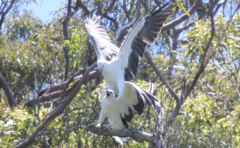
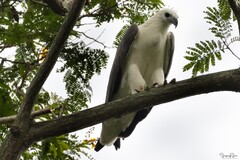
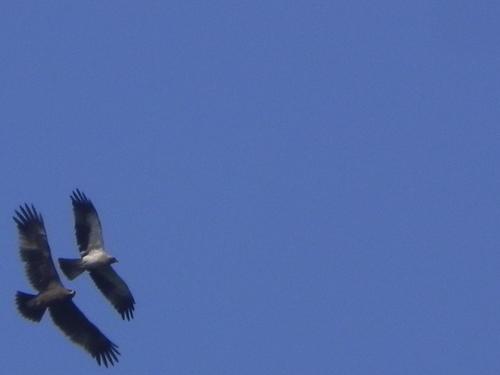
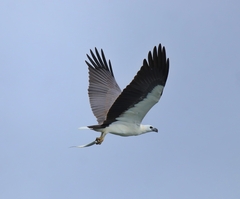
The white-bellied sea eagle (Icthyophaga leucogaster), also known as the white-breasted sea eagle, is a large diurnal bird of prey in the family Accipitridae. Originally described by Johann Friedrich Gmelin in 1788, it is closely related to Sanford's sea eagle of the Solomon Islands, and the two are considered a superspecies. A distinctive bird, the adult white-bellied sea eagle has a white head, breast, under-wing coverts and tail. The upper parts are grey and the black under-wing flight feathers contrast with the white coverts. The tail is short and wedge-shaped as in all Haliaeetinae species. Like many raptors, the female is larger than the male, and can measure up to 90 cm (35 in) long with a wingspan of up to 2.2 m (7.2 ft), and weigh 4.5 kg (9.9 lb). Immature birds have brown plumage, which is gradually replaced by white until the age of five or six years. The call is a loud goose-like honking.

Resident from India and Sri Lanka through Southeast Asia to Australia on coasts and major waterways, the white-bellied sea eagle breeds and hunts near water, and fish form around half of its diet. Opportunistic, it consumes carrion and a wide variety of animals. Although rated as Least Concern globally, it has declined in parts of southeast Asia such as Thailand, and southeastern Australia. It is ranked as Threatened in Victoria and Vulnerable in South Australia and Tasmania. Human disturbance to its habitat is the main threat, both from direct human activity near nests which impacts on breeding success, and from removal of suitable trees for nesting. The white-bellied sea eagle is revered by indigenous people in many parts of Australia, and is the subject of various folk tales throughout its range. Wikipedia →

Sounds

Call0:15

Singapore · 2026

© Joan Theng · XC1183270 · CC BY-NC-SA 4.0

Flight call0:23

Malaysia · 2024

© Lim Ying Hien · XC951987 · CC BY-NC-ND 4.0

Call0:23

Singapore · 2022

© Yeo SB · XC706575 · CC BY-NC-SA 4.0

Global Distribution

Parks Where Found

# Park Country Daily sighting probability
1 Komodo National Park 🇮🇩 Indonesia
~80%
2 Yala National Park 🇱🇰 Sri Lanka
~50%
3 Bako National Park 🇲🇾 Malaysia
~50%
4 Kinabatangan Wildlife Sanctuary 🇲🇾 Malaysia
~50%
5 Udawalawe National Park 🇱🇰 Sri Lanka
~50%
6 Wilpattu National Park 🇱🇰 Sri Lanka
~40%
7 Booderee National Park 🇦🇺 Australia
~40%
8 Maria Island National Park 🇦🇺 Australia
~40%
9 Kakadu National Park 🇦🇺 Australia
~40%
10 Cape Range 🇦🇺 Australia
~30%
11 Raja Ampat 🇮🇩 Indonesia
~30%
12 Ningaloo Marine Park 🇦🇺 Australia
~30%
13 Minneriya National Park 🇱🇰 Sri Lanka
~20%
14 Daintree National Park 🇦🇺 Australia
~20%
15 Freycinet National Park 🇦🇺 Australia
~20%
16 Noosa National Park 🇦🇺 Australia
~20%
17 Nitmiluk National Park 🇦🇺 Australia
~20%
18 Khao Sok National Park 🇹🇭 Thailand
~20%
19 Tangkoko Nature Reserve 🇮🇩 Indonesia
~20%
20 Royal National Park 🇦🇺 Australia
~20%
21 Sundarbans National Park 🇮🇳 India
~10%
22 Sepilok 🇲🇾 Malaysia
~10%
23 Way Kambas National Park 🇮🇩 Indonesia
~10%
24 Wilsons Promontory National Park 🇦🇺 Australia
~10%
25 Flinders Chase 🇦🇺 Australia
~10%
26 Hattah-Kulkyne National Park 🇦🇺 Australia
~10%
27 Rottnest Island 🇦🇺 Australia
~10%
28 Bali Barat National Park 🇮🇩 Indonesia
<5%
29 Springbrook National Park 🇦🇺 Australia
<5%
30 Horton Plains National Park 🇱🇰 Sri Lanka
<5%
31 Kosciuszko National Park 🇦🇺 Australia
<5%
32 Great Otway National Park 🇦🇺 Australia
<5%
33 Lamington National Park 🇦🇺 Australia
<5%
34 Taman Negara National Park 🇲🇾 Malaysia
<5%
35 Blue Mountains National Park 🇦🇺 Australia
<5%
36 Grampians National Park 🇦🇺 Australia
<5%
37 Sinharaja Forest Reserve 🇱🇰 Sri Lanka
<5%
38 Kaeng Krachan National Park 🇹🇭 Thailand
<5%
39 Periyar National Park 🇮🇳 India
<5%

Cities Where Found

# City Country Daily sighting probability
1 Singapore 🇸🇬 Singapore
~30%
2 Johor Bahru 🇲🇾 Malaysia
~20%
3 Colombo [Sri Jayawardenepura Kotte] 🇱🇰 Sri Lanka
~10%
4 Brisbane 🇦🇺 Australia
~10%
5 Denpasar 🇮🇩 Indonesia
<5%
6 Kuala Lumpur 🇲🇾 Malaysia
<5%
7 Sydney 🇦🇺 Australia
<5%
8 Jakarta 🇮🇩 Indonesia
<5%
9 Hobart 🇦🇺 Australia
<5%
10 Visakhapatnam 🇮🇳 India
<5%

Zoos & Centres Where Found

# Zoo / Centre Country
1 ZooParc de Beauval 🇫🇷 France In captivity
2 Bali Zoo 🇮🇩 Indonesia In captivity
3 Safari World 🇹🇭 Thailand In captivity
4 National Zoo of Malaysia 🇲🇾 Malaysia In captivity
5 Taronga Zoo 🇦🇺 Australia In captivity
6 Lok Kawi Wildlife Park 🇲🇾 Malaysia In captivity
7 Ninoy Aquino Parks & Wildlife Center 🇵🇭 Philippines In captivity
8 Lone Pine Koala Sanctuary 🇦🇺 Australia In captivity
9 Parndana Wildlife Park 🇦🇺 Australia In captivity
10 Gembira Loka Zoo 🇮🇩 Indonesia In captivity
11 Surabaya Zoo 🇮🇩 Indonesia In captivity
12 Bandung Zoo 🇮🇩 Indonesia In captivity
13 Bird Paradise 🇸🇬 Singapore In captivity
14 Thiruvananthapuram Zoo 🇮🇳 India In captivity
15 Rainforest Wild Asia 🇸🇬 Singapore In captivity
16 National Zoological Gardens of Sri Lanka 🇱🇰 Sri Lanka In captivity
17 Australian Reptile Park 🇦🇺 Australia In captivity
18 Albay Park and Wildlife 🇵🇭 Philippines In captivity
19 Featherdale Sydney Wildlife Park 🇦🇺 Australia In captivity
20 Bali Bird Park 🇮🇩 Indonesia In captivity
21 Davao Crocodile Park & Zoo 🇵🇭 Philippines In captivity
22 Farm in the City 🇲🇾 Malaysia In captivity
23 Penang Bird Park 🇲🇾 Malaysia In captivity
24 Singapore Oceanarium 🇸🇬 Singapore In captivity
25 Kangaroo Island Wildlife Park 🇦🇺 Australia In captivity

Before you go

What are the chances of seeing a White-Bellied Sea-Eagle in Mumbai?

Rare

Under 5% of wildlife watchers report a White-Bellied Sea-Eagle sighting in Mumbai on a given day, based on 18 verified sightings from GBIF citizen-science data. It is the 251st most-seen of the 283 birds we can rate there. Over three days the chance rises to under 5%, if each day is a fresh chance.

When is the best time to see a White-Bellied Sea-Eagle in Mumbai?

Any time of year

In every month with enough records, under 5% of wildlife watchers report a White-Bellied Sea-Eagle in Mumbai on a given day, so our monthly data shows no clear season.

What time of day is best to see a White-Bellied Sea-Eagle?

Between 2 and 5 pm

Across all the parks we cover, that three-hour window holds the most White-Bellied Sea-Eagle sightings with a recorded time, and about 9 in 10 of them come between 6 am and 6 pm: it is a daytime animal.

Is Mumbai the best place to see a White-Bellied Sea-Eagle?

13th of 15

Of the 15 cities where we can rate White-Bellied Sea-Eagle sightings, Mumbai ranks 13th at under 5%. The best odds are in Singapore (Singapore, about 30%), Johor Bahru (Malaysia, about 20%) and Colombo [Sri Jayawardenepura Kotte] (Sri Lanka, about 10%).

Which relatives of the White-Bellied Sea-Eagle live in Mumbai?

Same family: Accipitridae

The closest relatives of the White-Bellied Sea-Eagle that you can see in Mumbai (family Accipitridae, Hawks, Eagles, and Kites) are Black Kite (about 80%), Brahminy Kite (about 10%) and Western Marsh-Harrier (about 10%), with each one's daily chance of a sighting.

Where does the White-Bellied Sea-Eagle sighting chance come from?

GBIF citizen-science records

It is estimated from how often the White-Bellied Sea-Eagle is recorded against all the birds logged in Mumbai (18 verified sightings), calibrated against known sighting rates. Figures are rounded to the nearest 10% because citizen-science data supports honest approximations, not decimals, and months with records from fewer than five people show "—". How it works.

← Back to Mumbai