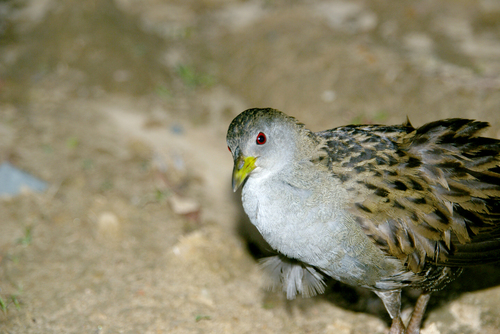
Gray-cowled Wood-Rail

Gray-cowled Wood-Rail

Aramides cajanea

Silhouette: Sheatherius · PhyloPic

LCLeast ConcernNTVUENCR
Daily sighting probability <5% · Rare
at Iguaçu National Park

In 3 days <5%

19 Verified sightings at Iguaçu National Park From 2019 to 2026
10,444 In all 42 parks
December Best month
☀️ Diurnal When it's spotted

About the Gray-cowled Wood-Rail

The grey-cowled wood rail or grey-necked wood rail (Aramides cajaneus; also gray-) is a species of bird in the family Rallidae, the rails. It lives primarily in the forests, mangroves, and swamps of Central and South America. Of the two subspecies, A. c. avicenniae is found in southeastern Brazil, while the nominate is found throughout the portion of the range not occupied by the other subspecies. The species as a whole is usually found at elevations from sea level to 2,000 metres (6,600 ft), although some have been found above that. This bird's large range, along with its significant population, is why it is considered to be least-concern by the International Union for Conservation of Nature (IUCN). In some places, it is occasionally hunted and kept for food.

This bird, large for a wood rail, has both a grey head and neck. In the nominate, the back of the head has a brown patch. The upperparts are olive-green to dark brown. The chest and flanks are a rufous colour, with the belly, rump, and tail being black. The legs are coral-red, the bill is a bright greenish-yellow, and the eyes are red. The sexes are similar. The juveniles can be differentiated by their duller look, and the chicks have a black, downy appearance, brown head, and black beak. The subspecies A. c. avicenniae can be differentiated by its smaller size, lack of a brown patch at the back of the neck, and its lower back being toned slightly olive. The underparts are also pale.

The bird is monogamous; pairs can be found together throughout the year. During the breeding season, which usually lasts from March to August, the grey-cowled wood rail builds nests that can be found on flat branches and in thickets, usually at heights between 1 and 3 metres (3 and 10 ft). In these nests, there is a clutch consisting of three to seven eggs, incubated by both sexes. The chicks that hatch are precocial, able to move soon after hatching. This rail feeds on a wide range of foods, from molluscs to seeds. It is also known to feed on the faeces of giant otters. Wikipedia →


Sounds

Song0:35

Brazil · 2026

© Robson Silva e Silva · XC1084399 · CC BY-NC-SA 4.0

Duet1:19

Brazil · 2025

© JAYRSON ARAUJO DE OLIVEIRA · XC1005731 · CC BY-NC-SA 4.0

Recording0:32

Colombia · 2022

© David Monroy Rengifo · XC771601 · CC BY-NC-SA 4.0

Global Distribution

Parks Where Found

# Park Country Daily sighting probability
1 Piedras Blancas National Park 🇨🇷 Costa Rica
~50%
2 Marino Ballena National Park 🇨🇷 Costa Rica
~40%
3 Parque Estadual Encontro das Águas 🇧🇷 Brazil
~30%
4 Manuel Antonio National Park 🇨🇷 Costa Rica
~30%
5 Caroni Swamp 🇹🇹 Trinidad and Tobago
~30%
6 Bastimentos Island National Marine Park 🇵🇦 Panama
~20%
7 Serra da Canastra National Park 🇧🇷 Brazil
~20%
8 Corcovado National Park 🇨🇷 Costa Rica
~20%
9 Coiba National Park 🇵🇦 Panama
~20%
10 Manu National Park 🇵🇪 Peru
~20%
11 Gandoca-Manzanillo Wildlife Refuge 🇨🇷 Costa Rica
~10%
12 Chirripó National Park 🇨🇷 Costa Rica
~10%
13 El Impenetrable National Park 🇦🇷 Argentina
~10%
14 La Amistad International Park (Panama) 🇵🇦 Panama
~10%
15 Tambopata National Reserve 🇵🇪 Peru
~10%
16 El Palmar National Park 🇦🇷 Argentina
~10%
17 Sierra de la Macarena National Park 🇨🇴 Colombia
~10%
18 Ostional Wildlife Refuge 🇨🇷 Costa Rica
~10%
19 Anavilhanas National Park 🇧🇷 Brazil
~10%
20 Emas National Park 🇧🇷 Brazil
~10%
21 Iberá National Park 🇦🇷 Argentina
~10%
22 Carara National Park 🇨🇷 Costa Rica
~10%
23 Cabo Blanco Absolute Nature Reserve 🇨🇷 Costa Rica
~10%
24 Soberanía National Park 🇵🇦 Panama
~10%
25 Henri Pittier National Park 🇻🇪 Venezuela
~10%
26 Monteverde Cloud Forest Reserve 🇨🇷 Costa Rica
<5%
27 Tayrona National Natural Park 🇨🇴 Colombia
<5%
28 Cahuita National Park 🇨🇷 Costa Rica
<5%
29 San Lorenzo Protected Forest 🇵🇦 Panama
<5%
30 Amacayacu National Natural Park 🇨🇴 Colombia
<5%
31 Chapada dos Guimarães National Park 🇧🇷 Brazil
<5%
32 Amboró National Park 🇧🇴 Bolivia
<5%
33 Yasuní National Park 🇪🇨 Ecuador
<5%
34 Los Nevados National Natural Park 🇨🇴 Colombia
<5%
35 Farallones de Cali National Natural Park 🇨🇴 Colombia
<5%
36 Chagres National Park 🇵🇦 Panama
<5%
37 Tijuca National Park 🇧🇷 Brazil
<5%
38 Braulio Carrillo National Park 🇨🇷 Costa Rica
<5%
39 Palo Verde National Park 🇨🇷 Costa Rica
<5%
40 Parque Natural Metropolitano 🇵🇦 Panama
<5%
41 Iguaçu National Park 🇧🇷 Brazil
<5%
42 Iguazú National Park 🇦🇷 Argentina
<5%

Cities Where Found

# City Country Daily sighting probability
1 Goiânia 🇧🇷 Brazil
~30%
2 Fortaleza 🇧🇷 Brazil
~20%
3 Campo Grande 🇧🇷 Brazil
~20%
4 Recife 🇧🇷 Brazil
~20%
5 Cali 🇨🇴 Colombia
~20%
6 Belo Horizonte 🇧🇷 Brazil
~20%
7 João Pessoa 🇧🇷 Brazil
~10%
8 São Luís 🇧🇷 Brazil
~10%
9 Asuncion 🇵🇾 Paraguay
~10%
10 Montevideo 🇺🇾 Uruguay
~10%

Zoos & Centres Where Found

# Zoo / Centre Country
1 Bronx Zoo 🇺🇸 United States In captivity
2 Parc zoologique de Montpellier 🇫🇷 France In captivity
3 Terra Natura Benidorm 🇪🇸 Spain In captivity
4 Aviario Nacional de Colombia 🇨🇴 Colombia In captivity
5 Topeka Zoo 🇺🇸 United States In captivity
6 El Nispero Zoo 🇵🇦 Panama In captivity

Before you go

What are the chances of seeing a Gray-cowled Wood-Rail in Iguaçu National Park?

Rare

Under 5% of wildlife watchers report a Gray-cowled Wood-Rail sighting in Iguaçu National Park on a given day, based on 19 verified sightings from GBIF citizen-science data from 2019 to 2026. It is the 291st most-seen of the 346 birds we can rate there. Over three days the chance rises to under 5%, if each day is a fresh chance.

When is the best time to see a Gray-cowled Wood-Rail in Iguaçu National Park?

Any time of year

In every month with enough records, under 5% of wildlife watchers report a Gray-cowled Wood-Rail in Iguaçu National Park on a given day, so our monthly data shows no clear season.

What time of day is best to see a Gray-cowled Wood-Rail?

Between 3 and 6 pm

Across all the parks we cover, that three-hour window holds the most Gray-cowled Wood-Rail sightings with a recorded time, and about 9 in 10 of them come between 6 am and 6 pm: it is a daytime animal.

Where does the Gray-cowled Wood-Rail sighting chance come from?

GBIF citizen-science records

It is estimated from how often the Gray-cowled Wood-Rail is recorded against all the birds logged in Iguaçu National Park (19 verified sightings from 2019 to 2026), calibrated against known sighting rates. Figures are rounded to the nearest 10% because citizen-science data supports honest approximations, not decimals, and months with records from fewer than five people show "—". How it works.

← Back to Iguaçu National Park